The following videos on the hazards of radiation are presented via Dr. Joe Alton of DoomandBloom.net. In these two videos, Dr. Alton explains the different types of radiation and the effects of exposure. Not a very pleasant topic Dr. Alton provides the information in a very “matter of factly” manner.
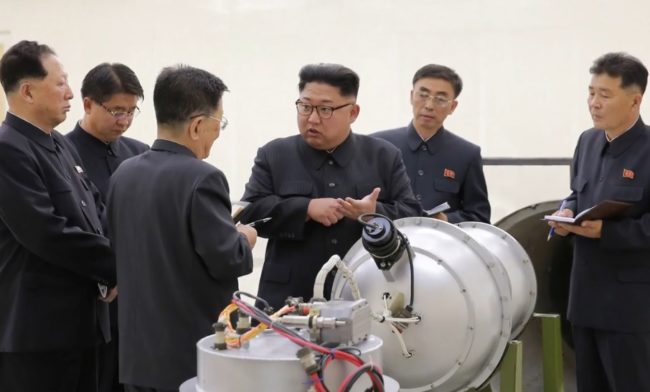
There has been a renewed interest in topics related to radiation mainly due to the current rhetoric coming out of North Korea.
Rourke: The following post was originally published over at PrepperRalph.com. Consider it a “scenario” post with a possible narrative of events that could transpire should war break out relating to North Korea.
The North Koreans have been on the minds of the US literally for decades. From the first onsets of the Korean War when we were fighting Communism, the remain a credible threat to US interest in the Asian Pacific. Now years after the United States developed and dropped the first atomic weapons the Norks now possess their own. Through economic sanctions around the world, we’ve done our best from allowing nuclear weapons on the peninsula. Whether a failure in diplomacy or plain carelessness, they now have those weapons.
Starting with the creation of an intercontinental ballistic missile program, there has been steady concern that the North Koreans could somehow mount an attack on Pacific US territories. Though for decades that threat remained low and in many cases laughable, they Norks have the capability to not only launch a rocket across the ocean to the US mainland but also to place satellites in orbit. It has gone through many prepper’s minds and surely those of the military that they could have somehow launched a warhead into orbit. They now have a hydrogen bomb that is up to 10 times the power of the ones we dropped on Nagasaki and Hiroshima. So what is in store for the US and a nuclear powered North Korea?
If North Korea does manage to launch an attack and land a bomb on a US territory, you can expect a very swift but diversified response. This would start with the absolute shock and condemnation of the international community. Nations would call for a new series of sanctions or military operations to cut the ability of the Koreans to further attack. Japan, Taiwan, Russia, China, and many other countries would more than likely see this as an immediate threat to their nations. The United States will have scrambled fighters and bombers to begin attack operations throughout the demilitarized zone, and more than likely an army of Norks will have started running towards South Korea.
The following day you would see a dramatic change in the US economy and stock markets. With the declaration of War by the current administration, fuel prices would start to rise again as the American war machine started to move towards the Korean peninsula as well as other commodities. A possible dip in employment rates could also occur. You may see lending practices change in the banking world, construction and infrastructure taking a dip. Silver prices would surge as would gold and other precious metals. US debt would also start to increase faster as the buying of munitions and equipment goes into full swing.
As the North Koreans continue to be bombarded by the American and South Korean air forces, their Armies would continue to flood south towards Seoul, ultimately taking most of the city. There would be large amounts of urban combat and many thousands of civilian deaths. Bodies, debris, and litter would cover the streets and the people fled the city. The American base nearby, as well as the naval ports, would be areas of high contention. If we can’t fly in or set anchor, that would limit the US response initially.
Russia may start air sorties into the northern parts of the country with China possibly assisting. Iran, one of the Norks closest allies would more than likely stage an attack on nearby US allies. Israel may take this time to attack neighboring areas and reclaim Biblical lands. If Jerusalem was not nuked by Iran initially, they surely have been by now. Britain, France, Germany, and a host of other countries then start jumping into the fight.
India may take this time to start an invasion of Pakistan. With Pakistan’s country threatened by an Indian incursion, they’ll use their own nuclear weapons to launch on India pulling the US into a three-sided war. Russian cooperation with the US on the Korean peninsula would cease as many of their largest buyers are now fighting on multiple fronts. Australia joins the mix as allies of the US and Britain. Many middle-eastern countries, on the heels of Israel’s attacks, may take this time forge a new Caliphate and become united. There is now World War within weeks of North Korea’s initial attack.
The average US household continues with their usual day-to-day activities… Except half the 18-30 population has begun to be drafted. The further downturn in the markets closes business doors as skilled workers are pressed into military service.
Unemployment at home continues to rise. Eventually, it will slow and employment rates will increase with the sustained war effort. Corporations buy huge tracts of American land for its resources to continue the war effort. The world as we know it is quickly changing. Allegiances on both sides of the war change and morph as territory, munitions, and souls are traded for the insatiable appetite of war.
But then again… Maybe we come to terms with a nuclear North Korea. South Korea decides to join the North and unite the nations under special agreements. Facing an enemy that can kill most of its population in a matter of minutes, what choice will it have had?
This is just a scenario that could play out easily in many many ways. The truth is that no one knows what will happen. We may wake up tomorrow and face a radioactive Guam, or new, tighter sanctions causing the Norks to abandon their current programs for the time being. No one knows…
Every Thursday I recommend a few things such as movies, books, and an assortment of gear – all kinds of stuff. Some of these are related to survival & preparedness – while others are just stuff I like. Most are on Amazon but not all.
Communications after the SHTF within several miles around a retreat – or even your neighborhood – can range from easy to almost impossible. Terrain plays a big role and of course the type of devices being used to communicate. I was sent a link to a new product soon to be released that may provide an inexpensive but extremely powerful area communications solution.
The Sonnet allows for a connection grid to be set up over a fairly large area – as in miles – and provide voice, text, and multimedia communications using smartphones. With a communications grid accessible over several square miles consider the possibilities:
Sending pictures
Sending audio messages
Sending video
Sending files
Communicating via voice
Communicating via video-to-video
I hope the Sonnett system works as well as this video suggests.
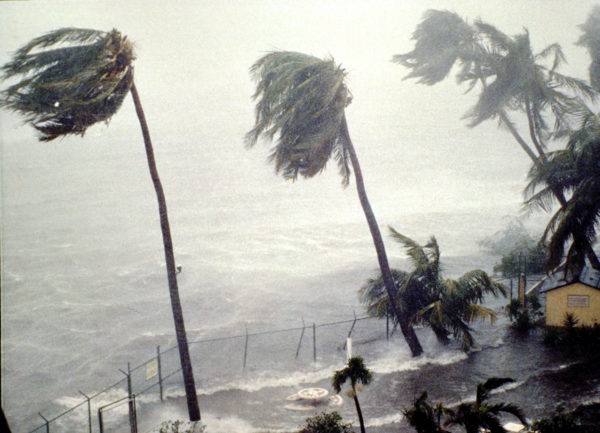
While many preppers look to North Korea and a zombie apocalypse to prepare let’s not forget events like hurricanes are much more likely to endanger us. If you live in an area prone to hurricanes preparing is a common sense step to take. With hurricane season upon us let’s review some basic tasks to prepare.
Before a Hurricane:
Secure your property. Storm shutters offer excellent protection from flying objects.
Secure your property. Nailing plywood over windows when an impending storm is coming also provides protection against debris sent airborne due to high winds. Have the plywood stored “just in case”.
Secure your property. Special straps are available to better secure the roof to the framework of the house.
Clean out all gutters and drains. This will help evacuate heavy rainfall away from the house.
Make a plan. Look at the design of the house for an area that everyone can go to if things get dangerous. An inside area away from exterior walls is best.
Stock up. Hurricanes can knock out power for weeks. Store extra food and water. Consider how food will be cooked if the power is out. a Coleman Camp Grill with extra fuel is inexpensive and works well.
Prepare. Think about supplies needed to go camping. Blankets, flashlights, batteries, etc.
Prepare. Store extra fuel away from the house as if a major power outage in the area occurs fuel will be difficult to obtain.
Prepare. Keep extra cash on hand as credit card machines may not work.
During a Hurricane:
Listen to the radio or watch TV to stay up to date on conditions approaching your area.
Install shutters or boards over windows.
Shut off the water supply going to the house.
Clean and then fill the bathtub. This will provide an emergency supply of water.
Walk the property and pick up anything that may get blown around./ Items include lawn chairs, toys, yard tools, trash cans, etc.
Stay away from windows and doors.
Evacuate if instructed to do so by the authorities.
After a Hurricane:
Keep listening to the radio for information.
Be mindful of dangers from fallen power lines. Stay away!
If cell phone service is not working try texting as sometimes a text will go through when a call won’t.
Be careful if the winds calm – this could be you are in the eye of the storm with more danger approaching.
After the hurricane caution must be taken while walking the property. Tree limbs can fall from above. Sharp objects may be everywhere. When moving debris wear gloves.
Watch for areas that are flooded. Do not drive through large puddles as the vehicle may stall and car swept away.
If power is out only open the refrigerator/freezer as needed. Food can be kept cold for hours if they are kept closed.
If there is damage to the property take pictures to document the situation.
Use extreme caution if using candles – FIRE HAZARD.
Be aware that running tap water may be contaminated.
If your property experiences damage contact insurance company.
As soon as possible let your family know you are safe.
The most important thing going through a hurricane is to be safe. If everyone makes it with their health or even minor injuries be happy. Property can be repaired and rebuilt. People cannot.
Every Thursday I recommend a few things such as movies, books, and an assortment of gear – all kinds of stuff. Some of these are related to survival & preparedness – while others are just stuff I like. Most are on Amazon but not all.
Those Patriots who wish to communicate with fellow Patriots in a more secure manner – for whatever reason – may want to look into the communications tool called “Telegram”. Telegram is a communications tool available as both a web-based and mobile app interface.
Working very much like any other chat app such as Facebook Messenger Telegram offers several features which may be attractive:
Telegram is secure – or at least much more secure than typical communication tools.
Telegram is fast.
Telegram allows for both individual and group messaging and chats.
Telegram allows the sharing of files.
Secret texts can be sent which will self-destruct.
Available on all of your devices.
Voice messages can be sent.
Telegram is 100% FREE
Setup is extremely easy and not much different than any other app. Telegram does require access to your contact list and camera in order to send messengers as well as photos.
Telegram can send two types of messages with both being encrypted.
CLOUD: The first is a cloud-based message which is stored on the Telegram servers. While this may seem very un-secure it is not at all. While it is possible for the FBI to access these messages via a warrant, the ability for hackers to access the cloud is extremely difficult. Security is what Telegram is built their reputation and existence on. As of today, Telegram has provided zero data to anyone making requests. This includes governments.
SECRET CHAT: The second type of message is called the “secret chat”. In this format, messages are sent and received and can ONLY be accessed using the end users devices. This means that they are not saved on the Telegram servers and cannot be accessed by anyone – except those who use the user’s devices. These messages can be set to self-destruct. This is the most secure method within the Telegram app. Currently, the Secret Chat option is only available for person to person communications. Group Secret Chats are not an option – at least for now.
While there are pro’s and con’s to all secure communication apps Telegram continues to be the leader of the pack. Constant updates and added features keep things interesting and new features are added all the time.
Telegram – Secure Communication Solution?
I will tell you from my experience using Telegram over the past year it is fantastic. My preparedness group uses it as their exclusive communications tool. We set up multiple group chat rooms to use for different topics. Pictures, videos, and other files can be sent as well as audio. Frequently while I am driving if I need to communicate something to the group I just press the audio button and record my message – and then it sends automatically when I am done.
Whether it is in the middle of the American Reformation or the beginnings we find ourselves now Telegram is but one solution for more secure communications.
Note: Telegram is available for both the Android and iOS operating systems, as well as a web based access point. This means that virtually every multimedia device from Smartphones, tablets, and PC’s can utilize the technology.
Every Thursday I recommend a few things such as movies, books, and an assortment of gear – all kinds of stuff. Some of these are related to survival & preparedness – while others are just stuff I like. Most are on Amazon but not all.
There is a movement that is somewhat tied to preparedness and self-reliance and it is all about minimalism. Basically getting by and living a full life and existence with as little as possible. I came across the YouTube channel IAmJake and his video about living in his Jeep for one year. Being a Jeep owner it certainly caught my attention.
In the video below Jake discusses his set up and how he will live in his Jeep. Pretty impressive and some good ideas can be pulled from it when it comes to a bug out vehicle.
I’ve often said that a vehicle can be an incredible survival tool that most just do not think about. It can provide shelter, power, heating, cooling, and also information. Yes – fuel is needed and there is always a risk of breakdown.
For those anticipating a complete breakdown of the economy, “bartering” is something that should be planned. Before diving into the list I’ll mention a couple things that generally stir up controversy.
First – the bartering of firearms and ammunition generally creates a huge argument. Why? The thought behind this is you’ll trade a firearm and/or ammunition and the recipient will turn it around and use it to take all your stuff. Sure – it’s possible. It’s also possible that the trade could be conducted safely and with minimal risk.
Second – the bartering of food creates almost as much craziness and the previous. Some people scoff at the idea of bartering food as they believe that you’re trading away your very salvation. I totally disagree as you would not and should not conduct the trade unless there were sufficient stores of food which to do so safely.
Third – discussions on silver and gold as barter items create enemies as opinions from most fall on either end of the YES/NO spectrum. I’m avoiding that here – and would appreciate it if you would as well.
On to the list:
Top 12 Barter Items To Stock Up On Now
1. SPAM – Available in numerous flavorings and packed with valuable protein. There is little doubt it would be highly desired in any kind of a food shortage. It is pre-packaged in smaller, tradable quantities.
2. Toilet Paper – explanation not needed.
3. Candles – Candles provide those in need with light, fire, and warmth. While very inexpensive now the demand and corresponding value in more desperate times will rise dramatically.
4. Alcohol – While some may find the inclusion of drinkable alcohol morally wrong it remains a fact that a shortage of supply will increase its value.
5. Flashlight & Batteries – Grid down the night will be…well…very dark. There are very inexpensive LED flashlights that run on a single AA alkaline battery. Perfect for bartering.
6. Matches – Matches packed in 32 count boxes will be worth their weight in gold. Small in size these boxes may be a form of currency at some point.
7. First Aid Supplies – Triple antibiotic ointment, band-aids, antibiotics, etc. will be very valuable. Purchasing multiples of small general purpose first aid kits would be an excellent pre-packaged barter item. Cough/multi-symptom flu medicine during seasonal sickness times extremely valuable.
8. Cordage – A variety of cordage from twine to rope would be beneficial. If I had to choose one type it would be para-cord due to its cost and strength.
9. Bar Soap – Bar soap goes a long way and does a great job cleaning the body. Extremely inexpensive combined with a great shelf life soap is a fantastic barter item.
10. Feminine Hygiene Products – ’nuff said.
11. Water Filters – Individual water filters such as the LifeStraw and Sawyer Mini Water Filter will be extremely valuable should clean running water cease. Larger family-size filters such as the Big Berkey and the LifeStraw Family.
12. Hard Candy – Something so simple will have high demand on the barter market. What an incredible treat to have – or get for someone you love – when it is no longer manufactured.
While this list suggests these 12 items as high-value bartering tools they are not alone. There are countless valuable items that could take the place of any of those listed above.
Gardening is one of the Top 5 Prepper Skills I recommend people learn. It can be both extremely rewarding – and fairly frustrating. I’ve been gardening for close to 15 years in my backyard using a 25′ x 30′ foot in-ground spot as well as buckets, raised beds, and various containers.
For many, space is lacking and soil is questionable. It is important to get started NOW to learn gardening and get your spots ready. Soil can be improved over time – and it can be made worse. The point is the sooner you start the better off you’ll be.
For many, raised beds offer a quick and simple way to get started. There are a lot of positives with raised beds such as being able to place them pretty much anywhere that will get sufficient sun.
Here is a simple, easy method for building a raised bed garden:
Needed Supplies:
1 12-foot board – or an 8-foot and 4-foot(width of board determines height of raised bed. I recommend no less than a 6″ inch board)
8 nails or screws 2″+ in length
Needed Tools:
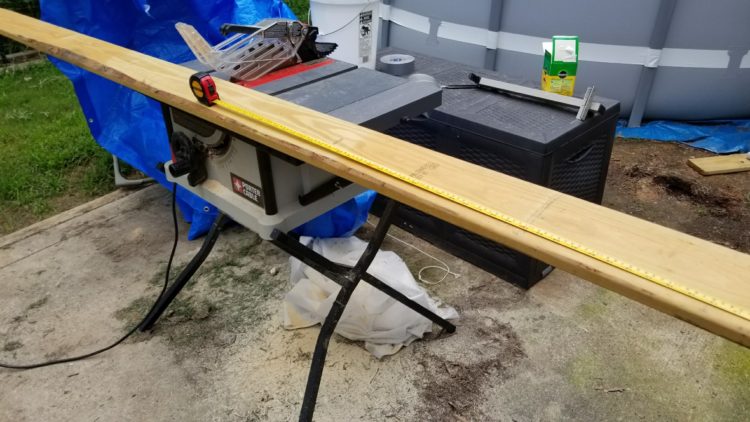
1 saw (jig saw or table saw will work)
1 ruler
1 pen or pencil
1 drill or hammer
1 drill bit slighter smaller than whatever size nail/screw selected
Steps to Building a Simple & Inexpensive Raised Bed Garden
The first thing to do is get everything together in one place. Make sure batteries are charged and power tools are plugged in.
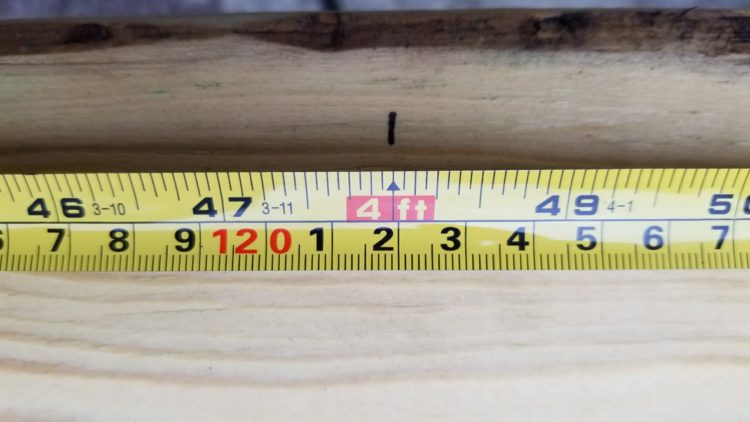
Next – we need to create two 4-foot pieces. If you have an 8-foot board simply mark it off and cut it in half. If you have a longer 12-foot piece mark off 4 foot – cut it, then mark another 4 foot and cut again.
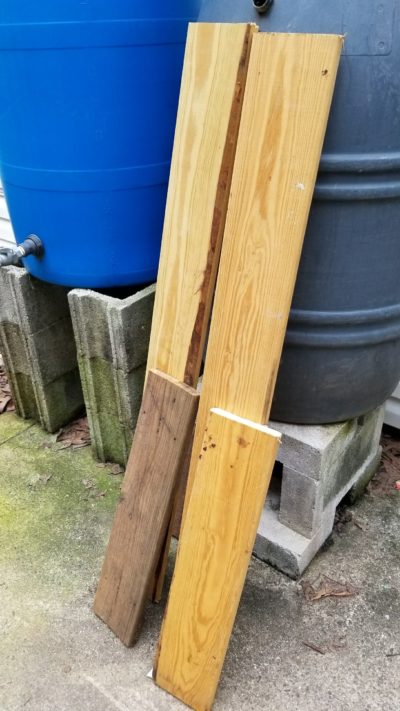
Either way, there should be a single 4-foot piece left at this point. Measure its length and cut it in half.
Above – a total of 4 pieces should be available. Two should measure 4 feet and the other two 2 feet.
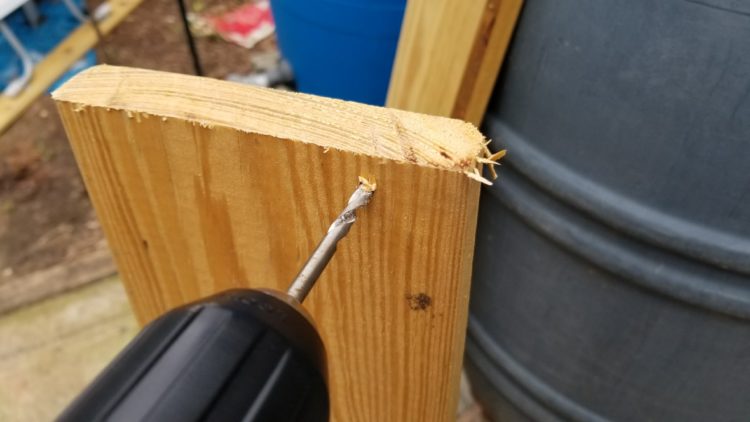
Pre-drill the holes for the screws/nails. This step is not necessary but helpful to reduce the chance the wood will split.
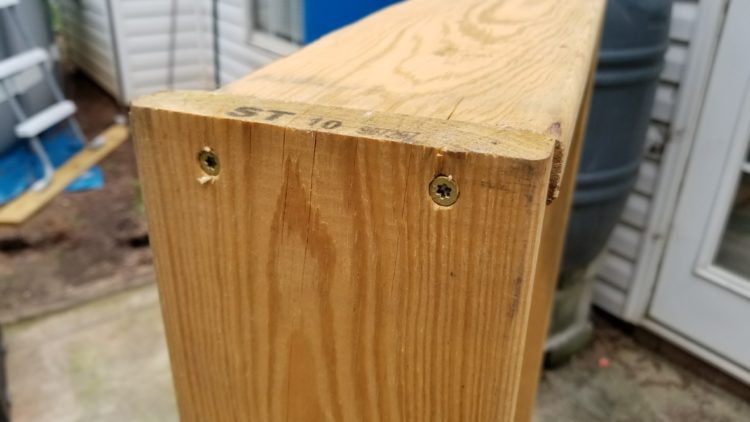
Now – go ahead and screw all the boards together in a rectangle shape. Make sure the longer boards are set on the outside of the short boards for each side or the rectangle will be off.
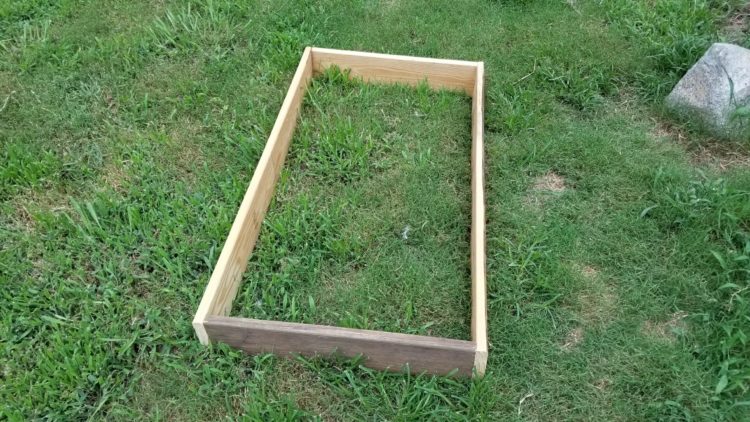
Your finished product should look like the photo above. Now simply place the raised bed wherever you wish, fill with soil – and plant some seeds or plants.
* * * * * * *
This project is not complicated and it’s not rocket science. I considered generalizing the instructions without all the pictures and lists but decided to make it a bit more detailed. The size of the bed can be easily adjusted to whatever you wish. 4′ x 8′ beds work well. Going longer has its advantages but going wider makes it difficult to reach in and pick.
Soil? That’s always a question and searching on the internet you’ll come up with all kinds of concoctions. I can only tell you what has worked for me and your mileage may vary:
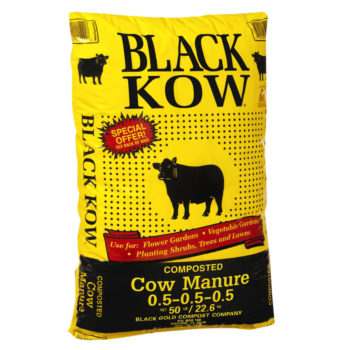
1/3 composted cow manure(Black Kow brand if you can get it)
1/3 peat moss
1/3 natural soil from area
The above formula is pretty much what I have been using for the past few years and it has worked well. A high-quality potting soil can be substituted for the peat moss or use it with everything else if you wish.
There is a lot of talk about “Mel’s Mix” on the net if you do a search for raised beds. It might work – but it is EXPENSIVE! I’ll pass.
When growing vegetables in raised beds here are two tips to keep in mind:
WATER: You need to WATER MORE OFTEN than in-ground gardens. In a raised bed gravity naturally pulls the water from the soil thus daily – and even twice daily watering – may be needed. I’ve seen many gardens start off looking good and then hear complaints stuff didn’t grow. Reason? Lack of water. The larger the raised bed the less of an issue this is.
MULCHING: Mulching is a huge benefit to decreasing moisture loss through evaporation and reducing weed growth. I’ve used grass clippings, dead leaves, pine bark, and local city mulch available to the public. Be careful with grass clippings as if any of the cut grass grew enough to have seed you just planted them in your raised bed.
This post may not seem very timely as much of the country is nearing the end of growing season…but WAIT, there’s MORE!!
Fall gardens are being prepared and readied for planting now.
No better time than now to jump on the gardening bandwagon.
Note: This post was originally published over at DoomandBloom.net. It has been republished here with permission.
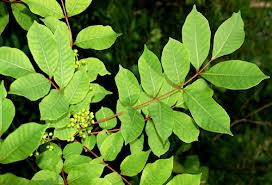
Whether you’re outdoors due to a major disaster or just on a wilderness hike, it’s possible that you’ll run afoul of poisonous plants. If you live in the continental United States, expect to find poison ivy, poison oak, poison sumac, and others in the environment. 350,000 cases of poison ivy alone are recorded in the United States every year.
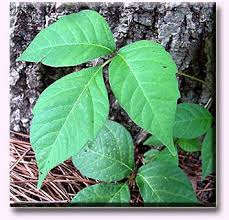
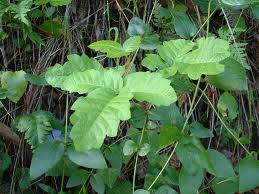
From Left: Poison Ivy, Poison Oak, Poison Sumac, Poisonwood (UFAS)
POISON IVY AND SIMILAR PLANTS
Poison Ivy
The typical “tri-foliate” appearance of poison ivy and another poisonous plant, poison oak, has led to the saying: “Leaves of three, let it be”. Poison ivy’s leaves appear almond-shaped, while poison oak looks like, well, oak leaves. There are various subtypes: Some are vinelike, others short and shrubby, still others appear as ground cover.
Poison Oak
There are, of course, plants that are perfectly harmless that come in “leaves of three”. Other poisonous plants, like poison sumac, have a different look. Poison sumac has 7-13 pointy leaflets and can grow into a small tree upwards of 20 feet in height. Poisonwood is a relative that prefers subtropical areas like the Florida Keys. It is thought that inhaling smoke from burning sumac and poisonwood can cause life-threatening respiratory distress.
Poison Sumac
WHAT CAUSES POISON IVY RASH
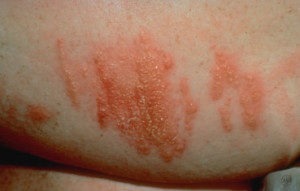
Poison Ivy rash can appear “streaky”
The common factor that makes all of the above plants dangerous is the compound “urushiol”. Urushiol is an oily resin that can be found on just about every part of the plant, including vines, leaves, and roots. The chemical irritant sticks to the skin on contact and causes symptoms in 85% of those exposed.
As poison ivy rash is essentially an allergic reaction, it is not, in and of itself, contagious. However, any clothing or body parts that have urushiol on them can cause symptoms when touched by others.
As an aside, the presence of urushiol in poison ivy and other plants appears not to be a defense mechanism; instead, it serves to help them retain water. Deer, birds, and other wildlife can eat poison ivy without ill effects.
DIAGNOSIS AND TREATMENT
Poison Ivy, Oak, and Sumac rash is caused by the compound “Urushiol”
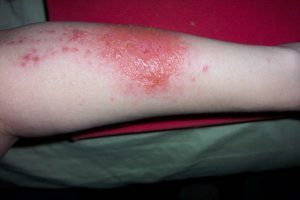
The rash of poison ivy, oak, and sumac causes itching and a red, bumpy rash within a day or two of exposure. The rash continues to spread for a few days and lasts for up to three weeks (more in some cases). Breaks in the skin from itching can cause secondary infections that can become serious.
It’s sometimes difficult to make the diagnosis. Most don’t realize they were exposed during their time outdoors. Exposure may also occur indirectly, for example, by petting the fur of a pet that has been outside. The rash might appear in winter and confuse health providers, but even plants that are dormant can cause reactions.
Therefore, a red, bumpy, itchy rash in anyone who has been in the Great Outdoors or near others who have (including pets) should raise your suspicions. Either poison oak, ivy, or sumac exist just about everywhere in North America except perhaps mountain top and desert environments. As such, it should always be on the list of possibilities in wilderness settings.
Touching kids and pets that have been outside could cause exposure to poison plant toxins
Once you have determined that there has been exposed to poison ivy, it’s important to wash the exposed area and clothing with soap and water as quickly as possible. Urushiol isn’t easy to remove, however, so you might consider soaps that are effective against resins or oil, such as Fels-Naptha or Tecnu.
Common treatments for poison ivy, oak, and sumac rashes include hydrocortisone cream, calamine lotion, capsaicin cream, and antihistamines like diphenhydramine (Benadryl). Some recommend the use of rubbing alcohol on the exposed areas. Cool compresses may are thought to be soothing.
There are many home remedies that are also thought to be effective to treat poison ivy rash. Here are just a few:
Apple cider vinegar (burns at first)
Baking soda paste
Epsom salt or oatmeal baths.
Chamomile tea bag compresses
Aloe Vera gel mixed with various essential oils, such as tea tree, lemon, lavender, peppermint, geranium, and chamomile.
Jewel weed (mash and apply)
There are many others. Natural or commercial creams and ointments should be dabbed on as opposed to rubbing, which may cause more irritation and slow healing. In the worst cases, prescription medications like Medrol (Methylprednisolone) may be needed to speed recovery and prevent complications.
The good news is that, even if you don’t treat the rash, it will go away by itself over 2-3 weeks in most cases.
PREVENTION
Long pants and sleeves will help prevent contact with poison plants
The best prevention is to avoid getting the toxin on your skin. If you can’t avoid exposure, make sure to wear long pants, long-sleeved shirts, work gloves, and boots if you’re doing work in areas known to harbor poison plants.
Some recommend an over-the-counter lotion called IvyX as a preventative. Apply it like you would a sunblock to likely areas of exposure. Theoretically, it prevents the oil from being absorbed by your skin.
The effects of poison ivy, oak, or sumac can make you miserable and even cause secondary infections, something that will decrease your work efficiency in the Great Outdoors. If you know how to identify these plants and be aware of your surroundings, you’ll have less headaches off the grid.
I’ve dabbled a bit into solar and love it. When it comes to time efficiency not much beats a solar system of any size that works all day long for you – while you put your time elsewhere.
This video does a good job explaining what a solar system is and how it is put together. A couple things I have learned:
Solar is useful for charging batteries – rather than running anything directly.
Anything that turns or moves uses A LOT of power.
Solar continues to get less expensive and entire home systems are often available with substantial tax breaks. My own efforts have targeted smaller self-contained systems.
I was asked recently what my opinion was of SouthernPrepper1’s recent video titled – “Prepper’s will die….No tactics are better than bad tactics“. In the video, SP1 discusses a combination of poor and incorrect tactical training, physical conditioning, and the propensity for prepper’s to train for offensive conditions.
While I have no military background and the majority of “tactical” training that I have had has been firearm based – I have a few thoughts.
I’ve always believed that given whatever the “SHTF” event is – avoiding problems is of paramount importance. This means taking a defensive stand on a day to day basis. Area patrol’s and scout’s to serve as information gatherers and early warning systems would be the extent of those leaving the retreat. Bringing the absolute minimum attention to yourself is a definite effort in self-preservation.
Preparation for suspect visitors is a must. Defensive tactics for protecting the property and fending off those who wish to do harm is certainly important. Tactics to go out and attack someone else’s property? Think about it. Consider the enormous risk to that operation.
Prepper groups need to work on what SP1 stated such as fortifying their position, covering areas of engagements, know the kill zones, and be capable of placing accurate fire into them. Everyone within the group needs to know their weapons systems. Placing fire downrange, accurately, and being able to quickly reload to re-engage are strong tactics that most should be capable of. A plan on what to do in case of attack needs to be made now.
SP1 discusses fitness level and age. I can tell you this is a HUGE problem I have seen first hand. Far too often people are just too “nice” to tell people the truth. If you cannot get down behind a 55-gallon barrel and get cover that is a issue that may get you killed. Prepper’s need to know their limitations. If a group member remembers what it was like before electricity then they are not likely one you can depend on for high demand physical activity. If someone is 150 pounds overweight and cannot run from Position A to Position B with some sense of urgency – then they need to stay at Position A or be delegated to another function(or not be in Position A to start with).
I’ll mention something else that drives me crazy – these posts about how as part of an arsenal you’ve got to have a rifle capable of shooting 600, 800, no – at least 1000 yards. Why? Again – if a possible threat is 1,000 yards away how much of a threat are they? How have you identified the target from that distance? If they are unaware of your presence and a shot is fired alerting them of your presence – wouldn’t it have been better to not shoot? Granted there are a gazillion scenario’s out there but in general, I don’t get it. I believe for the most part these types of discussions where a .300 Win Mag is pitted against the .308 Win versus a 6.5 Creedmore is an effort in futility. Come on.
The keyboard warrior mentality is alive and well. Preppers need to know their limitations and train/prepare accordingly.
YouTube favorite SouthernPrepper1 has a really good video series on firefighting. I rarely see prepper’s discuss firefighting. You can imagine that fending off potential marauders who may use fire as a weapon. You can check out the entire series HERE however below I have included a few below.
The use of inexpensive IBC containers combined with gas operated pumps – on the back of a truck or trailer – makes for an excellent home firefighting system. I’m looking at hooking up a similar system to my 3,000+ gallon pool.
I conduct regular fire extinguisher training with my family. I light a fire in my backyard firepit and have each person put it out while explaining how to use a fire extinguisher. It is not so much the theory that is valuable but the hands on experience. Should something happen it will not be the first time any of them used a fire extinguisher.
I’ll tell you right now as you read this if you do not have a fire extinguisher in your kitchen click HERE or go to the store NOW and get one. A kitchen fire can get out of control in a hurry.
Canning meat is an area of preparedness that I have zero experience with. One of the members of the 1776PatriotUSA Facebook Group just started a YouTube channel. Her first two videos are on canning chicken. With my recent interest in canning meat, this was perfect timing.
As Sheila mentions meat must be canned using a pressure canner. I have the same Presto pressure canner featured in the video and for the money, it does a great job. A higher quality but much more expensive option is the All American. One advantage of the All American is there is not a replaceable lid seal to worry about.
I’m going to talk to the Wifey and give it a shot soon.
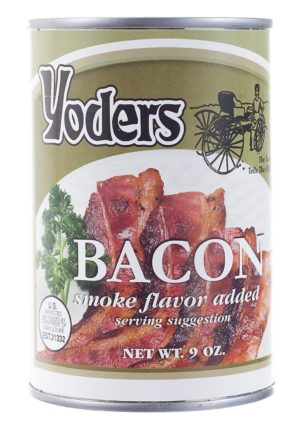
Bacon. Say “bacon” around a group of people and watch how their attention is instantly drawn to you. Hey – either you like bacon, or you’re wrong. For prepper’s considering what food to stock up on bacon is usually just a pipe dream due to its extremely limited shelf life.
Enter: Yoders Bacon.
I bought a few can’s of Yoders Bacon back in 2015. I decided to open one up and give it a try. Why? It’s bacon! I also wanted to see if the taste was good enough to purchase more.
The Test: Yoders Bacon
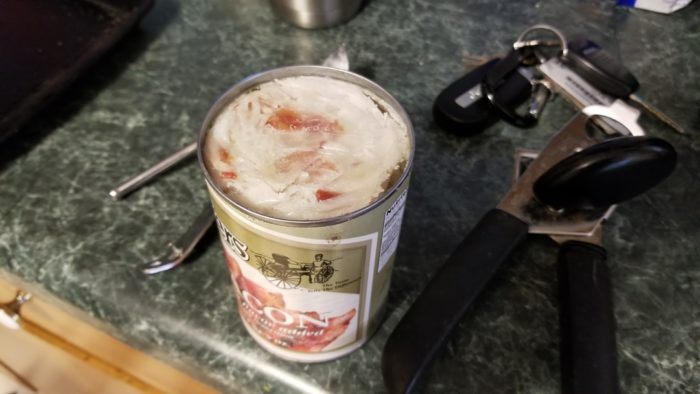
Opening the can shows the bacon wrapped in wax paper and pressed in the can. The smell is “bacon-like” and I would not call it exactly good.
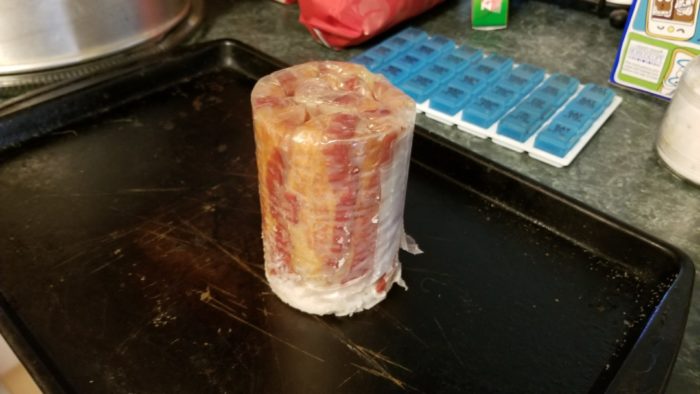
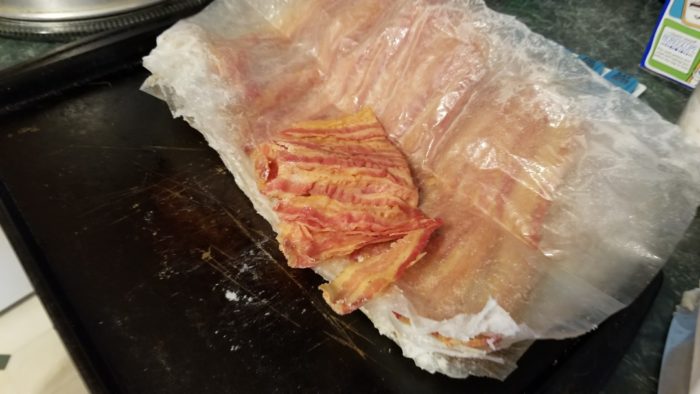
Pulling the wax paper and bacon out shows just how everything is packed. There was an accumulation of hardened grease at the bottom. While some may be grossed out by the appearance it was no big deal to me.
The bacon is placed in the can as full-length fully-cooked pieces. They are laid across the wax paper and then folded and rolled to fit in the can. I tried a piece fresh out of the can and it tasted like – well, bacon. It had a little different taste than I was used to. It might be the smoke flavoring – but it was good.
In fact – if I had come in on a cold winters day out hunting and had a piece – it would be VERY good.
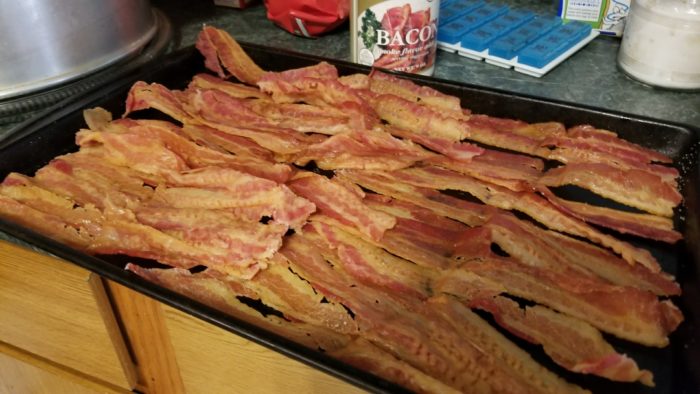
I prefer my bacon warm so we spread some out on a pan to place in the oven. There is a lot of bacon in that can. The picture above does NOT represent all of the bacon. There was some still in the wax paper.
Yoders Bacon is not very thick so while heating some care must be taken to not burn it.
Shelf life is claimed to be upwards of 10 years. I would assume storage methods would influence this heavily. Compared to other food storage options for bacon this is excellent.
RECOMMENDED
While Yoders Bacon can be found on sale throughout the year the best average price I have found is on Amazon.
Everyone should keep a good first aid kit in their vehicle. You just never know when something will occur and a compression bandage, tourniquet, or even just a band-aid is needed. My kit of choice is the Grab and Go Deluxe Trauma Bag from DoomandBloom.net. I have two of these kits. One sits at home and the other rides with me in my Jeep Wrangler.
Will You Need a Trauma Kit?
A couple of years ago I went off roading in the Uwharrie National Forest. While navigating some of the more rocky and difficult terrain a group of us had to move some large rocks to allow a lower-clearance vehicle to pass. The owner of the vehicle moved a rock and failed to move his hand in time when setting the rock down. This equated to a smashed and bloody finger. Holding his hand and somewhat hiding it out of embarrassment he dripped blood walking by me. I went to the Jeep and fetched the DoomandBloom.net trauma kit and provided aid. A few people came over and they said all they had was some electrical or duct tape.
A year or so ago I was on my way to work driving down a major local highway. 30 seconds in front of me a van flipped and laid on its roof as I approached. I pulled off the side of the road – retrieved the Grab and Go Trauma Kit from the back of the Jeep and headed to help the guy as he crawled out the back of the van.
These are just a couple out of several examples where a good first aid kit has come in handy.
The Grab and Go Deluxe Trauma Kit sold by DoomandBloom.net
Available in a variety of colors.
Grab and Go Deluxe Trauma Kit
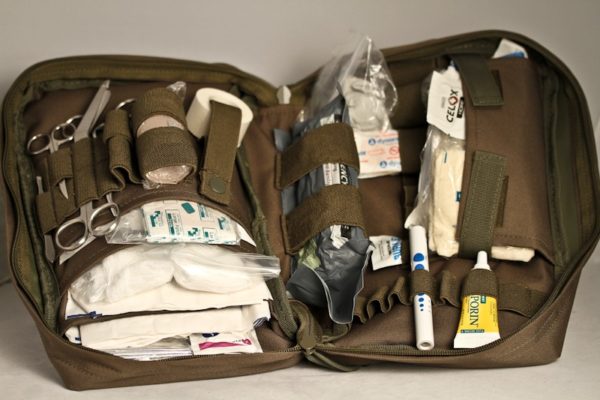
The Grab and Go is an excellent mid-sized kit for camping, hiking, and hunting. Measuring 13″ x 9″ x 4″ this is not going to fit in the typical vehicle glove box. There is a small compartment in the back of my Jeep where it fits perfectly as well as some paracord, knife, tire plug kit, and a couple more things. I very much prefer the included soft case over a hard plastic case that can crack or break.
As far as specifics with the kit – here is an excerpt from the Doom and Bloom website:
The Grab and Go First Aid Trauma Kit will cover most injuries that occur during daily activities. Such as: Burns, scratches, lacerations and bleeding, sprains and strains, blisters, wound closure and wound cleaning, bug bites etc.
It even includes duct tape, that all important do-it-all item for almost every need.
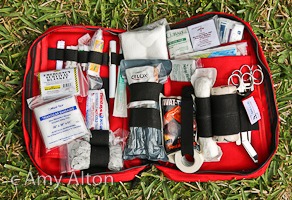
The Grab and Go First Aid Trauma Kit, also comes with a SWAT tourniquet, an Israeli Emergency bandage, Celox (blood clotting powder, easily washed out), a large Ace bandage, large roller gauze, Dr. Scholl’s Moleskin, CPR mask, stainless steel instruments, Steri strips, superglue, sterile sutures, instant ice pack, and more.
Professionally designed by Dr. Joe Alton, a Medical Doctor with over 35 years experience and Amy Alton, an Advanced Registered Nurse Practitioner, with over 30 years experience in the medical field.
There is also room within the kit to add additional items if so desired.
HIGH RECOMMENDATION
For more information visit the Grab and Go Deluxe Trauma Kit’s web page.
Next to firearms food storage is probably the most popular topic on survival and preparedness websites all over the internet. Dehydrated and freeze dried food is highly sought after due to their taste retention and long storage life. While freeze dried food is an excellent option it is extremely expensive compared to other options such as canned goods.
ENTER: Sam’s Club
It’s no secret that Sam’s Club carries a variety of food products that are attractive to prepper’s. What is not well known are their tremendous deep discounts on Augason Farm’s products.
Augason Farm’s has been an industry leader in the preparedness market for over 40 years. They pride themselves on being family-owned providing high quality and delicious food storage solutions.
Here are a few examples of the incredible savings at Sam’s Club:
Click HERE to visit Emergency Essentials and check and compare prices.
With a Sam’s Club membership these products can be purchased online and most delivered right to your home for free. The cost per serving as well as cost per calorie is simply the cheapest I have been able to find for comparable food products.
I put together a spreadsheet that has several examples of foods with comparisons from AugasonFarms.com and Samsclub.com. Cost per serving and even cost per calorie is displayed. Again – prices were accurate when the information was gathered.
It truly is a food storage secret that can save preppers a ton of money while building their food supply.
While many dismiss North Korea’s ability to bring harm to the United States directly – there are those who believe quite the opposite. There is evidence to suggest that if North Korea has not already placed nuclear warheads within multiple satellites passing over the United States – they could. Others suggest that an EMP threat exists at a minimum from an offshore container ship launch.
Who is correct? Who is right? Who has all the facts? Well, I don’t know. Article over, right?
Not quite.
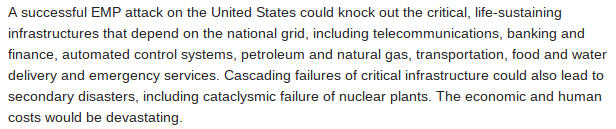
As prepper’s we prepare for possibilities. Logic dictates those threats that are most plausible should receive the largest weight in deciding what prep’s to work on. EMP is one of many and in my view moving up the list of possibility.
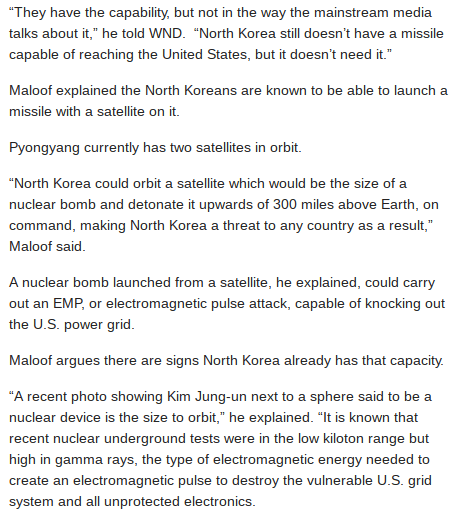
In a recent article on World Net Daily Michael Maloof, a former senior security policy analyst for the Secretary of Defense and the author of “A Nation Forsaken” – he lays out his belief that North Korea is a dangerous threat to the United States:
While it is understandable to prioritize economic troubles and personal job loss over a possible EMP threat – to ignore it is just not….recommended.
Here is a scenario that many of us could find ourselves in should the SHTF while we are at work.
Wednesday morning: Typical Wednesday morning. Alarm goes off at 5:30am and you reach over and hit the snooze. Grab your cell phone and check for text messages and emails. You see a post was published last night from 1776PatriotUSA.com on preparing in case an army of bigfoots attack. You think – “That Rourke is an idiot.”
After showering, getting dressed and a cup of coffee you hear on the news that there was an incident between North and South Korea. Apparently, South Korea sank a North Korean boat. Details are sketchy.
7:00am arrives too quickly and the drive to work starts. The news doesn’t report much as far as details regarding the sinking. North Korea is strangely silent about the incident.
Work starts a little before 8:00am and is another typical day. At 11:30am the power goes out. “Early lunch”, you think to yourself. You grab your keys and head for the car. Someone states as you are heading out the door their cell phone doesn’t work. Halfway to your car, you pull your phone out – dead.
The worrying begins.
You get in the car and quickly insert the key. Nothing. You know what it is. You know somehow, some way we got hit with an EMP. You think to yourself, “I’m 20 miles from home. I’ve gotta go.”
Questions:
What do you have in your vehicle right now to get you home?
What method of transportation would you use to get home? Walking? Bike? Other?
What tools of self-defense will be carried for the trip home?
Do you have any SOP’s(standard operating procedures)set up with the family so they know what to do in case something like this were to occur?
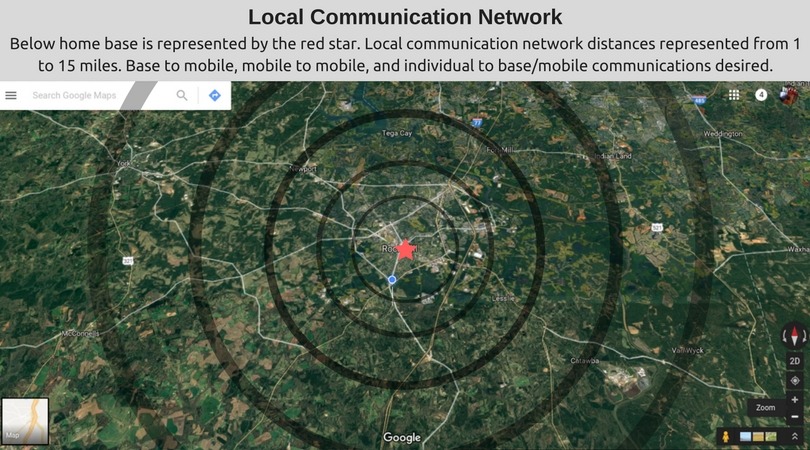
Articles on SHTF communications often dive right into super expensive systems allowing communication across the country – or the world. In my own personal efforts, I have been working on trying to set up a system for what I would refer to as a “local” communications network for my group. Ideally, we are talking 20 miles and less.
Many may hear this goal and consider it meager – “Hey – just connect to a Ham repeater.” While using a Ham repeater will allow 20 miles and much more I am looking for reliable independent communications. Efforts have been very frustrating and really not for this article. I have had some very good success lately and the retreat is currently set up for upwards of 10+ miles with no repeater. This is excellent for patrolling and inbound members. Longer range is just a matter of time.
The purpose of this article is to consider the perspective – in a world filled with cell phones, texting, Facetime, and other means of instant communication – if it disappeared today could you stay in touch with those heading up the street to check on a neighbor? That trip to the store or up the road to see Billy that used to be considered routine and no big deal post-SHTF might not be quite the same.
Although AM/FM and shortwave radios can bring in news and provide valuable information – they are both one-way communication methods which offer limitations.
Assuming that some form of SHTF situation has occurred – why would person to person communications be important?
Assist in finding missing persons and pets.
Announce rising flood waters to others in the area.
Communicate direction of brush fires.
Communicate with others in a hunting party.
Perimeter patrols.
Tactical operations and movements.
Save time and energy to be able to relay information over distance rather than drive or walk to those you are wanting to communicate with.
Warn of impending danger.
Communicate observations of people moving through an area.
Call of help or assistance while someone is not at home.
The list could go on and on.
Some considerations regarding a local communications network include equipping the home with some form of base station, vehicles with mobile units, and people with handheld transceivers(HT). Ideally, all could communicate with each other when within the boundaries of the local network area, however, that is not always possible when independent of any repeating system.
The exact components I have used and have had success with will come in a later article. Again the point of this article is to get you thinking. How far are you needing(not wanting) to communicate? This is an important question to answer before setting up your system. Know that generally the longer you want to be able to transmit and receive the more expensive it is.
Here is a place to share things you’ve been thinking about lately. What kind of things?
Recent accomplishments in preparedness.
Projects being worked on.
Thoughts on world events.
Recent purchases & recommendations
Current events related to politics, terrorism, crime – whatever.
Go on an adventure or have fun? Share it!
Whatever is on your mind….
* * * * * * * * * * * * * * *
My turn…..
This has been a crazy week. Way more happened than I needed and unfortunately not all good. I am sooo glad the weekend is here.
Spent some time cleaning guns this week. They were not terribly bad but overdue. I love Gun Scrubber to get the entire process done quickly. Not the cheapest quick clean but it beats the dishwasher.
Google+: I’ve never been much for the social media platform “Google+”. Had a buddy of mine at work tell me he really loved it and hardly used Facebook anymore. I decided to check it out since I haven’t messed with my account in quite some time. Impressed. I am definitely going to spend a little more time there. If you are a user my Google+ address is: https://plus.google.com/+1776PatriotUSA
REMINDER: Use coupon code “1776” for 10% off all orders at Valley Food Storage. This is through the end of the month.
Project Cherokee: The old Jeep Cherokee I bought for my 14-year-old has had a few more rust spots sanded and primed – and we actually started it the other day. On the project list is a new battery. Summertime money is always tight so I anticipate getting a decent amount of work done this Fall – when the weather cools down some.
SOMETHING FOR YOU:
REMINDER: Want to help support what we do here at 1776PatriotUSA.com? Follow any link from this website to Amazon, make a purchase, and we receive a small commission at no additional cost to you. Not a single penny more.
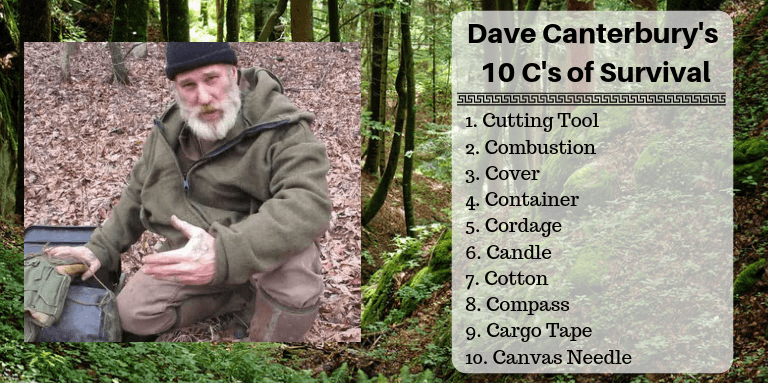
The 10 C’s of Survival was developed by Dave Canterbury as a means to provide guidance for those who spend a lot of time in the woods. In the case of some kind of emergency, Dave offers this list to be able to stay alive. For those not familiar with Dave Canterbury he was once half the duo in the first few seasons of Dual Survival and owner of The Pathfinder School. He also has a very popular YouTube Channel with an emphasis on bushcraft skills.
Dave Canterbury’s 10 C’s of Survivability
I have tremendous respect for Dave Canterbury. He has so much experience and practical knowledge – who am I to question his recommendations?
Overall I think his 10 C’s is a very good guide to use when putting together most any kit – get home bag, bug out bag, vehicle kit – whatever.
NOTE: For those not familiar with what the “American Reformation” check out The Coming American Reformation. It is important information as this is the direction our country is heading and no one will be immune to its effects.
* * * * * * * * * * * * * * *
Information is important and in the case of a mass event such as the American Reformation having the right information is critical. What follows is a list divided up into several categories of recommended books. This is not an all-inclusive list of every conceivable book but rather those that should sit – along with others – on the bookshelf(or in the Kindle).
I would be remiss if I failed to mention the digital aspect of books nowadays. More digital books can be purchased for the same money thus it’s an attractive option. I will say that if you go that route have numerous backups as only having one device which to reference the information is a disaster in waiting. Check out 5 Steps to Building a Digital Preparedness Library for more information.
This is not an all-inclusive list – but a recommendation.
Book Recommendations for the Coming American Reformation
As stated this is not an all-inclusive list of every conceivable book to have nor will these suggestions cover every possible topic. There are just too many specifics with any scenario including geographical and climate considerations. The suggested books are what should be considered a good start.
There is a huge market for specialty food bars made just for survival kits and bug out bags. I’m not talking about those 3,600 calorie bricks of cardboard that will enable you to try out your emergency dental kit. I’m talking high calorie, high protein energy bars that were developed by a Navy Seal and somehow due to the precise ingredient mix allows them to attain a “tactical” level of existence.
While many of these survival bars are great – they are also expensive and often difficult to find. There are alternatives right around the corner and down the street at the checkout of your local grocery store and corner market. That’s right – the candy bar.
After taste testing close to a dozen of the top selling candy bars(it’s a tough job but someone has to do it) and evaluating the nutritional and environmental ruggedness of each I came to one conclusion:
The Payday Peanut Caramel Bar is the ULTIMATE bug out bag food bar.
So – why does the Payday rank so high?
While a Snickers bar combines that ultimate combination of chocolate, caramel, nougat, and peanuts the extreme heat sitting in a vehicle trunk will leave that Snickers looking like something created after eating at Taco Bell.
By the way – what the hell is nougat?
Anyways – while the Payday will soften inside a hot car it doesn’t become a disaster like any chocolate confection. The combination of peanuts and caramel taste great and provide a very high-calorie protein boost.
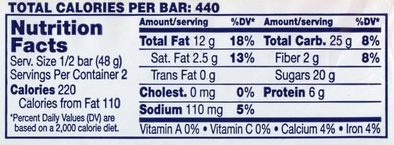
Here is the nutrient breakdown for the KING SIZE Payday bar:
In the King Size format, there are two smaller bars in one pack. For the entire 2 bar pack, there are 440 calories, 50 grams of carbs, 24 grams of fat, and 12 grams of protein. For someone expending a lot of energy via walking, running, or physical labor this is some serious fuel.
Shelf life pales in comparison to many of the more expensive cardboard survival bars. 6 months or so is a good estimate depending on storage conditions. Running less than $2.00 per Payday bar they extremely affordable.
So – when the asteroids are pummeling through the Earth’s atmosphere and zombies are crossing the railroad tracks to eat your brain and you need some quick energy – make it a Payday.
The original Homefront video game came out several years ago and for those of us who enjoy first person shooters, it was pretty good. My youngest and I played through the campaign and had a ball. In Homefront the US has been invaded so you’re fighting these invaders in your hometown. Pretty cool. Of particular interest to me was the introduction to the game. The video is below as well as the intro to Homefront’s sequal – Homefront: The Revolution. I have yet to play the sequel.
If you enjoy the apocalyptic art I post you’ll probably like these videos.
Any high-stress disastrous event will create a definite morale issue for most people. The absence of normal life comforts combined with potential life-altering conditions will wreak havoc on people – especially children. Having as part of any food storage system some specific foods to boost – even just a little – the morale of friends and family is simple and inexpensive.
Here are 5 morale-boosting foods with a long shelf-life:
Jelly Beans – Jelly Beans provide an explosive amount of flavors as well as a sugar rush. Shelf Life: 1-2 years.
M&M’s – Chocolate is one of the most popular comfort foods. M&M’s themselves are a popular favorite. Shelf Life: 1 year
Starburst – A fruity fix when times are tough? Starburst fit the bill perfectly. Shelf Life: 2-3 years.
Peppermint Hard Candy – Long lasting with an intense peppermint flavor. Shelf Life: 12-18 months.
MRE Cakes – Candy is great but MRE cakes will provide a smile when it seems impossible. Shelf Life: up to 7 years.
It would be recommended to store all of these foods – even the MRE desserts – in a vacuum sealed bag via a Foodsaver to extend life as far as possible.
While there is not a food in existence that can fix property destruction and heal wounds – the mental anguish often associated with disasters may be lessened just a bit – with morale boosting foods.
What’s your favorite?
Rourke
Support 1776PatriotUSA in 3 Simple Steps……
1. Click on any Amazon link.
2. Purchase any item at no additional cost to you.
The TacLight is an “As Seen On TV” flashlight advertised as extremely powerful and nearly indestructible. As with most As Seen On TV products, the claims sound unrealistic and outlandish. This “High Performance Flashlight” is reported to withstand boiling, freezing, and even being run over by a car. So – can it actually survive these tests?
Let’s find out.
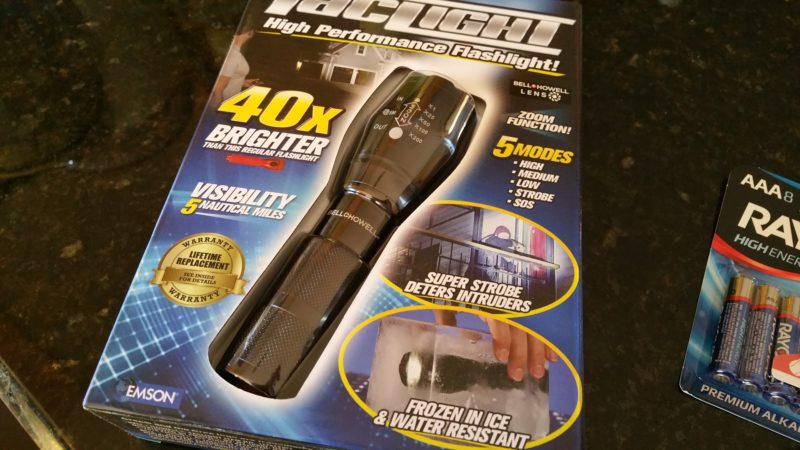
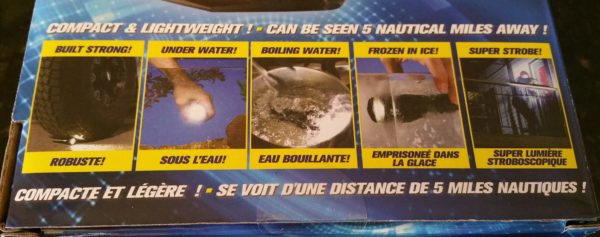
As can be seen from the packaging above the TacLight is touted to be super durable and incredibly bright. It is so durable in fact it can withstand being submerged in water, run over by a car, frozen in ice, and boiled in water. While I suspect using a flashlight in such conditions as boiling water and surviving a hit and run would lead to more issues than whether or not a flashlight works – I understand these tests are apparently an indication of quality and reliability.
One claim that I was unable to substantiate is the ability to see the light which is so bright it can be seen “5 nautical miles away”. Due to my living on land and not having my presence on the ocean anytime soon a 5 nautical mile test was simply unrealistic.
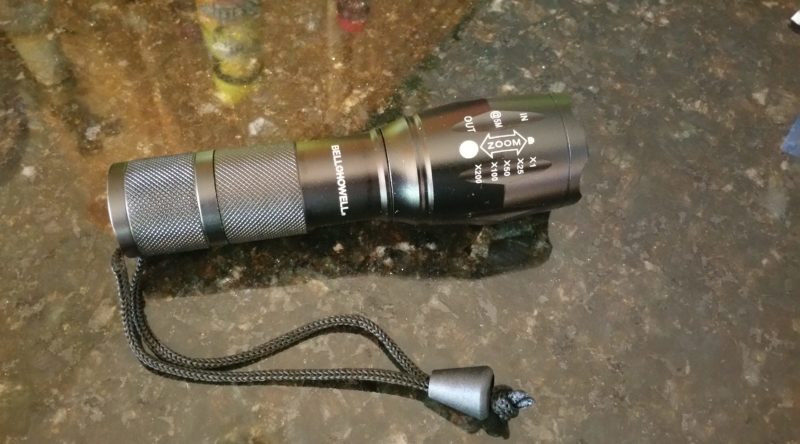
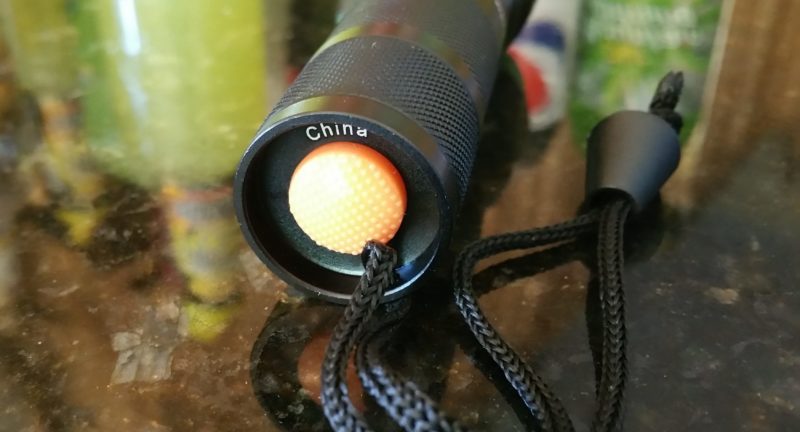
The TacLight is a medium sized flashlight at 5.4″ inches long and approx 1.6″ inches wide. It is made from lightweight aluminum and contains a lanyard. The light is operated via an end-cap push button.
It appears Bell & Howell take immense pride in the fact the TacLight is made in China. Now – the origin of manufacture is not much of a surprise as most electronics of any kind is made in China. Just a bit odd that it would be printed so visibly.
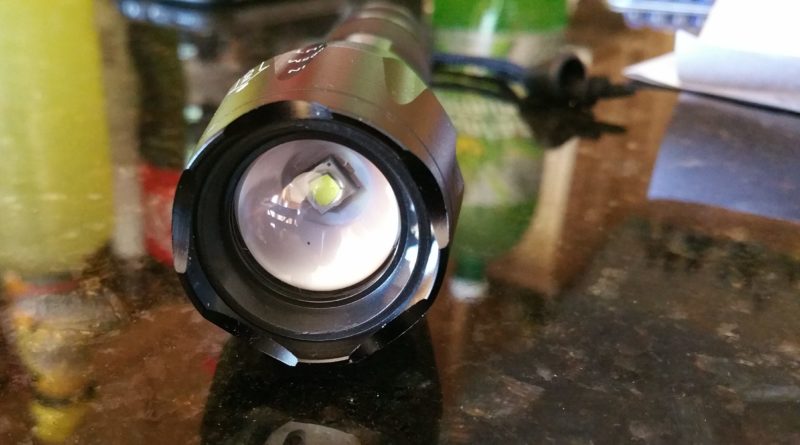
The LED element on my example was well centered and the lens was clear. The lens is protected by a shroud with semi-aggressive raised edges. These are meant to be useful in a self-defense situation and it appears they would not be pleasant to get hit with.
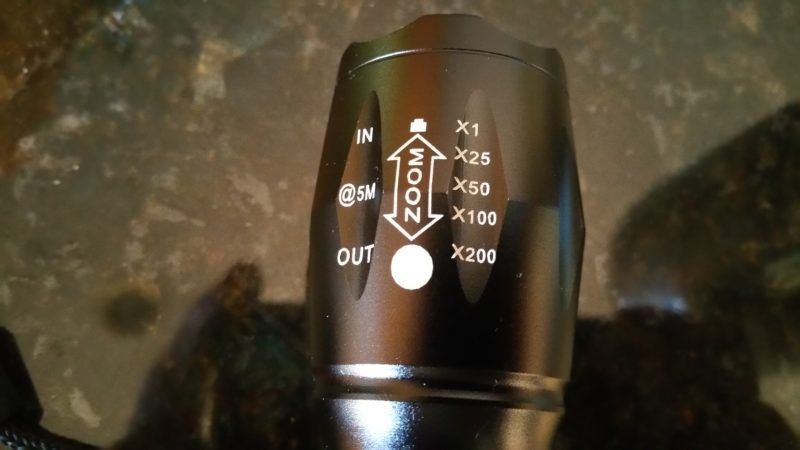
Unlike most LED flashlights I own the TacLight’s beam can be adjusted from a very concentrated beam to flood pattern. The pattern is adjusted by sliding the head back and forth. The action is smooth and it works well.
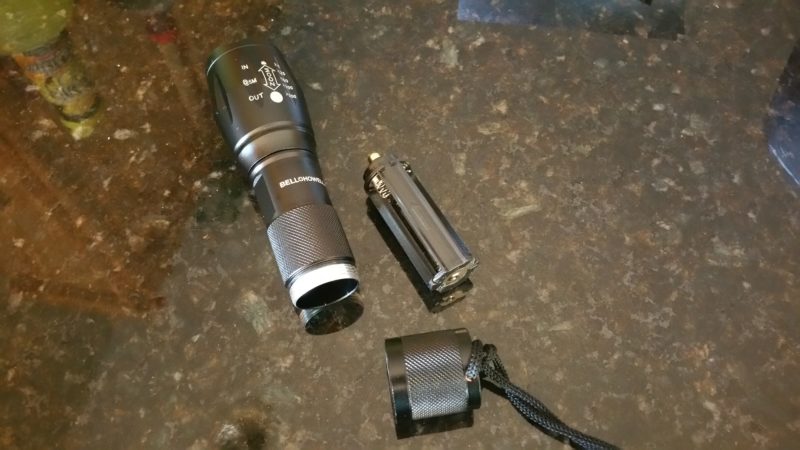
The light is powered via 3 AAA batteries.
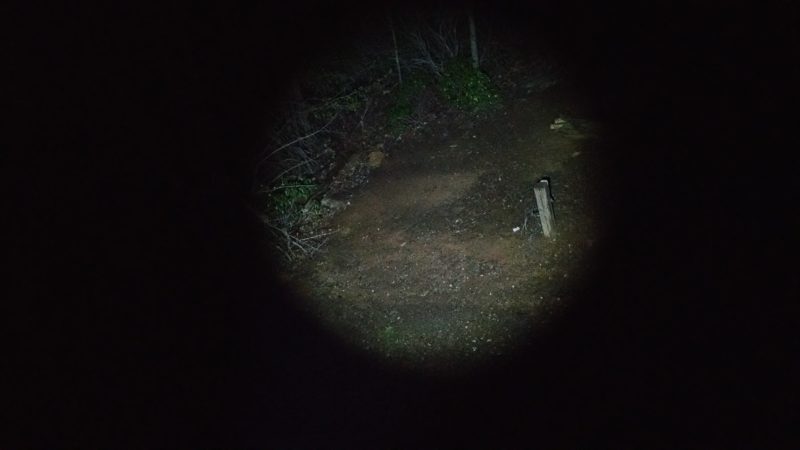
Above shows the concentrated spot adjustment. The square LED diode appearance is common among focusable LED lights.
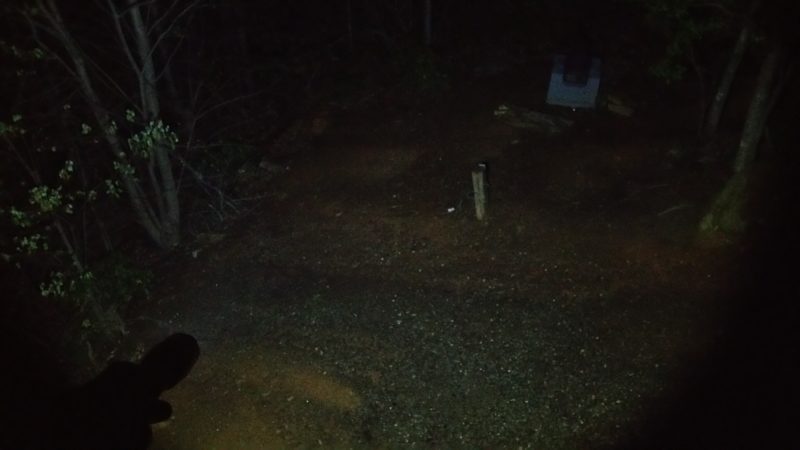
Medium focus above provides excellent brightness in total darkness with good area coverage. The picture really doesn’t do it justice.
In full flood pattern, a massive area is illuminated.
There are three levels of brightness, a strobe, and an SOS mode.As always the fewer the modes the better in my opinion so this is overkill.
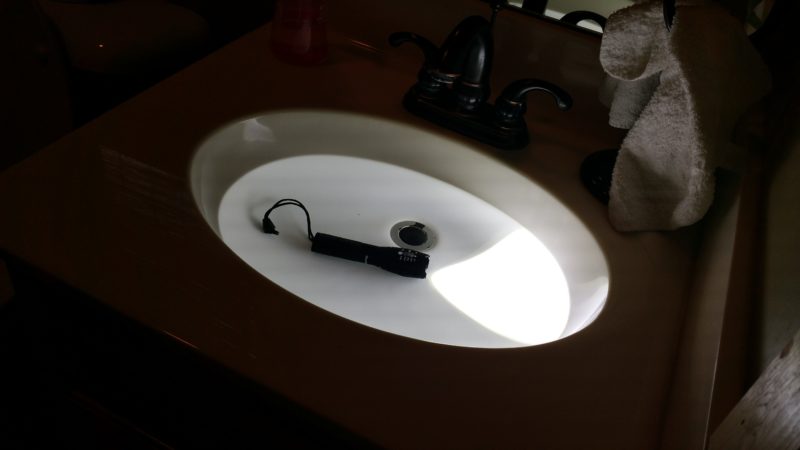
The TacLight is claimed to be waterproof. I left the light in this sink for over 15 minutes with no issues. PASS
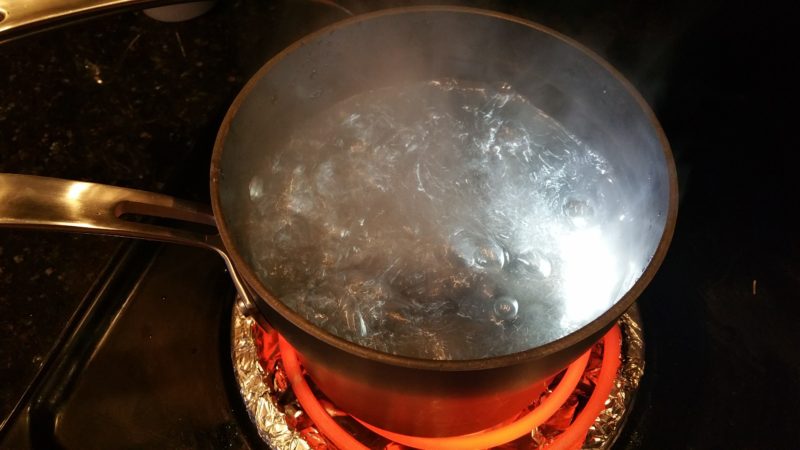
Above the TacLight was submerged in boiling water for close to one minute. Honestly, I was really surprised that it just kept running.
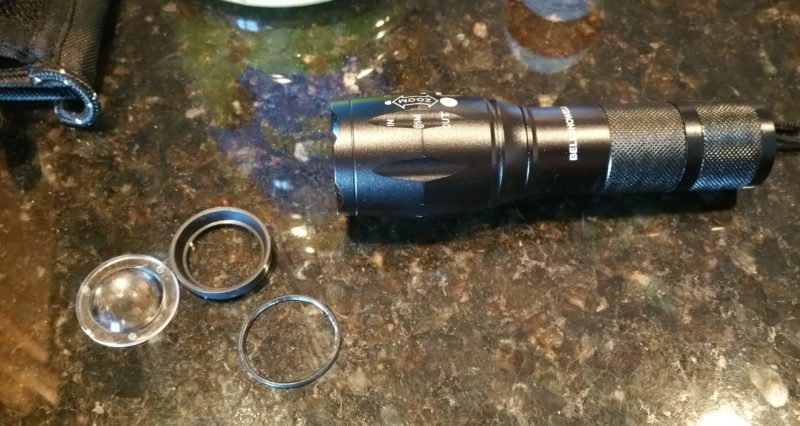
I had thought the TacLight survived the boiling water until the next morning I walked into the kitchen and found the scene below. It appears that the lens is held in place via an adhesive which must have softened during the boiling process. Some internal pressure from the heat likely aided in having the lens pop off.
Regardless of the lens popping off the TacLight still worked. It survived being submerged and boiling – but will it survive being run over.
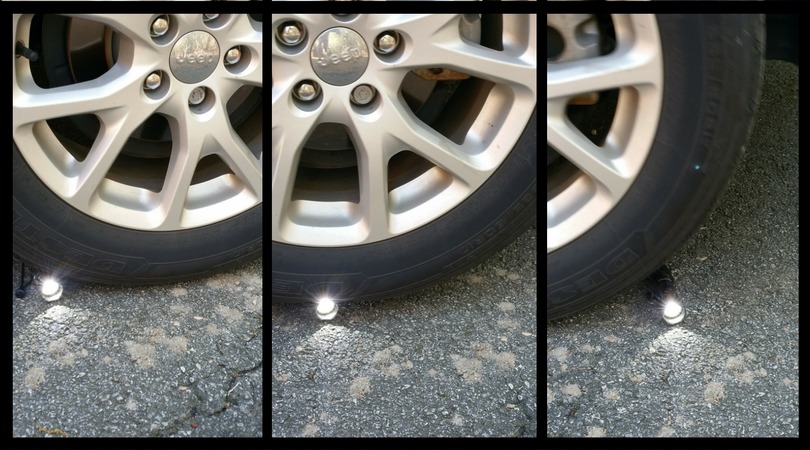
Below I ran over the TacLight with a 2016 Jeep Cherokee. It survived.
SUMMARY
The TacLight still worked after all these tests although it did not work as well. With the lens gone the light just did not look the same. I was not able to test freezing it as it was no longer waterproof.
I was honored to be asked to submit a written review to be read on The Prepper Website Podcast. Although there was very short notice, I just had to jump on the opportunity.
The entire Episode 69 can be listened to HERE or you can stream it from my website below: