Why reload your own ammunition? Two reasons: reloaded ammunition may be much cheaper than factory and reloaded ammunition has the potential to greatly increase the accuracy of your rifle or pistol.
I have reloaded rifle, pistol, and shotgun ammunition, and cast pistol bullets and big heavy bullets for the old black powder rifle cartridges such as the .45-70 for more than half a century. I also cast 0, 00, and 000 buckshot and 12 gauge slugs and sabot rounds. Much of my reloading equipment was purchased back in the 1960s and still in use.
Otis developed the first safe elevator with automatic braking. A favorite quote from this inventor is ‘safety first, gentlemen, safety first.’ I can think of no more fitting appellation for reloading ammunition. Please don’t smoke when using either black or smokeless powder and remember black powder is more static sensitive than smokeless. There’s a reason many black powder mills were on barges anchored in a river. I don’t like distractions and once set upon the task of reloading, that process proceeds without interruption.
Some basic nomenclature: a cartridge consists of primer, case, powder, and bullet, sometimes called a round; a fired cartridge consists of a spent primer and the powder container often called ‘brass, fired round, or case’ that may be steel, brass, plastic, aluminum, or a combination of brass and paper.
Over the decades, I’ve developed certain procedures in the repetitive process of reloading ammunition with the intent of reducing errors. If using a powder measure (more about these later), the name of the powder and charge is written with a magic marker on a low adhesive tape and affixed to the dispenser. This tape is typically green or blue and removes much easier than the cream colored masking tape of old. Upon completion of the loading process, I match the powder label on the dispenser with the factory powder container, peel this tape off of the dispenser, and dump any excess back into the bulk container. http://www.uline.com/BL_6141/3M-2090-Masking-Tape
MISIDENTIFICATION of powder charge, brand, year of manufacture, or type can have LETHAL RESULTS. Older Hodgen 4831 and DuPont IMR 4831 are not the same. Read and understand current reloading manuals. I try to choose loads based upon specific commercial bullet manufacturer’s reloading handbooks (when reloading Hornady XTP bullets, I use the Hornady manual). http://www.hornady.com/store/9th-Edition-Reloading-Manual3. Speer, Sierra https://www.sierrabullets.com/store/product.cfm/sn/0507/Sierra-5th-Edition-Reloading-Manual-Printed-version-and-Infinity-7-Exterior-Ballistic-Software-Program-CD-Rom, Lyman, Barnes, RCBS, Nosler and others produce reloading manuals. I often consult several from different sources as insurance against misprint https://www.amazon.com/s/ref=nb_sb_noss_1?url=search-alias%3Daps&field-keywords=reloading+manuals
[slideshow_deploy id=’2663′]
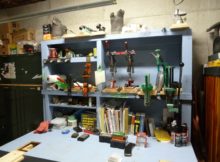
I carefully note the powder brand and type for the cartridge for bullet weight and type being reloaded. I remove that particular bulk powder container from my powder locker (green metal lockable cabinet adjacent to loading bench in photos). I verify this again when writing the powder and charge weight on the removable masking tape affixed to the powder measure dispenser hopper, and then again upon completion when removing the annotated tape from the measure before discharging back into the bulk container. This repetition is intentional.
Bullet weight and type is matched against that bullet manufacture’s published loading data. Before actually loading the bullet into a primed and charged case, I weigh a sample bullet to preclude any misidentification by the manufacturer. Depending upon the bullet, I may even measure its diameter and length with vernier calipers for comparison against published specifications https://en.wikipedia.org/wiki/Calipers.
Every reloader should have a stainless steel vernier caliper capable of measuring to the 0.001” along with a selection of inside and outside calipers mentioned in the beginning of the wiki article. Some calipers may have an easier to read circular analog dial (dial caliper) or the older linear vernier scale. Digital calipers are easiest to read but of course rely on batteries which mechanical calipers and micrometers never need. Vernier calipers are useful for measuring resized case length (cases ‘grow’ longer with each shooting and must be shortened to factory dimensions periodically) as well as case overall length inclusive of the loaded bullet. Exceeding case length and cartridge length specifications can drastically increase pressure resulting in LETHAL INJURY.
If you intend to build your own weapons or engage in gunsmithing, a good set of inside and outside micrometers capable of measuring 0.0001” are also useful.
From my primer locker (another of those lockable green cabinets adjacent to the reloading bench), I select the proper primer for the cartridge being reloaded. Primers come in three basic diameters and are further distinguished as being intended for rifle or pistol, as well as for magnum calibers. So a primer may be either small or large (diameter) or even bigger for the .50BMG cartridge http://www.midwayusa.com/product/1301713135/cci-50-bmg-primers-35; magnum or not; and for rifle or pistol. Pistol primers typically have thinner cups intended for less robust striker mechanisms and lower pressures found in pistols and if inadvertently used in a high pressure rifle cartridge, may explosively breach allowing both gases and debris to strike the shooter and/or bystanders. Magnum cartridges, both pistol and rifle, typically have a greater case volume than traditional cartridges and may require higher energy primers to optimally ignite the larger powder charge. Use of a magnum primer in a cartridge not so designated may cause excessive pressures resulting an explosive breach of the primer or cartridge along with possible destruction of the weapon and injury of the shooter and/or bystander.
I review the appropriate loading data for proper primer selection and remove a box (or boxes – primers are typically packed 100/discrete box) of the proper primers from the primer locker. Not necessary but expedient and time saving, I then charge a RCBS universal priming tool http://www.rcbs.com/Products/Priming/Tools/Universal-Hand-Priming-Tool.aspx with 100 primers. Next I label another strip of that masking tape with the primer manufacturer and type designators and affix to the hand-priming device. This tool is a convenience and time saving device and not essential to the reloading process as the press I use and recommend has its own priming device that unfortunately is much slower. Before actually priming decapped (a cartridge with spent primer removed) cartridges, I once again compare the specified primer with the primer box and primer label on the hand priming tool. Upon completion of the priming operation with all brass now primed, I repeat this process and return any unused primers left in the tool to the factory box and replace this box in the primer locker.
Grease from fingers (natural or lubricant related) can deactivate primers. Clean your mitts before handling primers and then strive to minimize contact. This is but one reason why I like the hand priming tool, I never touch the primers when using it and dump a box of 100 directly into the primer hopper that feeds the tool. I also tend to reload in groups of 100 so seldom am left with primers to return to the factory box.
Regardless of whether you use a hand priming tool or that with the press (which by the way requires handling individual primers), the primer should be seated completely against the bottom of the cartridge primer pocket. I feel the back of each cartridge with a thumb or finger to ensure the primer cup is slightly below flush with the back of the cartridge. A slam fire in a semi-automatic weapon or unexpected discharge may result when chambering any cartridge with primer cup extending even a smidgen beyond the cartridge base. Such is a dangerous condition and to be avoided. I seal primer pockets (not a required process) with a waterproofing agent (clear fingernail polish works well) and re-check each primer for proper seating during this process. By all means, avoid crushing the primer during the seating process or it might fire. A prudent person will also avoid putting eyes or other body parts over the open end of the cartridge when priming (which is easy to do with the hand priming tool).
Military cartridges are typically identified by the arsenal and year of production. The base of a 7.62×51 NATO (7.62 is the caliber and 51 the length in millimeters) might be annotated “LC 02’ designating a cartridge manufactured in 2002 by the Lake City Arsenal. Such brass often has a green or red rim around the primer cup. This colored agent is a waterproofing compound. Readers are likely interested in reloading 5.56x45NATO or 7.62x51NATO ammunition, or alternatively but not the same, .223 Rem or .308 Win. These pairs of cartridges are not completely interchangeable and both as a shooter and as a reloader. it is incumbent upon you to know and understand the difference.
Military cartridges are often fired in belt fed automatic weapons whose self loading and extracting process tends to be more robust than encountered with sporting rifles and handguns. To ensure primers do not back out, the primer pocket in the casing is often crimped around the primer. Decapping force required is slightly greater and the crimp ridge must be removed before re-priming. Lyman makes both primer pocket reamers (to remove that crimp ridge) and primer pocket cleaners (to remove firing residue). The reamers come in three sizes, small, large, and arsenal (for the .50BMG). The first two are essential for reloading most military cartridges. http://www.lymanproducts.com/lyman/case-prep/primer-pocket-reamer.php
The proper designator for the US caliber.30 main combat rifle cartridge is 7.62x51NATO. Specifics are important and even more for the reloader. There are a host 7.62 cartridges (7.62 Argentine, 7.62x54r (Russian), 7.62×39, etc.), and of course the popular 7.62x51NATO. I’ll repeat once more, 7.62x51NATO is not the same as .308 Win. The performance is different, the cases are different, and the bullets are different. Likewise there is a .38 S&W and a .38 Special, two different cartridges. 5.56x41NATO is different than .223 Remington.
Reloading begins with case inspection. Please do not try to reload Berdan primed brass or steel cases. When in contact with leather and a host of other materials, brass will corrode. Leather turns brass an ugly green (residual acids from the tanning process leaches copper from brass) and weakens the case. Some brass cases are nickel plated and usually shiny. Nickel is more corrosion resistant than brass and plated cases are highly reloadable. Steel cases are usually dull in color and may have a lacquer or shellac coating that reduces extraction friction. Non-US manufactured military ammunition is likely Berdan primed, steel, and will not have a central flash hole so conducive to decapping. Berdan primers differ from Boxer primers (the US standard) in that there is no integral primer anvil. I am convinced repressive governments limit civilian access to potential ammunition supplies by using Berdan primers. Picking up fired brass is illegal in some countries.
Examine the base of the fired cartridge and primer carefully. The primer cup often reveals over pressure issues. Primers are slightly rounded at the edges. Excessive pressure eliminates this slight radius so that the primer completely fills the primer pocket. Even more pressure causes a ridge around the circumference of the firing pin caused depression in the primer. That circumferential ridge is the primer flowing into the hole in the bolt that the firing pin passes through. This is a certain sign of incipient primer failure due to excessive pressure.
If a primer fails obturation (https://en.wikipedia.org/wiki/Obturation) and breaches, gasses and debris both powder and metal under very high pressure (60,000 pounds per square inch or more in the case of some rifle cartridges), blow back into the bolt and may strike the shooter. The barrel may even burst with disastrous effect to the shooter and bystanders. Always wear eye protection when shooting and insist on the same for all onlookers.
I next examine the case ending with the neck area, looking for swelling and splitting. Shooting expands the brass cartridge casing causing momentary obturation at the chamber. Brass is ductile and upon release of pressure (the bang), relaxes toward (but not reaching) its original diameter. This very relaxation makes case extraction possible. Resizing fired brass to factory diameter is a component step in the reloading process. Repetitive expansion and contraction (following firing and in resizing) both weakens and lengthens the case actually causing work hardening. Splitting around the case neck is the first sign a case may have been reloaded too many times. Annealing (softening the work hardened brass – https://en.wikipedia.org/wiki/Annealing_%28metallurgy%29) the case mouth may rehabilitate a group of brass cases when one exhibits characteristic splitting. Never reload a case with splitting around the opening. I crush such in a vice and discard.
A die is used in the reloading press to resize the cartridge to factory dimensions http://www.rcbs.com/Products/Dies-by-Category/Group-A-E-Dies/Group-A-Popular-Rifle-Cartridges/Full-Length-Die-Set-Group-A-Popular-Rifle-Cartridg.aspx. This die often decaps the case, removing the spent primer and then expands the neck to proper internal dimension. Should I mention that the dies being used in the reloading processes must match the cartridge being reloaded? There are exceptions, for instance .357 Magnum dies can be used to reload .38 Special, .44 Magnum dies can be used to reload .44 Special but such tends to be the exception rather than the rule and generally apply to certain straight walled cases. On the other hand, a neck sizing die for 7.62x51NATO and .308 Win are interchangeable and may be used with the .30-‘06; shell holders for .30-‘06 can be used for 7.62x51NATO, .308 Win, and .45acp and other cartridges based upon the .30-‘06 rim base dimensions. Loading manuals publish factory dimensions for both bullets and cases as well as trim to length dimensions. Be sure you understand all limitations and restrictions before making any substitution of die/cartridge/shell holder. Errors in application can cause the case to not achieve obturation and/or produce excess pressures resulting in catastrophic weapon failure. An error in the shell holder application may result in a case stuck in the resizing die. This is not a die ending event (a pun) and the stuck case can be extracted but at the expense of lost time and measure of frustration.
Bench loaders striving for ultimate accuracy and reloading ammunition for a specific weapon only, may just neck size fired brass. Most however desire their ammunition to function in any weapon so full length resizing is most often used. Reloading dies most commonly come in three diameters with 7/8×14 thread the most common. Rifle calibers often require only two dies, full-length resizing/decapping/neck expanding and bullet seating. Pistol calibers are typically straight wall cases and may require three or four dies. Dies are made of hardened tool steel, some with a carbide steel insert. The latter are more expensive but preferable as no resizing lubricant is required. http://www.rcbs.com/Products/Dies-by-Category/Group-A-E-Dies/Group-E-Straight-Walled-Cartridges/3-Die-Carbide-Taper-Crimp-Set-Group-E-Straight-Wal.aspx.
Reloading presses secure the brass case and provide a method for forcing it into and removal from the various reloading dies. The simplest of presses is the single stage RCBS Rock Chucker Supreme http://www.rcbs.com/Products/Presses-and-Kits/Single-Stage/Rock-Chucker-Supreme-Press.aspx. I’ve used the predecessor Rock Chucker press for more than a half century and are available for about $100 used. http://www.ebay.com/itm/RCBS-RC-Rock-Chucker-Reloading-Press-w-Primer-Punch-Lee-Lyman-Hornady-/191925134037.
Volume reloaders may desire a progressive or turret press to speed the loading process http://www.rcbs.com/Products/Presses-and-Kits/Turret/Turret-Press.aspx or a real high speed progressive press made by Dilllon http://www.dillonprecision.com/super-1050_8_1_23877.html.
The Lyman 310 tool is a time proven cheap entry to the reloading world http://www.lymanproducts.com/lyman/dies/lyman-310-tool.php. Its portability and simplicity make it a good item for deep stores. Lee also makes a hand reloading tool http://leeprecision.com/lee-loader-9mm-luger.html. I have a now obsolete Lyman Tru Line Jr. turret press that I use for small pistol cartridges. This press uses the same dies as the Lyman 310 tool (5/8×30 dies).
THE MECHANICS
After inspection, fired brass is lubricated if necessary, decapped and resized. http://www.cabelas.com/product/RCBS-reg-Case-Lube/741087.uts?productVariantId=1324051&WT.tsrc=PPC&WT.mc_id=GoogleProductAds&WT.z_mc_id1=25794311&rid=20&gclid=CK_U_a65_c0CFZaMaQodrjQE1Q&gclsrc=aw.ds.
Primer pockets are cleaned and reamed if necessary. The length of the resized cartridge is measured using the vernier caliper and compared with published specification. If too long, I trim to published length using the RCBS Trim Pro #2 cutter http://www.rcbs.com/Products/Case-Preparation/Case-Trimming/Trim-Pro-2-Manual-Case-Trimmer-Kit.aspx equipped with three way cutting head http://www.rcbs.com/Products/Case-Preparation/Case-Trimming/Trim-Pro-3-Way-Cutter.aspx.
The brass is then cleaned and/or polished (not necessary except for maximum pressure loads but makes for a nice end product) using an ultrasonic cleaner http://www.rcbs.com/Products/Case-Preparation/Case-Cleaning/Ultrasonic-Case-Cleaner-120-VAC.aspx and /or vibratory polisher http://www.rcbs.com/Products/Case-Preparation/Case-Cleaning/Vibratory-Case-Cleaner-120-VAC.aspx.
At this point the brass casings have been inspected, decapped, trimmed to length, and cleaned. If the brass is straight wall design (.357 Magnum, .44 Magnum, 9mm, .45acp, .45-70, etc.), the case mouth must be very slightly belled to facilitate bullet seating. This is done with an expander die. Some pistol rounds headspace on the case rim (9mm, .45acp, etc.). Caution must be used not to excessively bell nor crimp the case mouth of those type brass cases. Any residual belling after seating the bullet should be removed by adjusting the die to set a slight crimp resulting in straight case shoulder.
After resizing and before priming (or re-capping), I always measure case length and trim as necessary. The chamfering tool http://www.lymanproducts.com/lyman/case-prep/carbide-case-prep.php eases bullet starting, especially for non-boat tail bullets and can be used to bring overall case length into specification. If you intend to reload more than casually, I recommend the RCBS high capacity case trimmer or better, the Trim Pro 2 http://www.rcbs.com/Products/Case-Preparation/Case-Trimming/Trim-Pro-2-Manual-Case-Trimmer-Kit.aspx that both trims and chamfers in one operation.
The case is now ready to be primed using either the hand tool or reloading press.
An essential safety (and convenience item) is a reloading block http://www.rcbs.com/Products/Case-Preparation/Accessories/Universal-Case-Loading-Block.aspx. Some are made from plastic, some from wood, and others aluminum. All are different. A company long out of business produced mine. The loading block holds cases upright after charging with powder. Once all cases are so charged, one can visually cross inspect the powder level for all brass. Take your time with this. Ensure all cases have powder and all powder levels are the same. 1/10 of a grain makes a huge difference in pressure with maximum loadings and may be the difference between a ruptured barrel and an otherwise satisfying bang. Always weigh individual powder charges when loading near or at maximum pressures and work up to them gradually.
So you may ask, how is powder weighed? Very carefully, I quip. US powder measure is by the grain (an average weight of a grain of cereal such as wheat or barley). By established convention, there are 7000 grains to the pound.
Almost 60 years ago, I purchased a Redding #2 powder scale. http://www.midwayusa.com/product/658771/redding-2-master-magnetic-powder-scale-505-grain-capacity. It works as well today as when purchased. This is a magnetically dampened all metal balance beam type scale. More modern scales use plastics and at least one manufacturer had problems with static charges on plastic scales. Static charge is of concern in two ways, a spark igniting the powder, and worse affecting dampening causing erratic readings. Buy the Redding #2 and you won’t go wrong. When using a manual scale, a powder trickler is helpful for adding small amounts of powder to the scale pan http://www.rcbs.com/Products/Powder-Measures-and-Scales/Powder-Measures/Tricklers/Powder-Trickler-2.aspx and the Redding trickler is even better https://www.amazon.com/Redding-Reloading-Powder-Trickler-05000/dp/B000PW7KE2/ref=sr_1_3/000-9968453-7225914?ie=UTF8&qid=1468875980&sr=8-3&keywords=redding+scale.
Along with the trickler, a useful item is the powder measure. A powder measure dispenses an adjustable volume of powder. I like the Lyman #55 powder measure for discharging smaller charges such as for pistol or small rifle cases such as the 5.56x41NATO http://www.lymanproducts.com/lyman/scales-measures/55-std-baffle-stand.php.
For anything bigger than .30-’06, consistency requires a powder tube of more capacity such as the RCBS charger for .50BMG. If I only had one powder measure it would be the Lyman because of its better design (a 7000 grain charge tube is available as an option). Be sure and measure every 5th or 10th powder charge if using a powder measure. As the powder level in the tube decreases, the level of compaction in the measuring chamber does likewise. From time to time measure volume may need adjusting to compensate for changing density.
Volume reloaders striving for peak accuracy should consider the combination electronic scales and dispenser made by RCBS, the Chargemaster Pro http://www.rcbs.com/Products/Powder-Measures-and-Scales/Powder-Measures/Electronic/ChargeMaster-Combo-120-VAC.aspx. Users of this fine scale and powder measure desiring grid independence should still purchase a manual scale such as the Redding #2.
Weigh individual charges when loading near design pressure limit!
So now we have a block of 50 to 100 carefully inspected, trimmed, polished, primed, and charged cases. All have powder and all powder is at the same level in each case (use a flashlight for inspecting bottle neck cartridges) and any straight walled cases are very slightly belled at the mouth.
The bullet-seating die is installed in the press. I take a sample factory round and carefully adjust this die until it just contacts the nose of the bullet. That round is then removed and a charged case is installed in the press. A bullet is then started into the bell and this assembly is gently run up into the seating die. Overall cartridge (case + bullet) length is measured and compared to specification and the seating die readjusted as necessary until the bullet is properly seated, any bell at the case mouth is removed, and proper cartridge overall length is achieved.
The end product is a high quality round of ammunition as good as or better than produced by the factory and at a cheaper cost. By judiciously comparing different powders and charges and different bullets and bullet designs, one can usually develop a custom cartridge for each rifle or pistol whose accuracy far exceeds that possible with factory ammunition.
Serious shooters often add a chronograph to their reloading apparatus, as the ability to measure muzzle velocity for a particular load is worthwhile in developing trajectory curves for discrete loads. When I was young, pressure was measured by use of a universal bond receiver equipped with a copper crusher gauge. Strain gauges are now commonplace and are much more accurate. While once in the purview of commercial ammunition manufacturers, these tools are increasingly within the cost range of the serious shooter.
A summary of favorite equipment/manufacturers are as follows:
Presses: RCBS Rock Chucker
Volume reloading progressive presses: Dillon
Powder measure: Lyman #55
Powder scale (manual): Redding #2
Powder trickler: Redding
Case prep tools: Lyman
Case trimming tools: RCBS
Shotgun presses (not covered here): MEC Jr. These are available cheap. http://www.ebay.com/itm/MEC-12ga-600-JR-Shot-Shell-Reloading-Press-Vintage-1972-with-Lyman-Handbook-/131875958650
Bullet casting moulds, pots: Lyman http://www.lymanproducts.com/lyman/bullet-casting/mould-details.php?entryID=28
Bullet sizing: Lyman 4500 Lube sizer (will seat gas checks) http://www.lymanproducts.com/lyman/bullet-casting/4500-lube-sizer.php
Shotgun buckshot and slug moulds: Lee https://www.amazon.com/Lee-Precision-Buck-Shot-18-Mold/dp/B005Y50H5O; http://leeprecision.com/1-oz-slug-mold.html
Pistol shooters in particular can greatly reduce the cost of reloaded ammunition by casting their own bullets from automotive wheel weights. Another more complicated process for producing higher quality rifle and pistol bullets is called swaging. Casting and swaging are rightfully topics of an additional post and if interested let me know.
Reloading has many discrete steps and appropriate caution must be applied at each stage of the process. If you are uncertain, don’t do it. I began reloading as a pre-teen and shot competitively for some years afterward. Reloading is a very useful and cost saving process for the active shooter.
The Lyman Reloading introduction guide is available at: http://www.lymanproducts.com/lyman/presses-and-kits/pdf/IntroToReloading.pdf
In all things, follow the motto of Davy Crockett, ‘be sure you’re right and then go ahead.’ Marksmanship is a perishable skill set and reloading offers more bang for the buck.
Hope this helps someone.
Panhandle Rancher