There’s not much that will create an argument more than asking “What is the best firing stance and grip?” in a forum of AR shooters. While everyone has an opinion and many feel their’s is the only one that counts I’ll give you my quick answer – “The one that you are comfortable with and allows rounds to be sent down range – accurately.”
Pretty simple.
Several years ago I heard of this method competition shooters were using to control recoil and shoot very accurately – called the “C-Clamp”. I tried and hated it. Man – it felt so uncomfortable. I preferred to hold the magazine well however I just could not control recoil well and get multiple rounds on target quickly. I had signed up for a defensive carbine and pistol course from Wolf-Fire Firearms Training and decided to try the C-Clamp again. I used it throughout the class and it really grew on me. Now, this is the primary method I use for shooting the AR.
The video below gives some perspective on the “thumb over bore” and explains my position on it well. I agree with this guy 100%.
Note: Information being provided is meant to encourage research, education, and training. The posts in of itself are merely brief summaries at most. Consider the information to be an introduction to the topic. Topics are published in no particular order.
The main perspective of this ongoing series is a defensive response to a potential threat. Watching a video is not going to take the place of active, hands-on firearms and tactics training. For many, access to training is limited either due to finances or lack of qualified trainers in their area. Getting a group together and practicing tactics learned via video or books is certainly better than just watching John Wick.
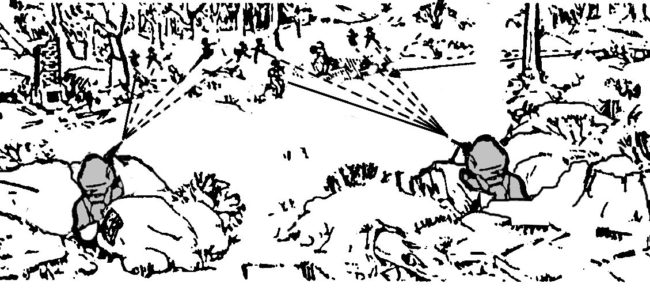
The following video shows basic movement tactics while under fire and threat from fire. The animation is rather dated however the information is quite valid.
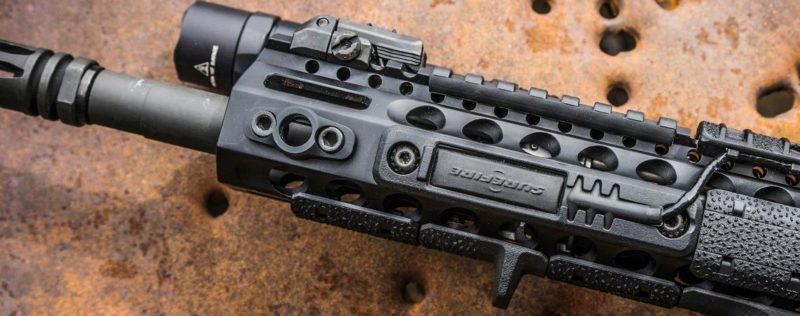
Let’s take a look at setting up a Duty AR-15. What is “Duty”? Anything from patrolling property, home defense, as well as battling brigands and other evildoers. Now – a good Duty rifle does not have to cost an arm, legs, and unmentionables. Especially with the current firearm market duty AR’s can be purchased with hundreds rather than thousands of dollars. Factory OEM AR’s from Ruger and Smith & Wesson can be found for under $500 and make good platforms which to have a Duty gun.
So – what are the main components of a Duty gun?
AR-15
Sling
Optic
Flashlight
With every aspect of all of the components listed above a great amount of personal preference is involved. What works for me may not work for you. What works for Operator A might be terrible for Operator B, etc. Consider a car lot. Every vehicle there will get you where you are going but there is a reason why so many models are manufactured. A general coverage of each component will be reviewed.
NOTE: Putting together a Duty gun is NOT complicated. This is also not a MISSION SPECIFIC firearm to serve a very certain tole with required abilities.
AR-15’s:
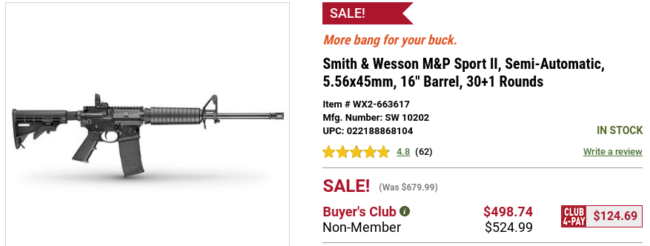
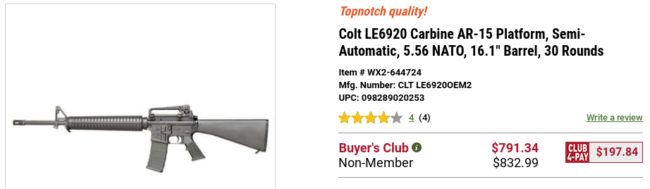
Most any AR-15 of at least carbine(16″) length will fill the role. Popular models from Colt, Smith & Wesson, Ruger, Bushmaster, Windham, and others are available and each having models to fit any budget. M4 carbine variants work well and also 20″ full-sized rifles. There is no need for an AR that will shoot sub-MOA groups, or have a special lower with engraving. Reliabilitiy is of upmost concern and importance. The choice is up to the one with the money which to buy.
Here are a couple examples:
I’ll note that models in 5.56mm are recommended for a few reasons including ammunition compatibility, ammo cost/weight, and magazine compatibility.
Sling:
I run a single-point sling which I like very much. They are simple to use and fast. The main issue with the single point is transitioning from pistol to long gun. When the AR is dropped to switch to a pistol the gun seems to like heading directly to my – gerbils. Not the most comfortable feeling.
Iron sights are a basic component as part of any Duty gun. A simple set of Magpul MBUS II folding sights will suffice. Want something better and made of metal? Buy ’em.
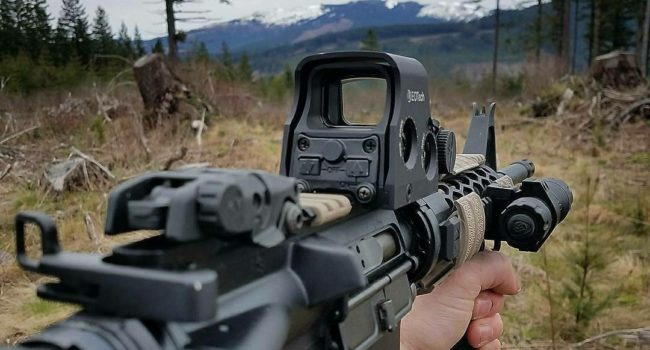
Most Duty AR’s today will run a red dot optic such as the Bushnell TRS-25, Vortex StrikeFire, etc. Money generally equals quality. EOTech’s and Aimpoints offer increased reliabilities and are worth the extra funds needed for purchase. Red dots provide much faster target acquisition than iron sights and also help those of us with aging eyes. Although there are many red dot optics available it’s important on a Duty gun to have something reliable with a very good track record. Although I am currently testing a Sightmark CSR I would never recommend a company such as Sightmark due to their very questionable reputation.
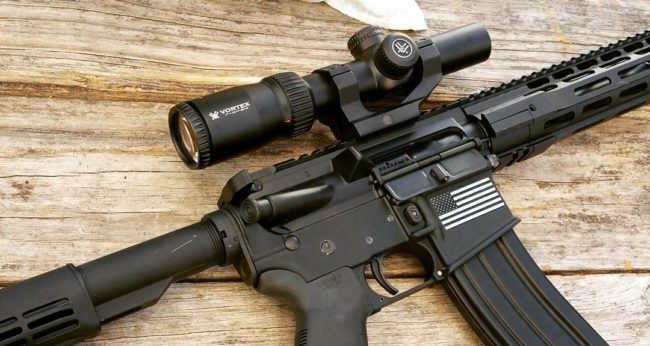
Magnified optics can prove very beneficial when targeting longer distances. They also can serve to assist in gathering information. For a Duty rifle, the optic should be something in the 1×4 – 1×6 range. The reason for not going to a higher starting magnification is the need to be able to use the optic in CQC. Turning the optic down to 1X will allow near red dot performance.
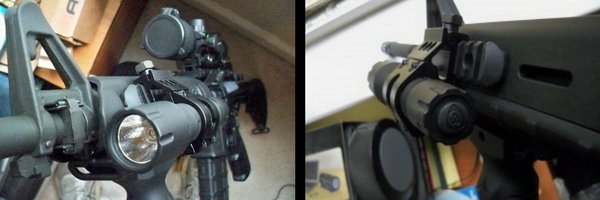
Illumination is an important component of a Duty rifle. The weapons platform may be used to illuminate a threat at night or possibly an intruder inside a building. While there is a lot of controversy as to just how bright weapon mounted flashlights should be in the end that is up to the shooter – and your wallet. Understand that an 800 lumen light reflecting off white drywall can interrupt the ability for the holder of the gun to see – not just the “bad guy”. Companies such as SureFire and Streamlight have great reputations for making reliable weapon lights.
Exactly how the light is mounted and run is up to the shooter.
The Duty Rifle is an integral component to preparing for the American Reformation. It is reliable, versatile, and accurate. Only with training can it be put to use to take advantage of its full capabilities.
Prior to founding Costa Ludus in 2011, Chris Costa spent 4 years as the President of Magpul Dynamics. Before founding Magpul Dynamics, Costa spent 7 years in the private sector at Applied Marine Technologies Inc. (AMTI) on assignment with the U.S. Department of Homeland Security’s Risk Management Division (RMD).
Also known as “The Beard” – Costa tells it like it is and provides logic and common sense to his opinions.
In the following video, he and those he trains provides thoughts on “Why We Train.”
I train for multiple reasons and it isn’t always as noble as “To protect my family”. I enjoy it. I love getting out from the narrow walls of a typical shooting lane and moving – running – from cover to cover engaging targets. Increasing a wide range of abilities and skills to a level superior to I had before. It’s rewarding. It’s fun.
The end result of all that fun is the ability to protect me, my family – and my country.
I was asked recently what my opinion was of SouthernPrepper1’s recent video titled – “Prepper’s will die….No tactics are better than bad tactics“. In the video, SP1 discusses a combination of poor and incorrect tactical training, physical conditioning, and the propensity for prepper’s to train for offensive conditions.
While I have no military background and the majority of “tactical” training that I have had has been firearm based – I have a few thoughts.
I’ve always believed that given whatever the “SHTF” event is – avoiding problems is of paramount importance. This means taking a defensive stand on a day to day basis. Area patrol’s and scout’s to serve as information gatherers and early warning systems would be the extent of those leaving the retreat. Bringing the absolute minimum attention to yourself is a definite effort in self-preservation.
Preparation for suspect visitors is a must. Defensive tactics for protecting the property and fending off those who wish to do harm is certainly important. Tactics to go out and attack someone else’s property? Think about it. Consider the enormous risk to that operation.
Prepper groups need to work on what SP1 stated such as fortifying their position, covering areas of engagements, know the kill zones, and be capable of placing accurate fire into them. Everyone within the group needs to know their weapons systems. Placing fire downrange, accurately, and being able to quickly reload to re-engage are strong tactics that most should be capable of. A plan on what to do in case of attack needs to be made now.
SP1 discusses fitness level and age. I can tell you this is a HUGE problem I have seen first hand. Far too often people are just too “nice” to tell people the truth. If you cannot get down behind a 55-gallon barrel and get cover that is a issue that may get you killed. Prepper’s need to know their limitations. If a group member remembers what it was like before electricity then they are not likely one you can depend on for high demand physical activity. If someone is 150 pounds overweight and cannot run from Position A to Position B with some sense of urgency – then they need to stay at Position A or be delegated to another function(or not be in Position A to start with).
I’ll mention something else that drives me crazy – these posts about how as part of an arsenal you’ve got to have a rifle capable of shooting 600, 800, no – at least 1000 yards. Why? Again – if a possible threat is 1,000 yards away how much of a threat are they? How have you identified the target from that distance? If they are unaware of your presence and a shot is fired alerting them of your presence – wouldn’t it have been better to not shoot? Granted there are a gazillion scenario’s out there but in general, I don’t get it. I believe for the most part these types of discussions where a .300 Win Mag is pitted against the .308 Win versus a 6.5 Creedmore is an effort in futility. Come on.
The keyboard warrior mentality is alive and well. Preppers need to know their limitations and train/prepare accordingly.