Tag: self defense

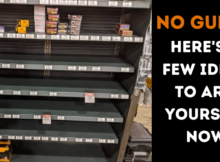
  • NO GUNS? Here’s a Few Ideas to Arm Yourself NOW

    NO GUNS? Here’s a Few Ideas to Arm Yourself NOW

    These are unprecedented times we find ourselves in and with civil unrest in many areas of the country and so much uncertainty much of the firearms and ammunition supply has dried up. While we can point fingers to all those that failed to stock up and prepare accordingly, that not very productive. So this article is dealing with the current situation NOW – not 6 months or 6 years ago. There are many who are just now looking to purchase a firearm. Available choices are slim.

    For those wishing to purchase a firearm for the first time here are a few ideas in no particular order:


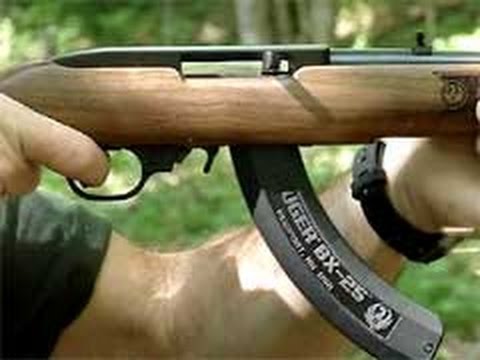
    .22LR Semi-Auto Rifle

    When it comes to self-defense the #1 rule is to be armed. Next – being able to hit your target while engaging the threat is a must. The topic of the .22LR being used for self-defense has been discussed numerous times. It’s not the best self-defense round. Everyone knows it. ‘Nuff said.

    Ruger, 22LR, 10/22, survival rifle, project, build,

    Why?

    Ruger 10/22’s are still available online for purchase and at some Wal-Marts and other sporting goods stores. They are inexpensive and immensely reliable. While .22LR ammunition has become more difficult to find, it is available and inexpensive compared to all other calibers. Magazines with capacities ranging from 10 to 25 rounds are readily available and can function very reliably.


    Shotgun

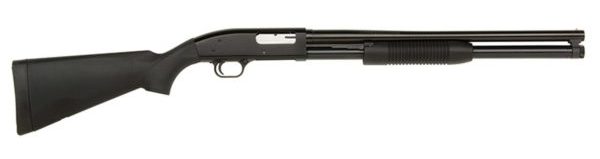
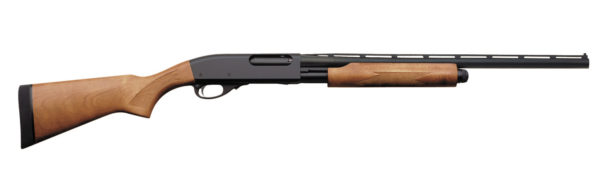
    Shotguns of various configurations are available from most gun dealers, online, and at Wal-Mart and other stores that carry firearms. The most versatile firearm made, the shotgun is an extremely capable firearm for medium to short distance self-defense. Shotgun ammunition is still readily available.


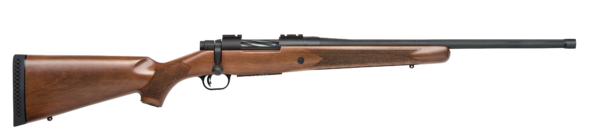
    Lever Action/Bolt Action Hunting Rifle

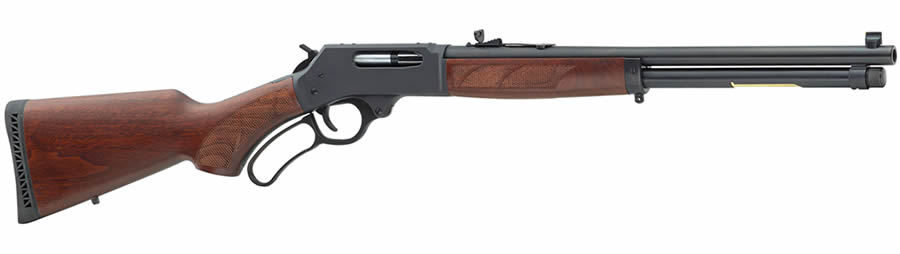
    Take a gander at your local gun shop long gun area and it will still be filled with lever action and bolt action rifles. These are most often looked at as hunting firearms. Lever actions have an advantage over bolt actions in reloading speed. This is the case for most people. Bolt actions generally have an accuracy advantage due to their longer barrels and better triggers.


    Numerous calibers in lever actions are available and include .30-30 Winchester as the most common. This ammunition can be found on shelves right now. Bolt actions can be found in a variety of calibers including .243, .270, and .308 which all can be found readily available in most gun shops.

    None of these are perfect for self-defense. Some have advantages where others do not. No pistol is represented. This is on purpose as most ammunition in pistol calibers have skyrocketed in price and are difficult to find.

    So – comment below. What would you recommend?

    Take care all!

    Rourke

  • Thoughts on the .22LR for self defense

    Thoughts on the .22LR for self defense

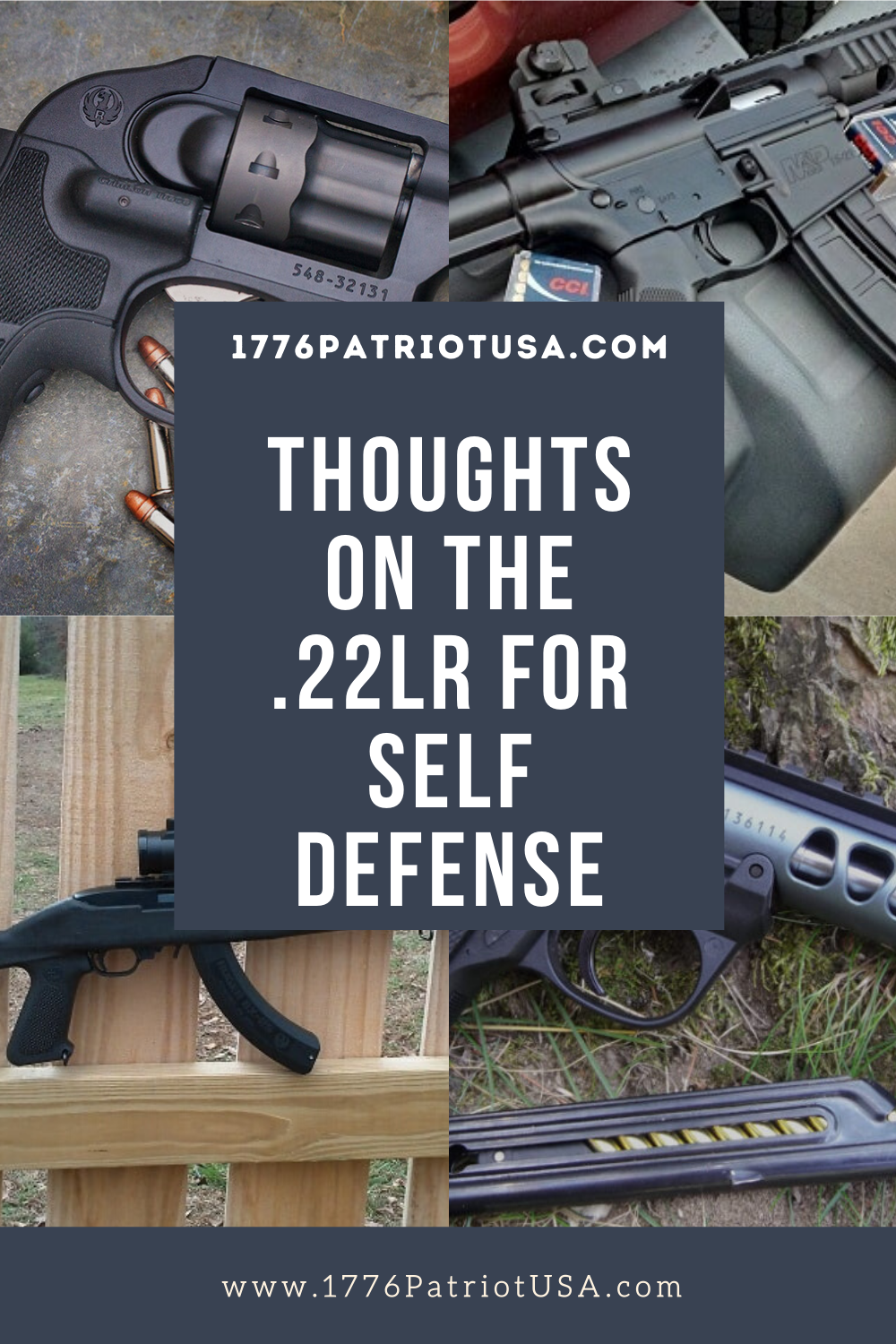
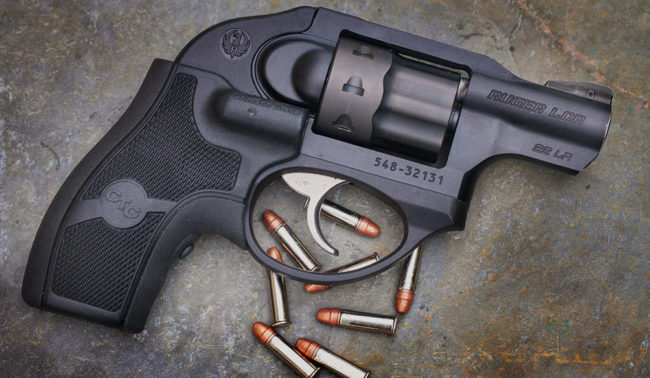
    I know – “Why would anyone in their right mind ever consider the .22LR for self-defense?” Using the .22 for self-defense is a frequently discussed topic and often creates huge augments.  I try to base my opinions on facts and logic with a dash of common sense thrown in.

    Here are a few thoughts:

    • An extremely high volume of .22LR rounds can be thrown down range upwards of 100 yards give or take – accurately.
    • Generally, most .22LR firearms are lighter than larger caliber firearms.
    • Semi-auto .22LR firearms are less reliable than their centerfire counterpart.
    • Many that are scared or apprehensive to shoot larger caliber firearms find it easier to shoot the .22LR – thus the “First rule of a gunfight is to have a gun.”
    • Many real-life self-defense encounter videos have the criminal element running at the first sight or sound of a firearm.
    • Statistics show that the .22LR provides a one-shot stop nearly 40% of the time.
    • Many .22LR firearms are less expensive than their larger-caliber counterparts. This increases the chances of actual firearm ownership.
    • While compared to other handgun calibers velocity of the .22LR is on par or even higher in many cases.
    • The mass of the .22LR is significantly less than typical self-defense calibers such as 9mm, 45ACP, and 40S&W.

    Let’s just cut to the chase – the .22LR is not the ideal round for self-defense whether at 7 feet or 70 yards. What it most certainly is is an option. It’s an option that in thousands of cases has worked – and in others, it hasn’t – just like every other caliber.

    Not everyone is cut out to be Rambo. Not to be sexist, however, it is typically women that are apprehensive to firing larger caliber firearms. .22LR’s? Usually not a problem once they actually get just a little trigger time. This is advantageous in that preparing for any defensive plan requires as many people behind a gun as possible – even if some of those guns are .22LR’s.

    lcr-22

    I’ll take my S&W M&P9 2.0 9mm or my Stag Arms 5.56 carbine over any .22LR any day. I’ll take my Mossberg Shockwave or my Ruger .45ACP Lightweight Commander as well. I would also prefer one of my M&P15-22’s loaded up with 25 CCI Mini-Mag’s over being unarmed every day of the week.

    Rourke

    Shop Palmetto State Armory for the best deals on .22LR firearms – and anything else you can think of.


    survival, preparedness, SHTF, library, digital, information, PDF, prepper, download

    [UPDATED for 2020]

  • Are there guns that are best for woman?

    Are there guns that are best for woman?

    There is no such thing as a handgun that is best for women.  Everyone regardless of gender has strengths, weaknesses, and preferences.  The old adage….“Just get her a revolver” is both an insult and dangerous. Far too often a woman walks into a gun shop with very little experience and is sold a revolver. I understand the concept, however, every owner of a gun should practice and train so they are capable – no matter the gender. Most women(and men) are perfectly capable of shooting Glocks, 1911’s, Sheilds, etc.

    So, why not treat a woman as a shooter rather than an incapable victim? The reason might be as simple as people are resistant to change. Come on guys, how many of us have dreamed of being the hero and saving the damsel in distress? To believe that women are just as capable of defending themselves may play physiological chess with your manhood, but it doesn’t change the fact that they are.

    The video below shows a competitive 13-year-old girl demonstrating that almost anyone with sufficient training can be very capable and proficient.

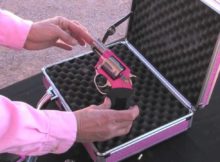
    Let’s stop recommending that cute pink pistol just to lure women into purchasing a firearm that is clearly not the best tool for the job.

    Now that I’ve stirred a hornets nest…bring it!

  • Hands On: Ruger SR1911 Lightweight Commander 45ACP

    Hands On: Ruger SR1911 Lightweight Commander 45ACP


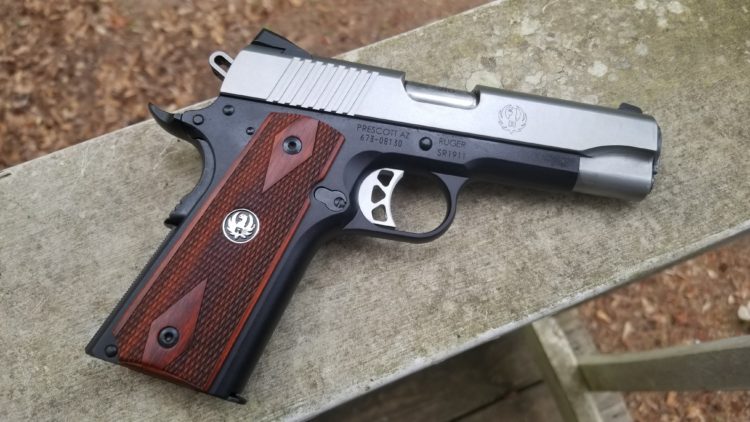
    With all the new offerings for defensive pistols on the market, one thing remains crystal clear: The 1911 is far from dead. Armchair firearms experts continue to boast the superiority of their choice thus deifying all others. OPtions are good and the 1911 has been a viable option for numerous decades. The reason why is obvious for those who have owned them. They are reliable, highly accurate, and shoot a cartridge that many feel is a superior manstopper.

    The most significant criticism that is fairly accurate for many is that 1911’s are heavy compared to polymer-framed pistols. Consider the Glock 17 9mm fully loaded at 32 ounces compared to a fully loaded full-sized 1911 coming in close to 44 ounces. When carrying as a duty weapon this weight may not be particularly significant. When carrying concealed and living everyday the extra weight may not be welcome.

    Enter the Ruger SR1911 Lightweight Commander.

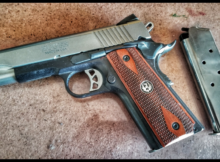
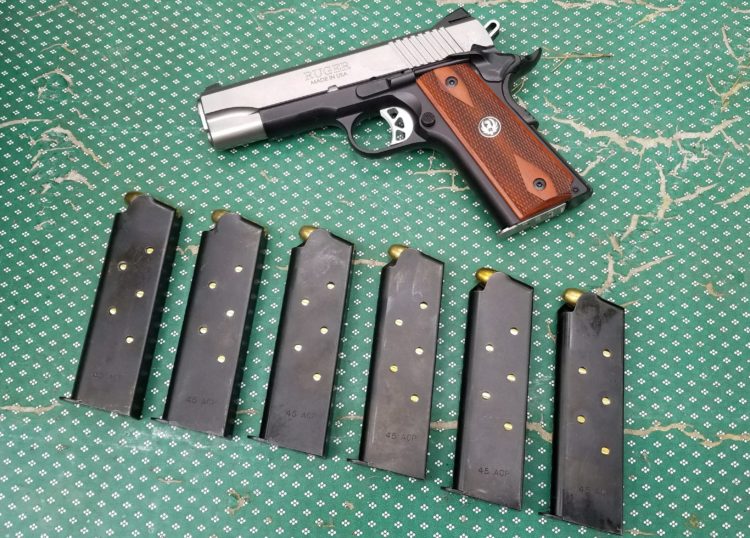
    Ruger, known for extreme reliability in their firearms, is producing the Lightweight Commander version of the 1911 with a slighter shorter barrel(4.25″) and an aluminum frame. This combination affords a significant weight reduction of close to 10 ounces. This is significant.

    Ruger 1911, Ruger, SR1911, Combat Commander


    Impressions

    Ruger, Combat Commander, review,

    Trigger: The aluminum trigger is skeletonized and adjustable. No adjustment was needed and it broke very light and crisp, which aids tremendously in the accuracy department

    Ruger, pistol, 45ACP, Combat Commander, SR1911

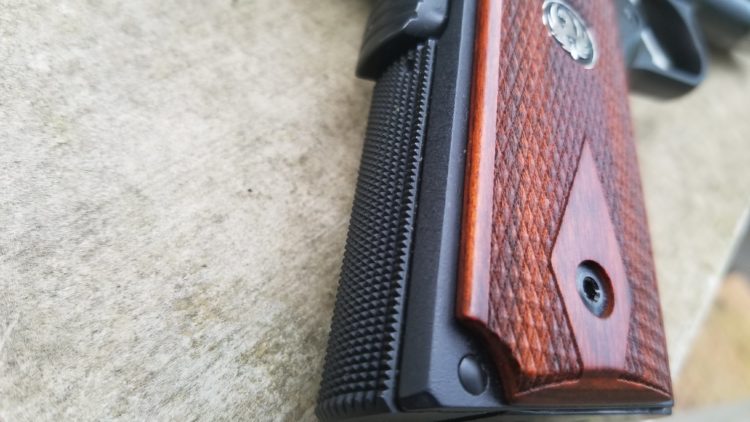
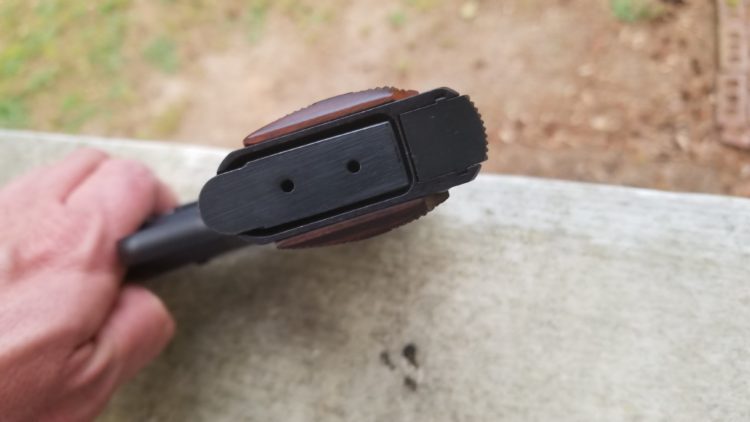
    Mainspring Housing: The mainspring housing is heavily checkered aiding in retention and control of the weapon.

    review, Ruger SR1911, 45ACP Combat Commander

    Magazine Well: The magazine well is beveled providing extra space to facilitate magazine insertion. It works well.

    Ruger SR1911, Ruger, 1911, Combat Commander, 45ACP, review

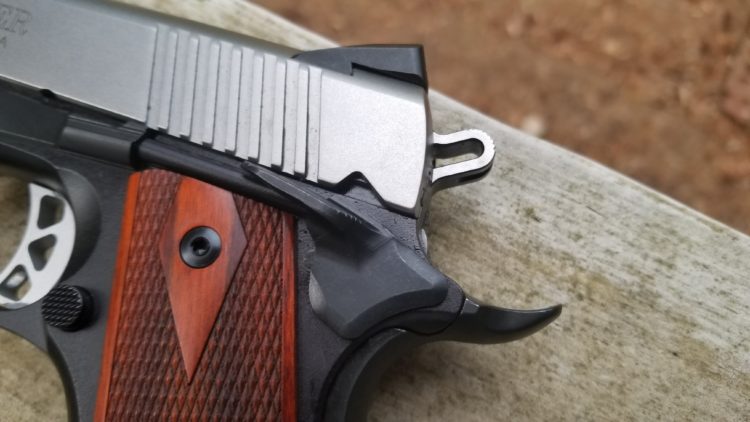
    Thumb Safety/Hammer: The thumb safety is sized perfectly to provide easy manipulation and clicks on and off very positively. No issues. The hammer is skeletonized with excellent cocking serrations.

    Ruger, 1911, 45ACP, SR1911, Combat Commander, review

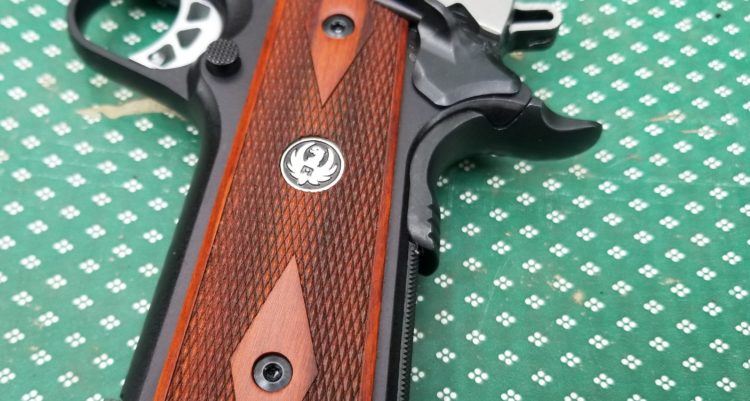
    Beavertail Safety: The oversized beavertail safety makes for a very comfortable grip and positive function.

    Ruger, 1911, pistol, review, Combat Commander

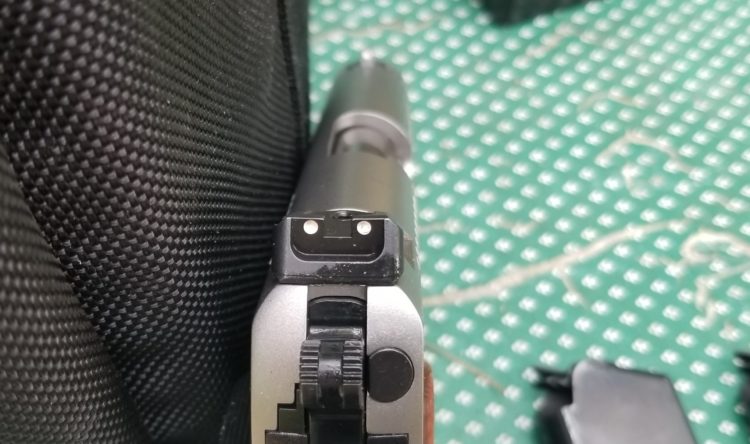
    Sights: The sights are excellent and are the 3-dot variety with smooth edges to reduce snagging.

    Ruger, 1911, SR1911, 45ACP

    Misc: The stainless slide contains deep serrations rearward to assist in cocking. The ejection port is enlarged and flared for positive ejection. The grip feels very nice however I may try some Magpul TSP grip panels or maybe a set of wrap-around Pachmayr’s. The feed ramp is titanium ensuring positive feeding for years to come.


    At the Range

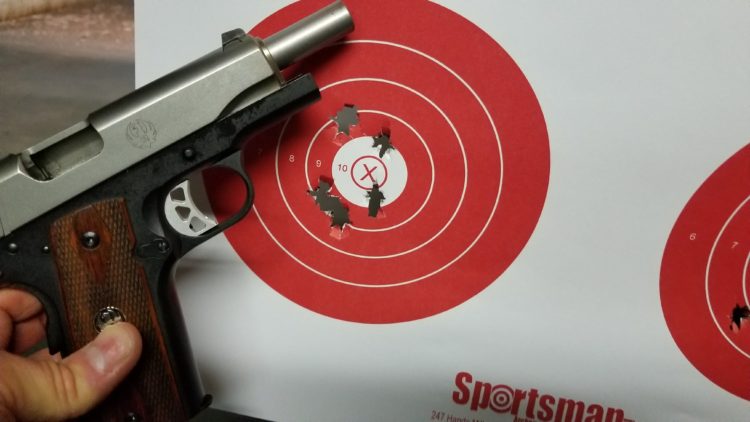
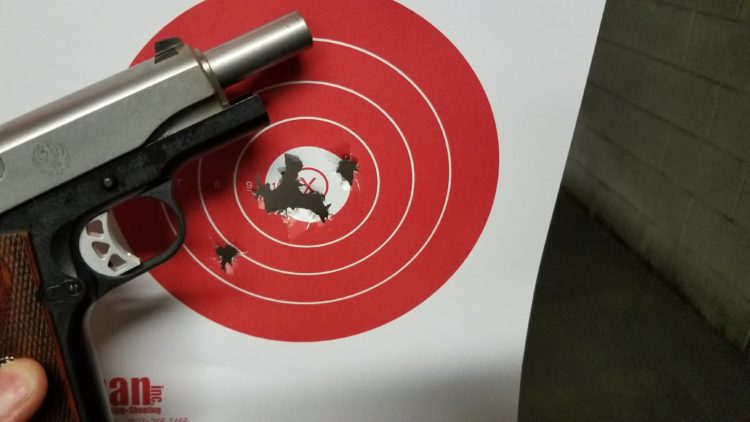
    Let me cut to the chase and just state for the record this thing shoots awesome. It has been 100% reliable, super accurate, and a joy to shoot. I do not proclaim to be the best pistolsmith however its inherent accuracy utilizing tight tolerances and fit combined with a great trigger makes me look better. I have no doubt in a better shooters hands it will perform much better.

    range test, Ruger, SR1911, 1911, 45ACP

    Above: 7 shot group from 7 yards. Yes – I know 7 shot groups are a bit unusual.

    Ruger Lightweight Commander, review, pistol, 45ACP

    Above: My best 7 shot group from 7 yards. My 7th shot was the flyer.

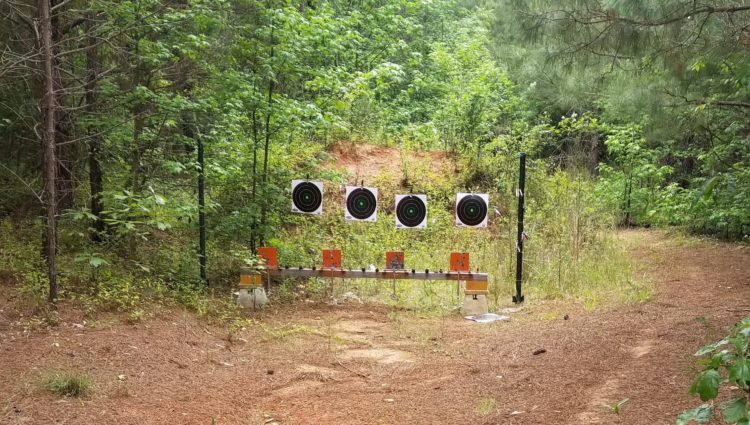
    Above: My brother’s range. At around 30 feet I was easily able to hit the orange metal plates round after round with fairly rapid shooting.


    What ammunition did I shoot? Monarch brass 230-grain ball and an assortment of Federal and Winchester White Box ball. No hollowpoints as of yet.

    Summary: This is an excellent carry pistol and very capable of putting rounds on target accurately and repeatedly. It’s lightweight makes carrying a bit more comfortable than a regular full-sized 1911. Excellent fit and finish make this an attractive self-defense solutions running a street price of around $800.

    line

    Support 1776PatriotUSA in 3 Simple Steps……

    1.  Click on any Amazon link.

    2.  Purchase any item at no additional cost to you.

    3.  Accept my humble “Thank You!”

    Amazon-Logo-schwarz

    Amazon Camping & Hiking

    Amazon Backpacks and Bags

    Amazon Hunting and Fishing

    Amazon Hunting and Survival Knives

    Amazon Tactical and Defense

    Amazon Shooting Supplies

    Amazon Survival & Preparedness Supplies

    line

    Don’t forget to vote for this website over at the Top Prepper Sites. Click HERE to vote.

    vote

      *    *    *    *    *    *    *    *    *    *    *

    Recommended reading for every Patriot? 

    Untitled design (8)

  • Marlin 336W .30-30 Lever Action Rifle Review

    Marlin 336W .30-30 Lever Action Rifle Review


    With the large selection of modern semi-auto “black” rifles such as the AR-15 and AK-47, the lever action is rarely discussed. Although many would argue there is little reason to consider a lever action in .30-30 Winchester with the availability of low-price semi-auto’s – options are a wonderful thing. As stated in the video there are numerous areas around the country where semi-auto, magazine fed weapons are illegal. The lever action in those areas would be a good option. Besides – there are a lot of uses for firearms than just self-defense.

    Growing up it was common to see pickup trucks with rifles mounted in the rear window. More frequently than not at least one of those rifles was a lever action and the other a shotgun. Sometimes called a “truck gun”, the lever action certainly attracts less attention from people than an AK-47.

    While there are pro’s and con’s to the design, function, and ergonomics of the lever-action – it is found in thousands of gun safes all across the United States.

    I wonder how many deer have been harvested with lever actions?

  • Panhandle Rancher: Living with the Model 1911 Caliber .45ACP Pistol [Part 1]

    Panhandle Rancher: Living with the Model 1911 Caliber .45ACP Pistol [Part 1]


    Living with the Model 1911 Caliber .45ACP Pistol

    By Panhandle Rancher


    Warning: the following article is intended to provide an overview on the safe handling of the M1911 series caliber .45acp semi-automatic pistol. This article is not a substitute for professional hands on instruction, which the shooter must have before proceeding to load and safely handle this weapon.


    Introduction

    Many consider the Browning designed Colt Model 1911 (named from the year adopted by the US Government) semi-automatic, short recoil pistol, chambered in .45ACP (Automatic Colt Pistol) the finest combat pistol of all time. Others have a love/hate relationship with this venerable weapon but all recognize that it is a war proven man stopper. Over the decades, this fine weapon has been gradually improved and streamlined however the fundamentals of operation and safe handling remain unchanged.
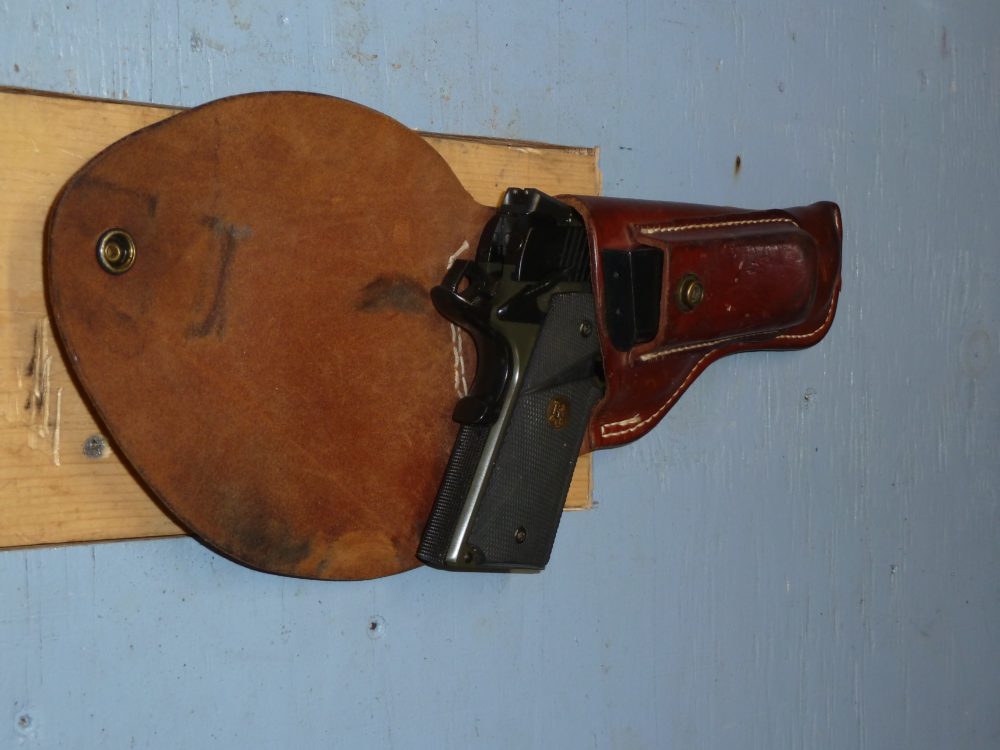
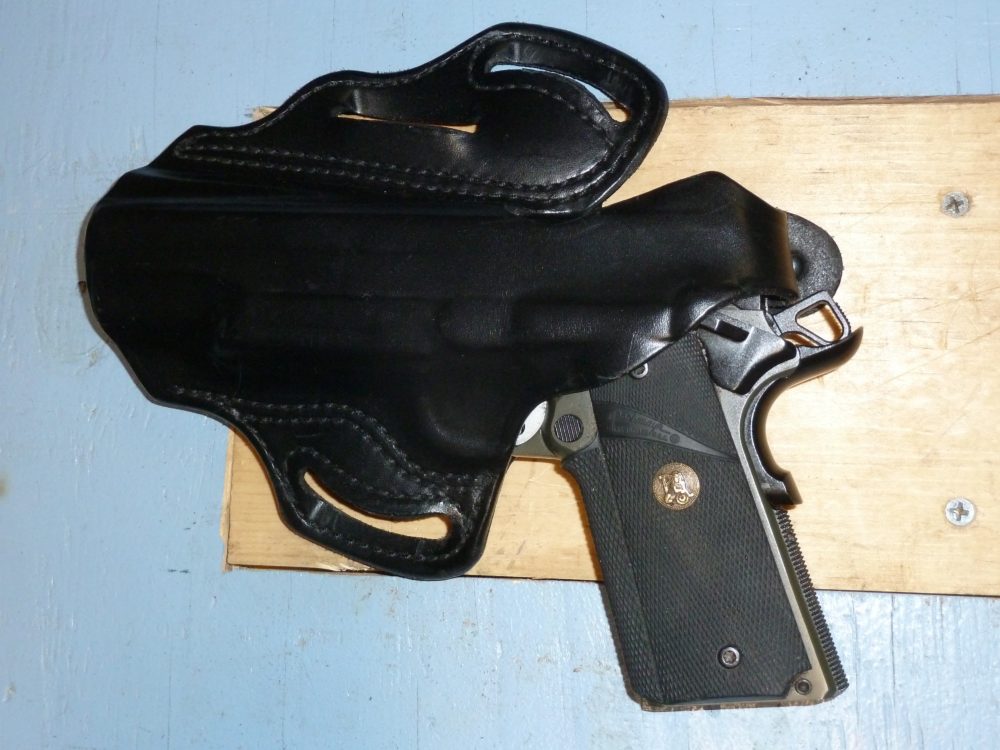
    US Government service in a three-letter organization provided me with some of the very best training in fighting techniques with handguns. Several things happen over the course of years and even decades when shooting from an unending box of ammunition: one becomes smooth and in so doing speedy, accuracy improves dramatically, and one learns what really works and what does not. Speed and smoothness of use come naturally with time and if rushed, all sorts of unintended consequences may follow, perhaps even lethal. Concentrate on always handling weapons in measured, controlled, and smooth manner without jerkiness or overt abrupt motion. Proper practice over a period of time will produce speed of deployment as a byproduct of safe handling and shooting.


    This article will discuss how to make certain a 1911 series pistol is actually safe for the shooter to handle, how to almost completely eliminate the possibility of an accidental discharge (based upon decades of being around pistolarios professional to gang banger), and will offer suggestions on the carry, shooting, and cleaning of this century-old weapon design.


    The reader may have been trained by the military or in a law enforcement academy and consider himself or herself an expert with this weapon. Due to the long period of time it has been in use, a number of bad and even dangerous handling and shooting techniques have been taught. Regardless of your experience level with this or any other handgun, I urge you to read this article in detail. Comments, observations, and suggestions are always welcome and I look forward to hearing from you.


    Shooters in the United States have a wide selection of handguns from which to choose. A choice right for one may be awful for another. The frail or weak may be better off with a revolver as manipulating a pistol slide demands both a measure of strength and dexterity. The small-handed shooter of normal strength may be better off with a revolver or pistol in a smaller caliber, as these weapons tend to have a smaller sized handgrip. For those with normal sized hand and strength, the 1911 has long proven to be a superb combat weapon. With proper training and experience, this pistol is capable of exceedingly fast deployment, great reliability, and awesome accuracy.


    Some nomenclature

    Modern handguns fall into broad categories, break action, revolvers, pistols, and short barreled rifles meeting the legal definition of a pistol. Some handguns have even been manufactured that are bolt action (Remington XP-100, the first I believe in that third category), single shot break action (the Thompson Contender) and others made from shortened double barrel shotguns, another type of break action.


    A double action trigger pull is long and heavy; the single action trigger pull is short and light. Revolvers are generally fed from a revolving cylinder and can be both double action and single action as in the S&W Model 10, or single action only as in the Model 1873 Colt Single Action Army (SAA), also known as the Peacemaker and ‘the gun that won the west.’ This revolver is often chambered in .45 Long Colt.

    Pistols are generally magazine fed, self-loading, and semi-automatic in function.  Pistols may have an external hammer, an internal hammer, or striker. They may be double action only, double action on the first shot and thereafter single action (the SIG P220 for instance), or single action only, such as the Colt 1911 series pistol.


    Both the Model 1873 Colt SAA revolver and Browning-designed Colt Model 1911 semi-automatic pistol (and variants) are known colloquially as ‘Colt .45s,’ These two handgun models are generally chambered for two non-interchangeable .45 caliber cartridges of approximately the same power. This article will focus on the pistol.


    Each of these handgun action types were designed to fit a particular need. Each has distinct advantages and disadvantages. Some handgun designs such as the 1911 may require more training in safe handling than other designs but generally provide a perceived advantage as a combat weapon. The ability to safely carry a modern 1911 with round chambered and hammer cocked coupled with a light single action trigger makes this pistol a very fast first round on target weapon.


    Safe handling of the 1911

    So then, how does one handle the 1911? The glib answer is with care. The shorter any firearm in overall length, the easier it becomes to inadvertently point the muzzle on a partner, bystander, treasured animal, and/or valuable inanimate object. Accordingly, more accidents seem to occur with pistols than with rifle and shotgun.


    The 1911 pistol is a single action only self-loading, magazine fed, semi-automatic characterized by a very light trigger; and although capable of single action firing, revolvers are primarily double action with long and heavy trigger pull. If your finger is on the trigger of a 1911 at the wrong time with safety off, this weapon is ready to discharge, and all too often with sad and sorry result. It is one thing to deliberately and with witting intent, take pistol in hand with the intention of ending a human life. It is quite another to take pistol in hand and accidentally wound self or worse, kill your spouse or child. Each has serious ramifications but the latter, oh the unending and mournful grief.


    The first three rules of safe firearm handling enumerated below are often heard and stand the test of time. The fourth rule is based upon personal experience and if followed along with the preceding three rules, should completely eliminate the possibility of an accidental discharge.


    Rule One: Don’t point the muzzle of a pistol or any other firearm toward anything you don’t intend to shoot.


    Rule Two: Keep the slide safety (sometimes called the manual safety, slide lock safety, or thumb safety) engaged and your trigger finger outside of the trigger guard until ready to shoot.


    When under stress of imminent combat these first two rules are paramount.


    Many 1911 series pistol platforms are not safe with hammer down and round chambered. An unexpected blow on the lowered hammer with a round in chamber may cause a predictable loud noise. Accordingly, the modern 1911 can be safely carried in a holster with round chambered, slide safety engaged, automatic grip safety engaged, and hammer cocked. One has only to draw, unsafe the weapon, and fire. If the pistol is always maintained in a cocked and locked condition with chamber loaded, there is never a doubt of the lethal status of the weapon.


    Always keep that trigger finger outside of the trigger guard and slide safety engaged until ready to fire. Haste coupled with an awkward position, for instance sitting in an automobile or laying prone on the ground, makes it very easy for a finger to accidentally come in contact with the trigger when drawing and holstering. Make absolutely certain the slide safety is engaged and the trigger finger outside of the trigger guard until ready to fire.
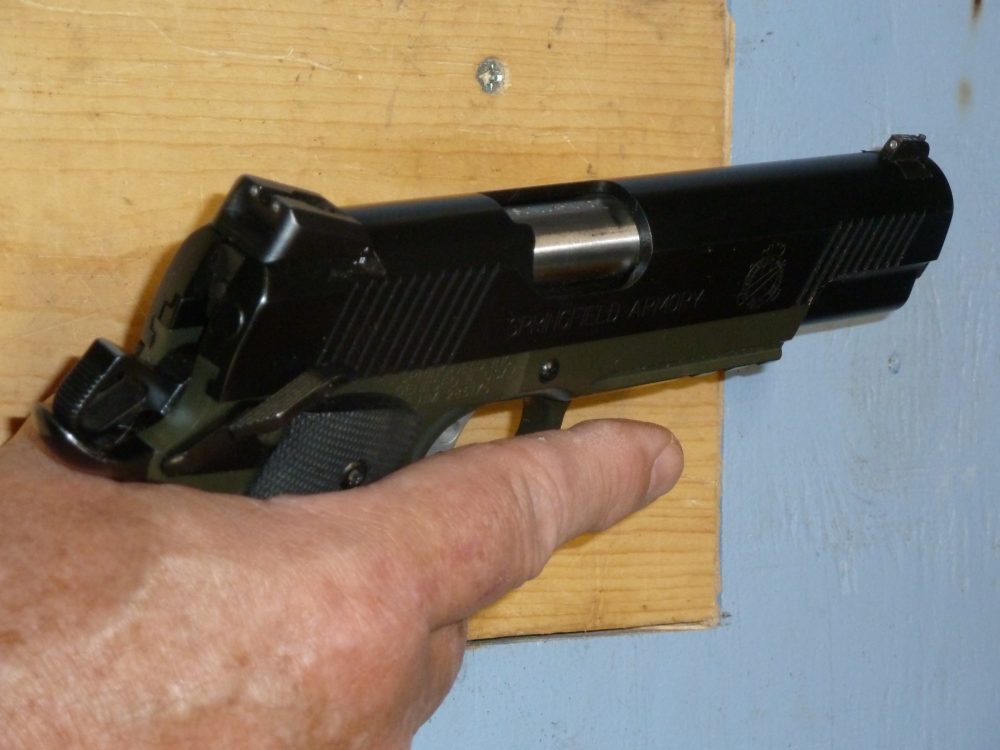
     [finger outside of the trigger guard, slide safety engaged]


    Rule Three: Accidental and unintended discharge commonly happens with the so-called ‘empty’ weapon. Always, always make certain the pistol is empty, magazine removed, and no round chambered, before handling for any purpose other than to intentionally discharge the weapon.


    Rule Four is a partial safeguard when Rule Three is disregarded: After shooting and cleaning the pistol, load the magazine, chamber a round, activate the slide safety, remove the magazine, top with an additional round, reseat the magazine in the pistol gently until it latches, and holster the weapon. DO NOT handle the weapon outside of its holster again until intentionally intending to shoot. Following this and the preceding rules should almost eliminate the possibility of a handling related unintentional discharge. It should go without saying that alcohol and many drugs, over the counter, prescription, and illegal, make handling and shooting of any firearm exceedingly dangerous.


    Rule Four necessarily includes a prohibition against dry firing.  Dry firing, or snapping the hammer on an empty chamber or one with a chambered dry fire cartridge made for this practice, has probably been the cause of more unintended discharges than from any other form of weapon handling. Dry firing has long been advocated as a method of developing trigger and weapon control however when this practice is regularly engaged in, that unexpected loud noise is occasionally heard. This happens with experienced target shooters and trained police. An innocent woman was recently killed by a policeman wielding an ‘empty’ weapon during a police academy practice exercise, http://www.latimes.com/nation/nationnow/la-na-police-academy-exercise-death-20160810-snap-story.html.


    The only really safe way to practice tactics involving pointing a firearm at other people is to have the firing pin removed and a quarter inch in diameter gas relief hole drilled in the barrel just after the chamber!


    How to safely ensure the 1911 is unloaded

    Withdraw the weapon from the holster and ensure the slide safety is engaged. Keep the trigger finger outside the trigger guard and point in a safe direction. Remove the magazine, empty if necessary, and ensure the magazine contains no ammunition. Re-insert the empty magazine into the pistol, and snick off the slide safety. Hold the weapon in your strong hand. If you are right-handed, the thumb on your right hand will lay alongside the left hand side of the pistol handgrip; if left handed the thumb of the left hand will lay alongside the right hand of the pistol handgrip [see photo’s below]. Some pistols have friction ridges toward the muzzle. The same technique is used with the forward ridges however care must be used to ensure no body parts extend beyond the muzzle. Lefties using the forward friction ridges have their right hand palm ready to catch an ejected round.
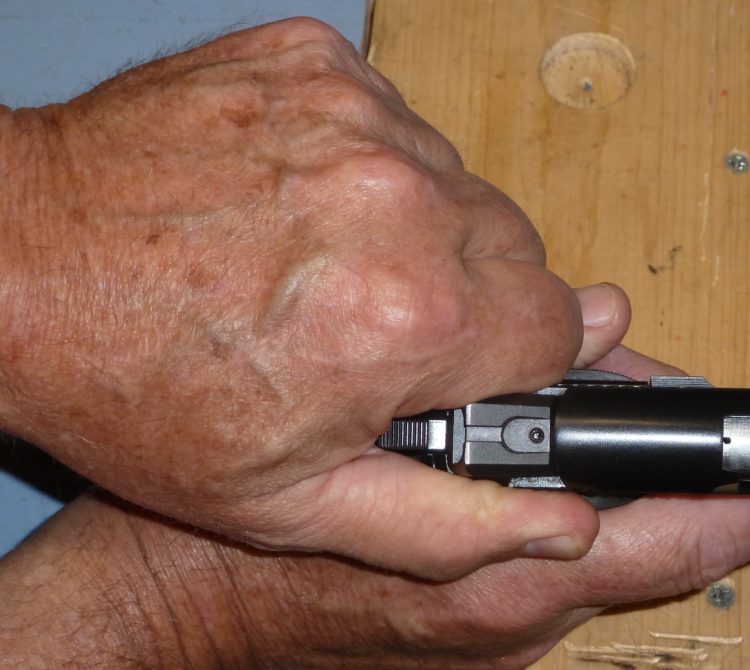
    [right-handed]
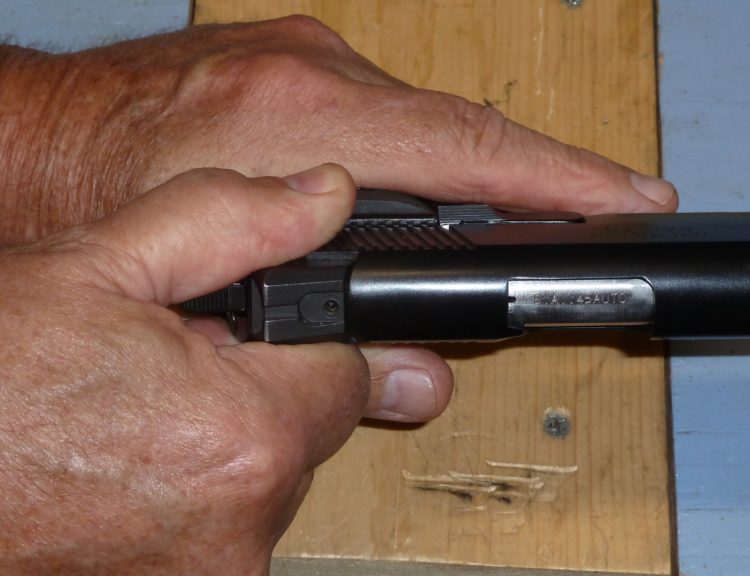
     

    [left-handed]

    Pointing the pistol in a safe direction and with trigger finger remaining outside of the trigger guard, pull the slide to the rear until it locks back. The empty magazine follower should automatically engage the slide hold open locking mechanism. Verify the chamber is clear and remove the magazine. The weapon is now safe for handling and if necessary can be disassembled for cleaning. With a little practice and dexterity, it is possible to engage the slide hold open mechanism with the right hand thumb. This is however not recommended for unloading the pistol because if a loaded magazine is seated and the slide accidentally slips from the fingers of the weak hand, a round will chamber.


    Resist the urge to slam seat the magazine into the grip well. This practice is often dramatically depicted in the movies to emphasize determination and if followed religiously, is guaranteed to eventually deform magazine feed lips, damage the magazine latching notch, and cause damage to the magazine latching mechanism of the pistol. Any of which conditions can cause ammunition feed problems with predictable jams. Gently, press the magazine into the grip well until seated properly. This is always more difficult with a full magazine. A telltale click of the magazine latch will accompany proper magazine seating. Tug on the extending forward edge of the magazine floor plate to ensure the magazine is fully seated and locked into place.
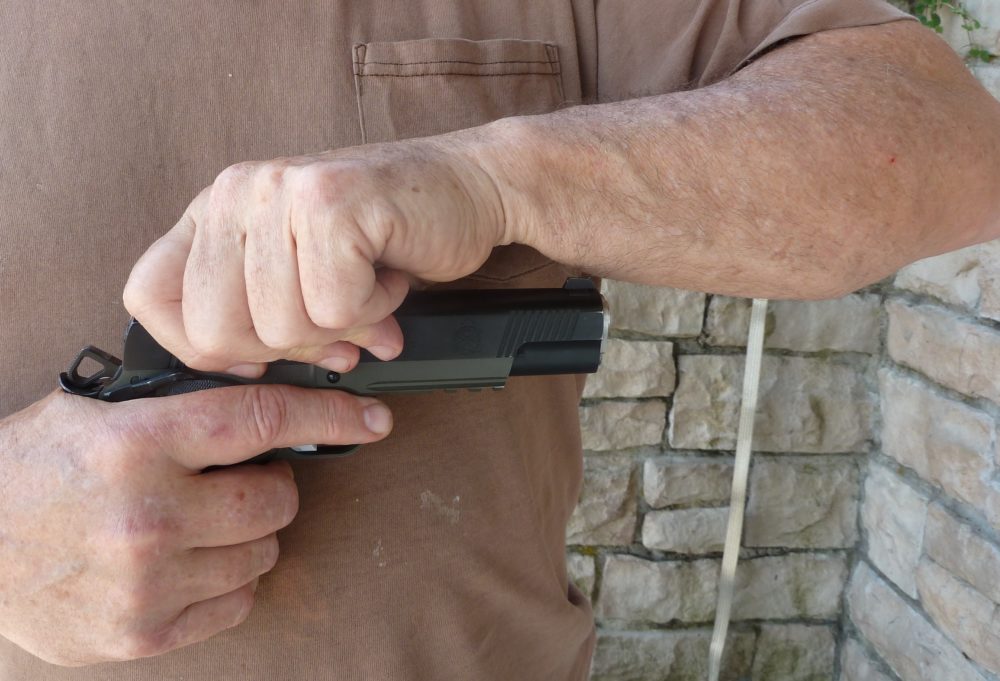
    [showing improper technique]

    A commonly seen loading and unloading technique begins by holding the pistol in the right hand with muzzle pointing to the left. The slide is covered in the top middle with the left hand, gripping the side between the fingers and thumb/palm. This method is dangerous and should never be used. This technique requires the shooter’s left and right thumbs to be on the same side of the slide, pointing in opposite directions. The left hand covering the slide makes it difficult to observe and control muzzle direction. The ‘cover the top of the slide’ technique even when properly executed obstructs the shooter’s view of a large part of the barrel orientation and points the muzzle in a lateral more difficult to observe orientation with muzzle often aligned with the shooter’s left underside forearm.


    Another popular combat taught technique is similar but with the pistol muzzle pointing forward with the rear half of the slide gripped between the fingers and palm of the other hand. When executed properly this method is safe. We, however, have a lifetime of gripping objects using our opposing thumb and fingers and many find the finger/palm approach unrealistic and unnatural.
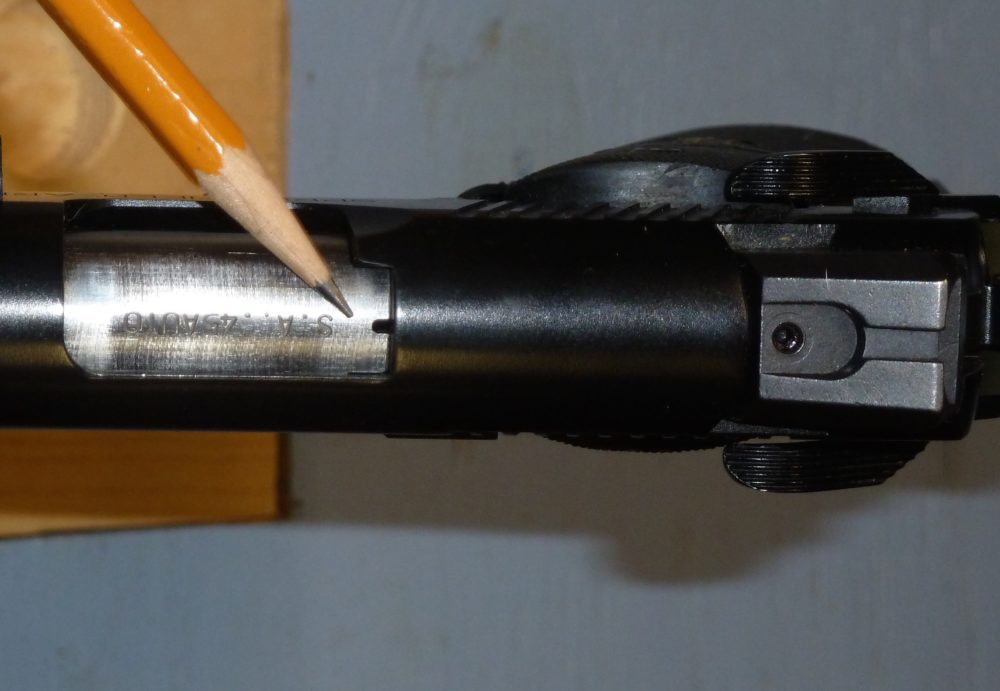
    [witness slot]

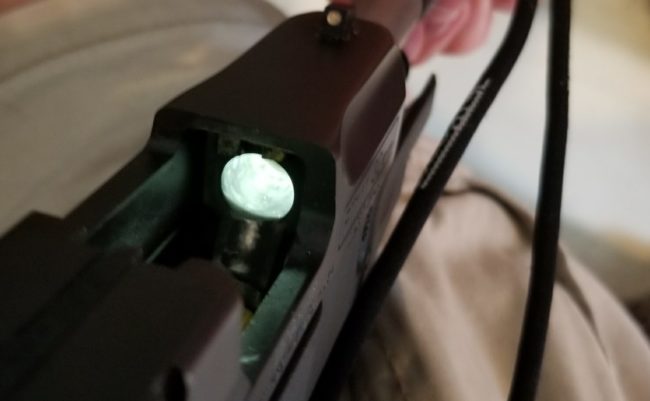
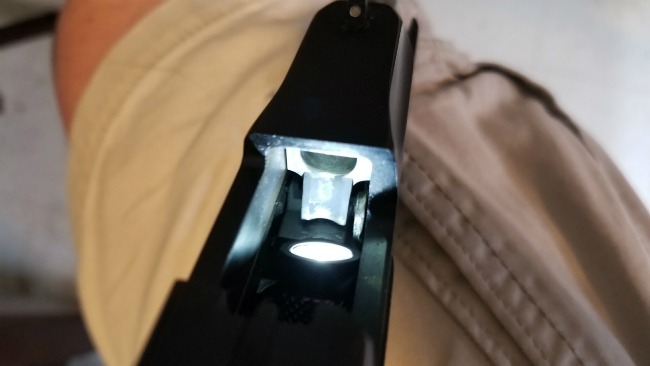
    Some 1911s have a loaded chamber indicator or witness slot in the rear of the barrel. The former may be as simple as an extractor protruding from the outside rear barrel area indicating a round is chambered, and the latter, a small slot milled in the breach end of the barrel allowing a portion of the rim of a chambered round to be seen. If your weapon has either type loaded chamber indicator, make checking of the witness device a routine practice, especially when handling an unfamiliar weapon. If your weapon is always maintained in a locked and loaded condition, then there is no need to ever perform a press check or to be uncertain as to whether a round is chambered.


    Why use both thumbs facing toward the muzzle technique of slide manipulation?

    The body is biomechanically more suited to rack the slide while holding the weapon with left and right thumbs pointing in opposite directions on the same side of the slide. This method makes use of opposing large chest muscles. You probably have done this in the past or observed others doing so. This points the weapon laterally across the body, sometimes toward the left forearm and usually to the left hand side for right-handed shooters. This potentially aims the muzzle toward a partner or other bystander and certainly not in the normal direction the eyes are pointed. Racking the slide in this manner to either chamber a round or to remove a round from the chamber absolutely ensures that it is difficult to track where the muzzle is pointing because the barrel and muzzle are hidden below the left hand and forearm.


    Safe slide manipulation as described earlier with thumbs pointing in the same direction but on opposite sides of the pistol ensures the weapon is pointed at least somewhat forward with muzzle oriented in an easily seen and highly controllable direction. This action is more difficult bio-mechanically and thus not commonly seen. Make this both thumbs forward on opposite sides of the pistol technique a habit whenever racking all semi-automatic pistol slides. It will become easier with practice. This method is depicted in the operator’s manual from Springfield Armory http://www.springfield-armory.com/wp-content/uploads/2014/03/1911Manual_5.pdf pages 21, 33, and others. Unfortunately, a dangerous method of uncocking the hammer of older model 1911s is shown on the same page (a safe technique for all 1911 models is described following).


    Strive never to allow the slide to slam shut if not stripping a round from the magazine into the chamber. Doing so can cause damage to frame, slide, and sear, potentially wrecking a good trigger. Chambering a round from the magazine reduces slide forces to design thresholds. An exception to this rule follows.


    How to test the 1911 for proper operation and safety functionality

    The modern 1911 pistol can be safely carried with chamber loaded and hammer cocked only because of multiple redundant safeties and proper training with the pistol. The correct function of these safeties should always be verified after field stripping and cleaning.

    1. Ensure the pistol is unloaded following the previous instructions.


    1. With empty chamber and magazine removed, ease the slide forward into battery. Holding with a normal one-handed grip, point the pistol in a safe direction and squeeze the trigger. The hammer should drop.
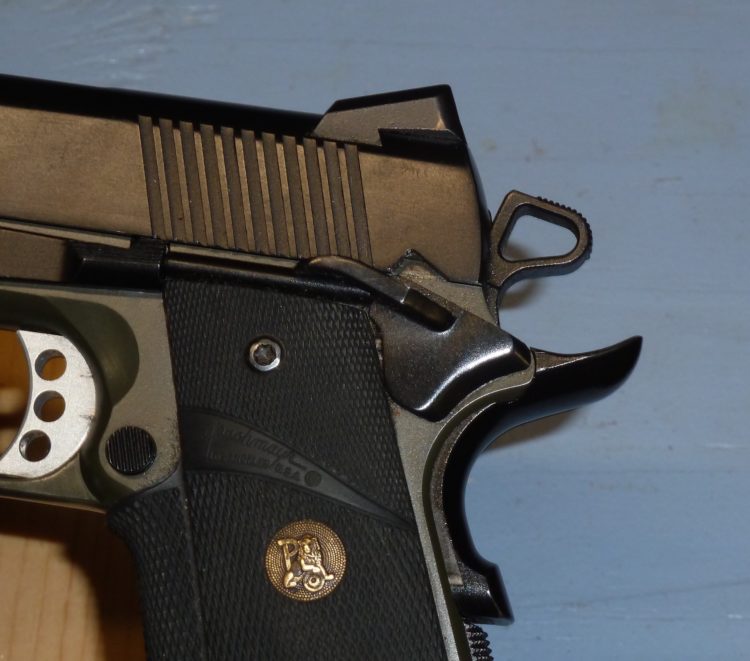
    [hammer in half-cock]

    1. Testing the half-cock sear notch. Point an empty pistol in a safe direction. With the slide forward and hammer down, ease the hammer back toward the cocked position stopping after the first click. With safety off, grip the pistol normally and while still pointing in a safe direction, squeeze the trigger. The hammer should not drop out of the half cock position. The Colt Mark IV Series 80 model introduced after 1983 will drop the hammer but with reduced force supposedly insufficient to actually fire a round. Series 80 1911s also have a firing pin block safety with internal levers and a plunger to positively block the firing pin from moving until the trigger is pressed. The pistols also have a redesigned half cock notch eliminating the possibility of the weapon firing if the hammer is struck. Other modern manufacturers of 1911s have incorporated some or all of these features and if so, should be described in the operator’s manual. The half cock sear notch is designed to catch the hammer should it slip while being lowered and is not intended as a normal carry position.
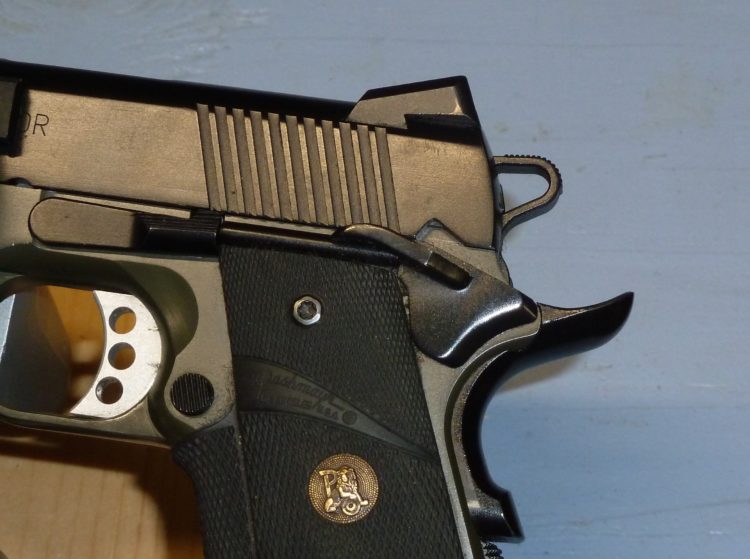
    [Pistol hammer completely lowered]

    There are many older design 1911 pistols in circulation. Treating every 1911 as if it were of the old style avoids a multitude of problems, especially when handling an unfamiliar 1911 series pistol.

    1. Sear reset test. Point an empty pistol in a safe direction and with hammer down, pull and hold the trigger. Pull the slide back and engage the slide hold open mechanism. Press down the slide hold open mechanism permitting the slide to slam into fully closed battery onto an empty chamber. Yes, this might cause damage as pointed out earlier but easing the slide down will not provide enough of a shock to fully test the sear reset mechanism. With the slide now in battery, the hammer should remain in the cocked position created when the slide was pulled back. Release the trigger and pull. The hammer should fall normally. If the hammer fell automatically following the slide closing, a dangerous situation exists that may permit full and likely uncontrollable automatic fire. Do not shoot the pistol until the sear reset is repaired to full functionality.
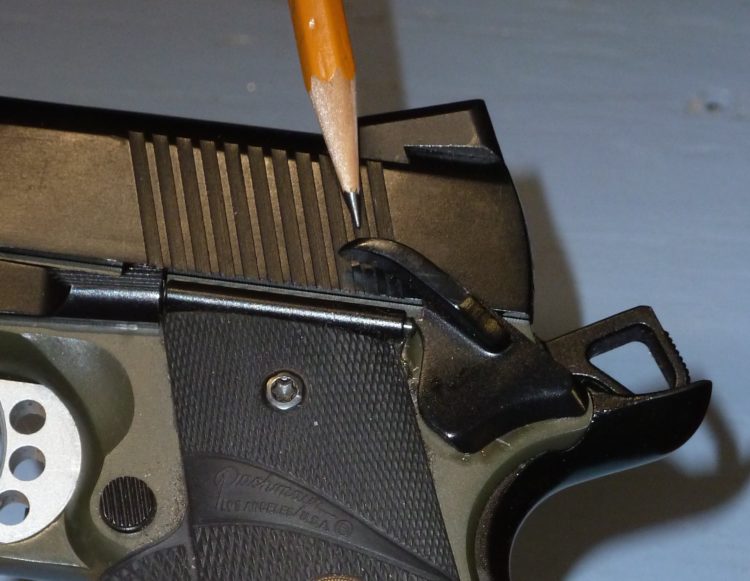
    [slide safety fully engaged]

    1. Slide safety test. Hold the empty weapon in the right hand, slide closed and hammer cocked. Pointing in a safe direction, engage the slide safety. Still holding the weapon as if to fire, squeeze the trigger. It should not move much if at all. The normal shooting handhold automatically disengages the grip safety yet the hammer should not fall due to the action of the slide safety. Other than a very slight movement of the trigger, no perceived movement of any mechanism should occur within the pistol. Grip the rear friction ridges of the slide with the left thumb and outside first finger (thumbs on each hand are pointing in same direction on opposite sides of the pistol). Try to pull back the slide. It should not move. Squeeze the trigger again and release. Disengaging the slide safety should not cause the hammer to drop.
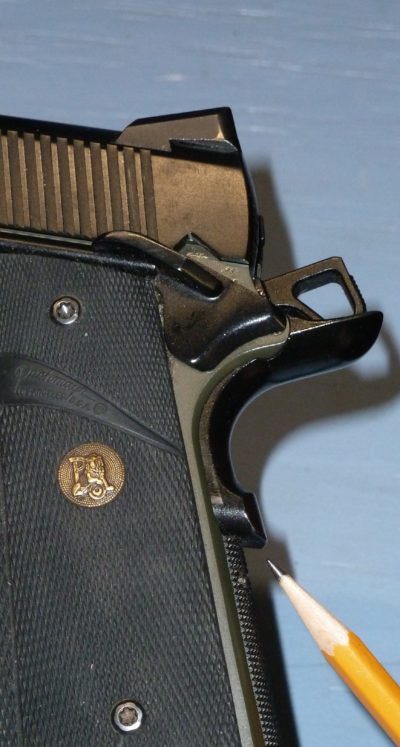
    [grip safety disengaged]
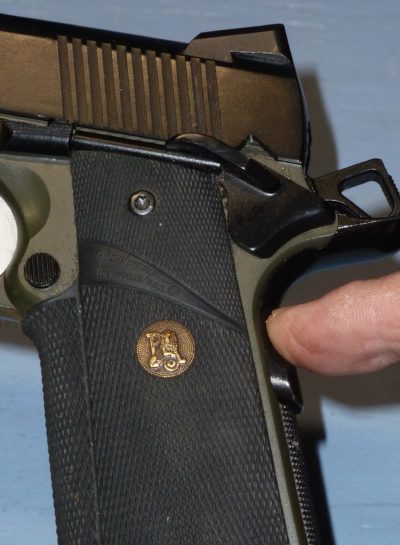
    [grip safety engaged]

    1. Grip safety test. With the empty weapon pointed in a safe direction and slide safety off, cock the hammer. Reposition the holding hand so as to disengage the grip safety [see photo’s above]. Squeeze the trigger. It should either not move or move very little. The hammer should not fall.
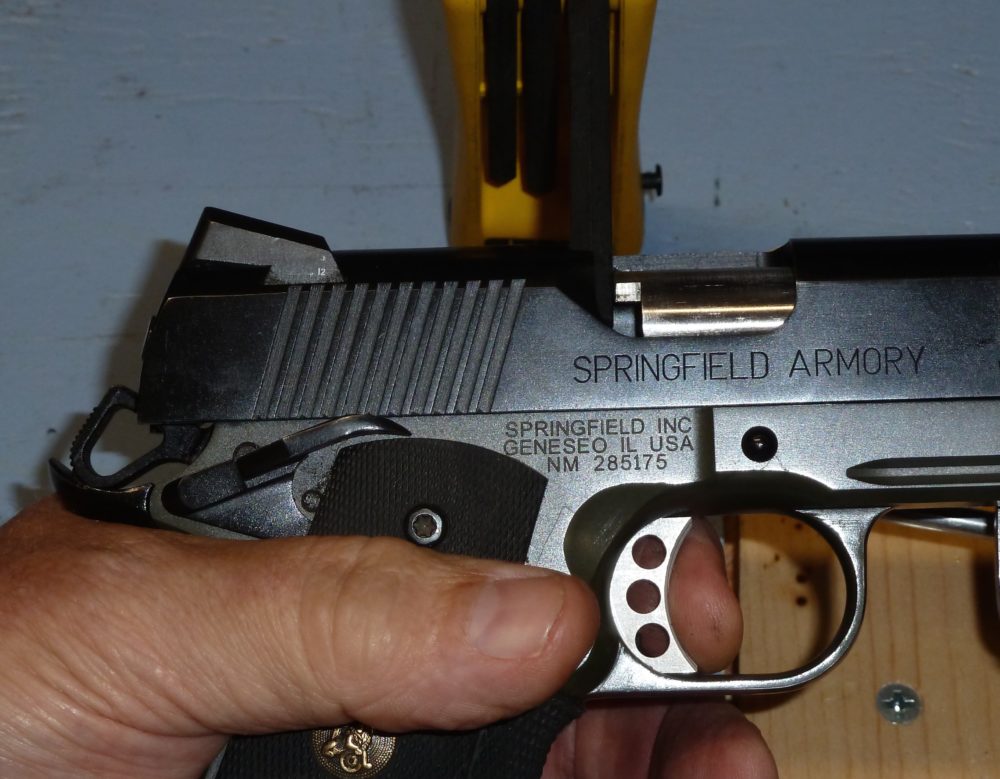
    [safety disconnector test]

    1. Safety disconnector test. With an empty weapon pointed in a safe direction, manipulate the slide ¼” back out of battery. The grip safety should be off (pressed into grip). The slide safety mechanically cannot be engaged. Squeeze the trigger. The hammer should not drop. Ease the slide forward, squeezing the trigger in increments of slide movement. The hammer should not drop until the trigger is pulled with slide closed in battery.
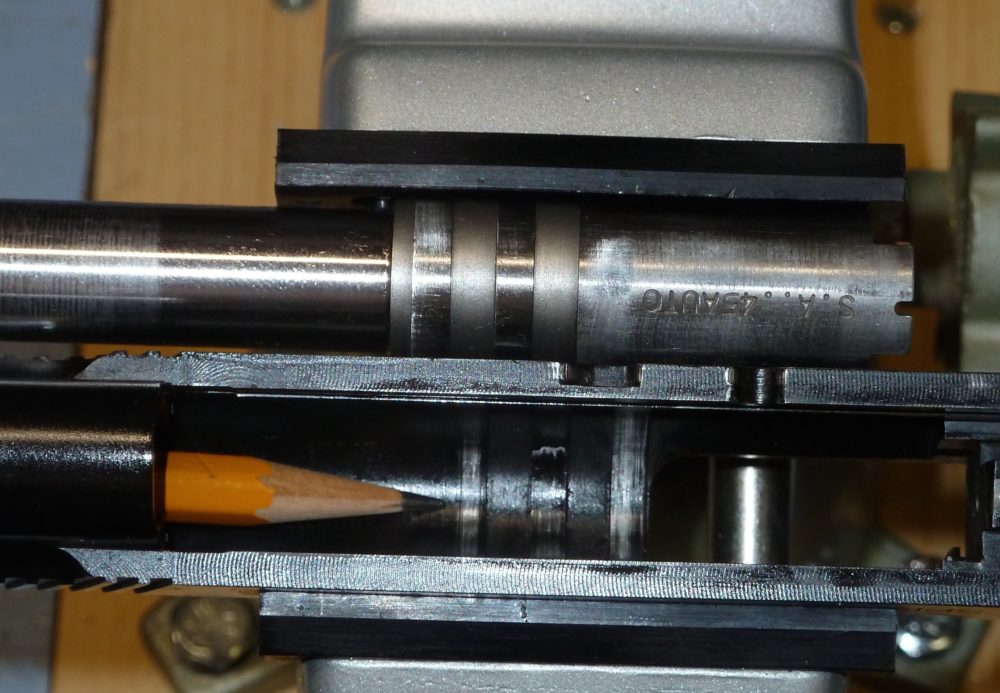
    [interlocking barrel and slide ridges that lock the barrel to the slide]

    1. Barrel lock engagement. With an empty pistol pointed in a safe direction, slide fully forward in battery, with grip and slide safeties disengaged, forcibly push down on the exposed area of the chamber. There should be very little or no movement. Keeping as much of the body as possible out of the path of the barrel, try to push the barrel back into the slide. Again, there should be very little or no movement. A lot of movement in either of these tests indicates that the barrel is not locking up with slide in battery. Firing the weapon in this condition may damage the weapon and shooter.
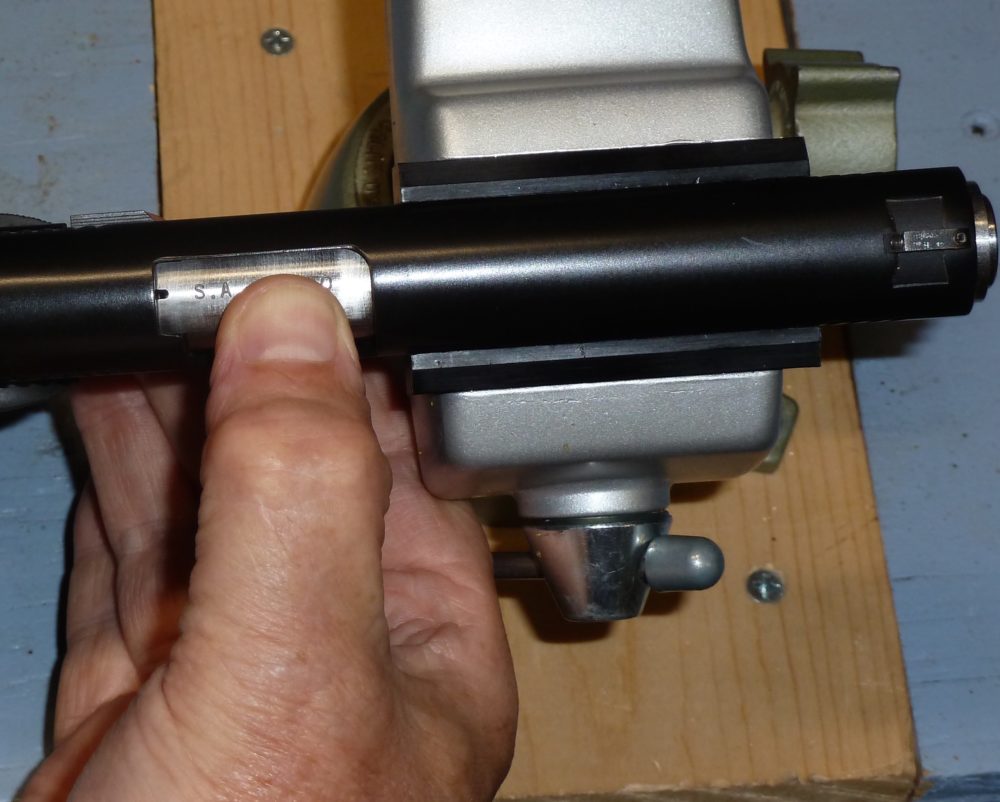
    [barrel locking engagement]

    Faulty barrel locking may cause the action to open before pressure from firing subsides (indicated by the bang when the bullet exits the barrel) and the partially unsupported brass case from the opening action and/or primer may breach from the high pressure. If so, a dangerous release of high-pressure gasses, powder, powder residue, brass fragments, and primer fragments may result. Always wear protective eyeglasses and hearing protection when shooting any firearm.


    1. Slide lock open (or back) on empty magazine test. With an empty chamber, no magazine in the firearm, and slide forward in closed battery, point the pistol in a safe direction. Insert an empty magazine into the slide well. Pull the slide fully to the rear and release. The magazine follower should raise and automatically engage the slide hold open locking mechanism to hold the slide open. There are numerous magazine manufacturers and magazines for the 1911 have been made over many decades resulting in large variations of fit, finish, and wear. As a result, this test should be duplicated with every magazine used with the weapon. Features such as the automatically held open slide on empty speeds the process of reloading.


    1. Magazine release test. Point an empty weapon in a safe direction and insert an empty magazine fully into the magazine well. Holding the pistol in a normal firing position, press the magazine release. The empty magazine should drop from the pistol. Repeat this test with all magazines used with the pistol.


    1. Magazine drop test. Hold a fully loaded magazine at shoulder level and drop on a hard ground level surface. No rounds should eject from the magazine. Repeat for all magazines used with the pistol.


    Should the pistol fail any of the above tests it should be inspected by a competent gunsmith and repaired as needed. Magazines failing Steps 9, 10, and 11 should be replaced with properly functioning magazines.


    How to safely lower the hammer on a 1911 pistol with round chambered

    There is only one way to safely lower the hammer on a loaded 1911 pistol. The hammer is lowered in exactly the same manner that the pistol is properly handled: with care.


    One popular manufacturer shows a method whereby the hammer is gripped between the thumb and first finger, trigger squeezed, and hammer lowered. This practice followed often enough with an early generation 1911 will eventually result in a loud noise accompanied by ringing in the ears. Likewise will lowering the hammer by use of a thumb over the external margin hammer friction ridges. With either technique, the hammer will eventually slip, the half cock safety fail, and that loud noise will occur.


    The competent pistol handler will habitually keep the muzzle pointed in a safe direction with slide safety engaged while keeping the trigger finger outside of the guard until actually ready to shoot. If for some unlikely reason, that unexpected loud noise is heard, no serious damage should result. With this safe handling posture as a starting point, and firm understanding of the following three actions, the hammer can be safely lowered to the full down position.


    The shooter is encouraged to practice and master the following safe method of lowering the hammer with an empty pistol before attempting with a loaded chamber.


    1. Hold the cocked pistol in the right hand. While always pointed in a safe direction, interpose the thumb of the left hand between the slide and hammer[see picture below].
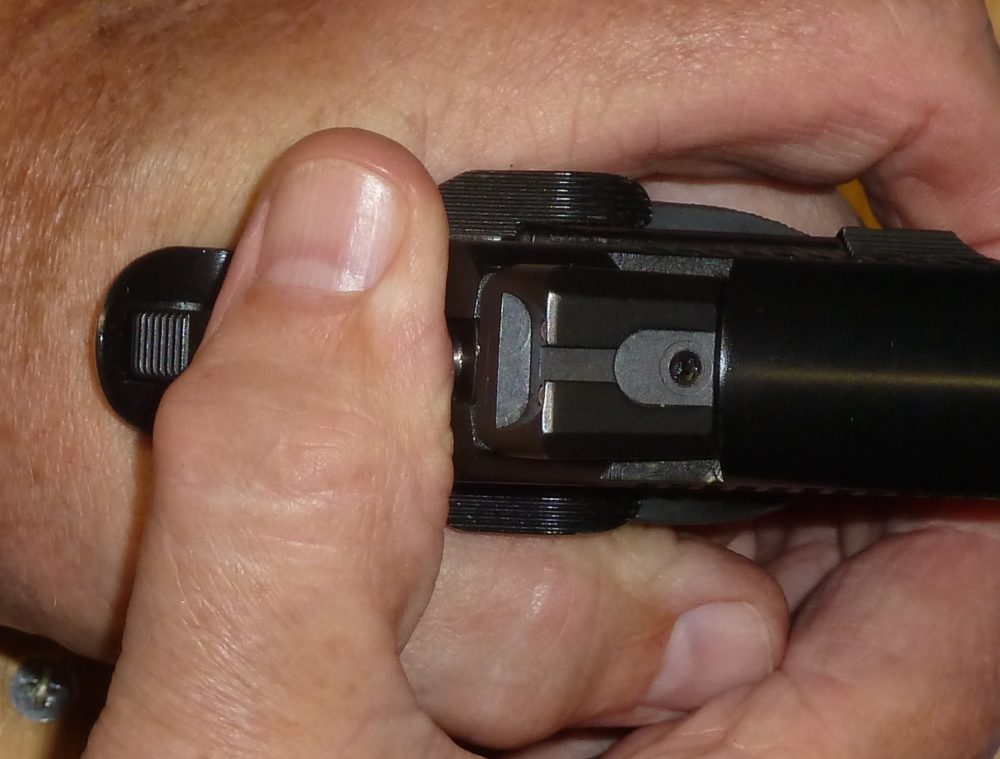
    1. Squeeze the trigger. The hammer should move slightly coming to rest on the outer margin of the left thumb.


    1. Roll the left hand and thumb toward the body while at the same time gradually lifting the thumb from between the hammer and rear of slide. This allows a controlled release and gentle lowering of the hammer.

    With a little practice, the hammer can be safely and quickly lowered on a loaded chamber and without pinching the thumb.


    ……….Check back tomorrow for Part 2.
     

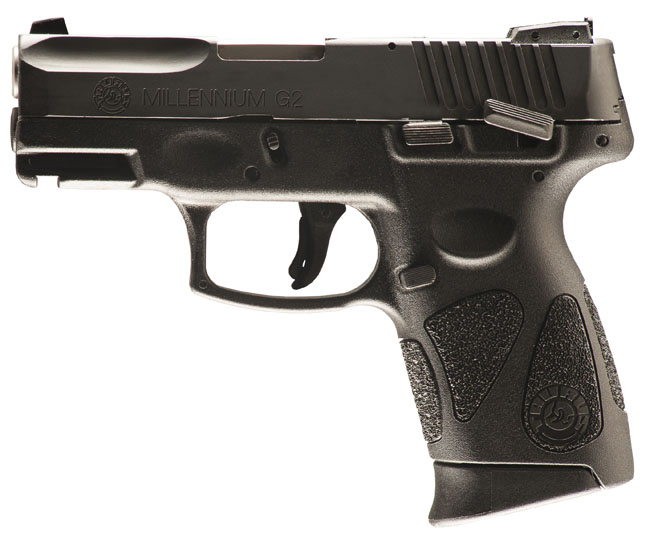
  • Taurus Millennium G2 9mm:  Rounds 461 – 660

    Taurus Millennium G2 9mm: Rounds 461 – 660


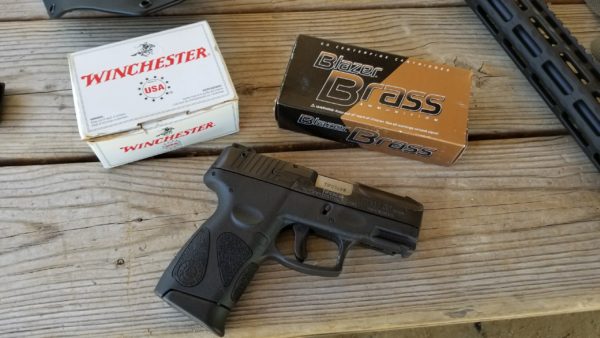
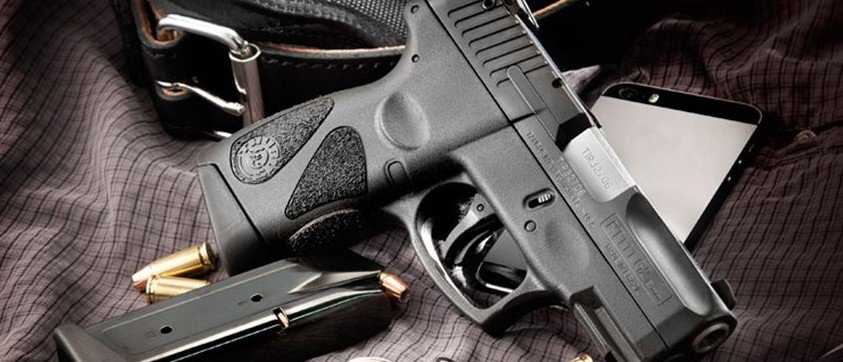
    The testing of the Taurus PT-111 G2 9mm continues with rounds 461 through 660. The goal of this project is to track the reliability and performance of the G2 through 2,000 rounds. No cleaning will be done however lubrication will take place each shooting session. Should the G2 begin to experience reliability issues with ammunition previously proven reliable then I will go ahead and clean it.

    Taurus G2, 9mm, pistol


    For this segment 200 rounds of “freedom seeds” was sent down range. No cleaning has been done so far, however, a couple drops of Rem-Oil were placed on the rails. A single failure was experienced. What occurred was in the midst of firing I pulled the trigger – there was a click – and nothing. I pulled the trigger again due to the G2’s double-strike capability – and the round(Winchester white box) did not fire. I ejected the round and the primer hit looked good. The round was then placed in another pistol and it did indeed fire.

    Beyond this issue which I deem ammunition related – the Taurus has remained 100% reliable. No failures to feed. No ejection issues.

    So – here’s the data through 660 rounds:

    300 rounds Winchester White Box 115-grain FMJ bulk pack

    160 rounds Independence 115-grain Aluminum case

    50 rounds LAWMAN 115-grain TMJ

    50 rounds Blazer 115-grain FMJ aluminum cased

    100 rounds Blazer Brass 115-grain FMJ

    There is a decent amount of buildup on the feed ramp and the chamber. Difficult to photograph I gave it a shot and you can take a look at the pictures below. Once I start to experience failures I will give it a thorough cleaning.


    1340 rounds to go…..

    Rourke

  • Top 5 Firearms That Have Never Been Made – But Should

    Top 5 Firearms That Have Never Been Made – But Should

    Over the past several decades there have been some very cool firearms produced. Some of the ingenuity used is really a testament to the firearms industry that these companies would take a risk to depart from the norm.

    Even with all the firearms created and manufactured, there are a few I’ve thought of that just never made it to the production line. Hey – I’ll admit some of these are far-fetched but it’s my dream – right?

    Here are the……

    Top 5 Firearms That Have Never Been Made – But Should Be

    2,000fps Air Rifle – OK – maybe this isn’t a true firearm but it shoots which is good enough for me. Whatever the caliber – .177, .22, or something else having an air rifle that shoots 2,000 fps would be awesome. I’d like to add it needs to be affordable and not some $800 dream gun. I like buying AR-15 upper receivers and upgrading the guns I currently own, and this gun looks like a lot of changes can be made to it by simply replacing a few parts. Some type of sound deadening device like on the Gamo Whisper would be needed so it remained fairly quiet. The market is there now someone needs to do it.

    The Magnetic Ball Bearing Shooter – getting out there a bit but a battery operated rifle that shoots the ball bearing via a magnetic rail would be something else. The electromagnet would push each ball bearing – around .30 caliber – down the rails at incredible speeds. Consider a reservoir could be filled with 100 or so ball bearings giving the shooter a lot of firepower. Lithium-ion battery packs would allow many rounds between pack changes.

    .357 Magnum Semi-Auto Carbine – While I imagine this was done at some point I know of no successful mass produced .357 Magnum firearm. This firearm would not have to be an AR-variant but could be similar to the Camp 9/45 or the Ruger 44 Carbine. Important is that it be magazine fed. Why create something like this? FUN! Would be a great cartridge that is commonly found and would be good for someone who carries a .357 Magnum revolver.

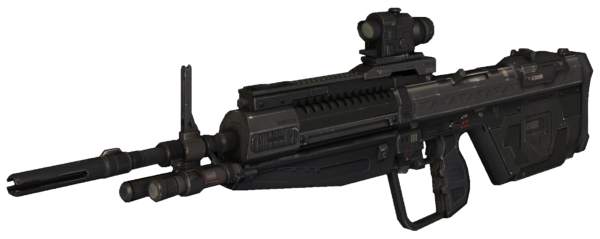
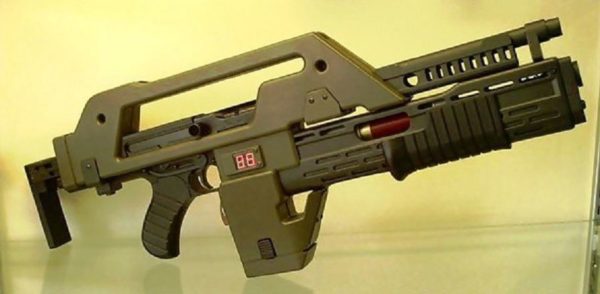
    The M41A Pulse Rifle from Aliens – I have considered trying to build one of these and maybe some day it will happen. This thing is awesome. A digital counter on the side which shows the number of rounds left – and automatically resets once a magazine is inserted. I would imagine this rifle would shoot a round similar to the 5.7x28mm and then have a shotgun action – rather than grenade launcher – connected to the underside.

    Smith & Wesson M&P15-22 .22 Magnum – this gun would absolutely rock and provide an incredible amount of fun. I just don’t get it why S&W hasn’t done it. Someone there has to have thought about it.

    Out of all of the above concepts, the M&P15-22M is probably the most realistic and marketable.

    Come on S&W – get to it!!!!!

    So, how about you? Is there a concept firearm that you have thought about that just never made it to production? Maybe heard of a prototype but the design never made it to gun shops?

    Go!

    Rourke


  • 5 Reasons My EDC Must Include a Pistol

    5 Reasons My EDC Must Include a Pistol


    EDC(Every Day Carry) is a hot topic on many internet forums and discussion groups. Many approach EDC like a science weighing the pros and cons of each and every item. While there are many items discussed that should be carried I will not be found without my pistol. At this moment my EDC pistol is a Taurus PT-111 G2 9mm. That can change from time to time depending upon weather and where I’m going and what I’m doing. What is constant is my EDC must involve a pistol.

    5 Reasons Why My EDC Must Include a Pistol

    You Just Never Know – The news is full of stories where someone finds themselves “in the wrong place at the wrong time”. Often these situations turn out very bad for the innocent. Evil people exist in this world and yes – even in your neighborhood. I carry my pistol as I may cross paths with this evil.

    Bad Guys Have Guns – While I may have practiced martial arts for years and carry a pocket knife the reality is many bad guys carry guns. Knife to a gun fight? I’ll pass. I need to be as prepared as possible to meet the threat and eliminate it.

    I Am The True First Responder – No disrespect to law enforcement, fire, and EMS when an emergency happens around me or involving me I am the first responder. When there is a fender-bender and some irate, steroid infused gang-banger heads my way determined to pound me into next week waiting for the police to arrive may not be prudent.

    Deterrence – While I would never promote showing a gun around(and in my State could get me in big trouble) just having the gun could de-escalate a situation. A violent crowd seeing my pistol could overwhelm me – if any of them are willing to get shot in the process. Hopefully, they would choose to move along and let me be. That goes for an individual as well. The last thing I want is to have to pull the trigger.

    Non-Human Threats – A few years ago I was working in my garden. My youngest was about 8 at the time. My neighbor opened his back door and his dog came running out and went after Christopher. I saw it all happen in a blur but still had the awareness to reach for my gun…..which was in the cabinet inside the house. All I could do was run to his aid. The dog chased my son down and did not attack him but it could have been quite different.

    The reason why I must carry a gun as part of my EDC goes well beyond “it’s my right” and the 2nd Amendment.

    Why do you carry? Please share……

    Rourke


    The Prepared Bloggers present - Everyday Carry Bag. What will you find in ours?

    The Prepared Bloggers are at it again!

    Everyday carry, or EDC for short, refers to items that are carried on a regular basis to help you deal with the normal everyday needs of modern western society and possible emergency situations.

    Some of the most common EDC items are knives, flashlights, multitools, wallets, smartphones, notebooks, and pens. Because people are different, the type and quantity of items will vary widely. If you have far to travel for work or have young children, your EDC could be huge!

    But, even if you’re just setting out for a walk around the neighborhood, taking your essential items with you in a pair of cargo pants with large pockets, may be all you need to be prepared.

    Follow the links to see what a few of the Prepared Bloggers always carry in their EDC. Would you feel safer with these items close at hand?

    Shelle at PreparednessMama always carries cash, find out why and how much she recommends.

    John at 1776 Patriot USA tell us the 5 reasons he thinks his pistol is the essential item to have.

    LeAnn at Homestead Dreamer won’t be caught without her handy water filter.

    Justin at Sheep Dog Man has suggestions for the best flashlights to carry every day.

    Bernie at Apartment Prepper always carries two knives with her, find out what she recommends.

    Nettie at Preppers Survive has a cool way to carry duct tape that you can duplicate.

    Todd at Ed That Matters tells us about the one item you’ll always go back for…your cell phone

    Erica at Living Life in Rural Iowa knows how important her whistle can be when you want to be safe.

    Todd at Survival Sherpa always carries 3 essential fire starters wherever he goes.

    Angela at Food Storage and Survival loves her Mini MultiTool, it’s gotten her out of a few scrapes!

  • It’s illegal for conservatives to defend themselves: Why Michael Stickland is a political prisoner

    It’s illegal for conservatives to defend themselves: Why Michael Stickland is a political prisoner


    The following post was originally published over at 299Days.com.

    By Glen Tate

    Michael Stickland is a conservative alternative journalist in Portland who covers Leftist protests on his channel called “Laughing at Liberals.” He goes to the protests and videos all the violence they commit. They hate him.

    He was jumped a few months ago and severely beaten by an anti-Second Amendment activist. Here’s the video (that crunching sound at 0:04 is his shoulder being broken). He knew the identity of the attacker (the guy drove away and his license plate is clearly visible) but the police never got around to arresting him. His shoulder has never recovered from the beating he endured by the “peaceful protestor.”

    Learning his lesson that you can’t defend yourself without a weapon, he obtained an Oregon concealed carry permit and took extensive training on the safe use of a defensive firearm. Everyone has a right to defend themselves. What could go wrong?

    Last summer he was covering a Black Lives Matter protest and a crowd of thugs, who recognized him and shouted out his name, taunted him as he was trying to escape. Then they charged him. He drew his weapon but did not fire. Here is the video of what happened. Four police officers who saw the video said no crime was committed and Michael clearly acted in self-defense.

    He is now facing decades in prison.

    Why? Because Portland, Oregon, like many liberal-controlled cities, hates people like Michael Strickland. The trial was a total travesty with a “surprise” prosecution witness, who Michael’s attorneys were not allowed to talk to in advance, being allowed to suddenly testify after the prosecution rested its case. (I’m a lawyer and have never in my life heard of this in my entire life.)

    In my opinion, the prosecutor in Portland wants to “make nice” with Black Lives Matter and offered up Michael as a sacrifice to curry political favor. This is why I think Michael Strickland is a political prisoner. His political beliefs meant that he was prosecuted when others are not, all for the political benefit of the government. That’s the classic definition of a political prisoner. That’s Michael Strickland.

    Portland officials want to make it illegal for conservatives to defend themselves, and by throwing Michael Strickland in jail forever they have succeeded. Black Lives Matter can burn down entire sections of a city but you can’t defend yourself, and they like it that way.

    Don’t let them get away with it. Donate to Michael’s legal defense fund here.


  • Taurus Millennium G2 9mm review

    Taurus Millennium G2 9mm review


    by Prepper Ralph

       I was looking for a 9 millimeter subcompact that would not break the bank but would also make a good carry gun for my wife and I. We looked all over the place from the Kahr CM9 single stack 9 millimeter to the Kel-Tec P11, and even used a SCCY CPX-2 for about 6 months. The new Glock 43’s were nice, but we really wanted a double stack that would fit in either of our hands, and also be comfortable. My wife has never enjoyed a Glock 26 so that was out of the question. I wanted something that wouldn’t break the bank or my wallet. That eventually lead me to my local gun shop where I ran across the Taurus Millennium G2 in 9mm. A lot of you may remember the old Taurus PT-111 Pro’s… this is the Gen 2 of that weapon.

    First Impressions…

       My initial shock was the fact that this weapon was sitting in the glass case at a meager price of only $199.99! I was stunned that someone would put a tag like that on a handgun and expect it to function. More on that later. I asked to hold the gun so the salesman pulled it from the case. I was amazed by how it felt in my hands. The grip has a texture unlike anything on the market that I could think of; almost like sandpaper, but nicer. It also fit in my hand like it was made for it. I have large hands, and wear a large sized glove, and this felt great – almost like it was glued into my palm due to the texturing. FYI, though the texture is rough, it isn’t painful, or too abrasive. I never knew what the perfect texture was until I held the G2. It’s light weight, a subcompact, and was double stack just like we wanted. Another thing I noticed was the attractive and modern lines of the G2. It’s rounded in the rear of the slide/frame for comfort while carrying, while slightly wedge shaped in the nose for holster insertion. The front of the slide also has a “scallop” on both sides to lighten the gun which I also found attractive. The finish on the slide seemed to be as good as any higher priced weapon on the market with no blemishes. Machining was perfect in my opinion, with zero tool marks to be found. As always, I had some research to do before I took the gun home finally so I handed it back over to the salesman.

    Specs…

       Taurus’s website has the specs on the G2 at http://www.taurususa.com which is where I did my research. MSRP of the G2 is listed at $301.52 though I’ve seen it as high as $250, and as low as the price I paid: $199. I found that the gun was 6.24” long with a barrel of 3.2”. It weighs 22oz. without the 12+1 rounds in it. Did I mention that it came with 2 magazines? That was a shocker to me. Both have a high gloss bluing and drop freely from the gun when the mag release is pressed. It holds 2 more rounds than a Glock 26, with the G2 weighing .29 ounces more. Since I’m comparing it to the Glocks, it’s roughly the height of a 19, but roughly the length of a 26 if that helps. The barrel is stainless steel, as well as the slide. Frames of G2 handguns are polymer as is typical of modern handguns with one other color option that I have found: desert tan. Sights are the typical 3 dot system, though the rear is adjustable. Both front and rear sights are polymer. Taurus has placed several safeties in the G2 which include a Loaded Chamber Indicator on the top of the slide, a thumb safety on the left (up is safe, down is fire) Taurus’s iconic Security System that utilizes a key, as well as a Trigger Safety. I’m not a fan of all that, but I can say that the thumb safety was easy to get used to and it reassured my wife since I carry with a loaded chamber. The chamber indicator never gets in that way, and when sighting along the slide it is below the sight plane. Lastly, the G2 carries another Taurus icon; the double/single action trigger. The initial trigger pull is SA, and if a dud is in the chamber, you can release the trigger and pull a second time in DA. Basically, it allows a second strike capability in times of high stress. The SA is slightly mushy but with a fast break/reset, while the DA is long with a definite breaking point that is easy to feel when firing.

    Reliability and Accuracy…

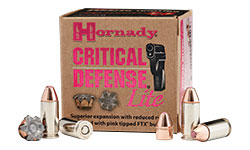
       The Taurus Millennium G2 has proven to be highly reliable and accurate since I went back and picked up one for my wife and I each. With the adjustable rear sight, hitting a 6” plate at 25 yards becomes routine with easily 10/12 hits on target. Within 7-10 yards (typical gun fighting distance per FBI) it’s easy to place all 12 rounds in about a 2” pattern. Hostage drills, El Presidente, and target shooting are great with the G2. I found with our particular examples that they would not reliably chamber hollow point ammunition. I’ve tried Hornady, Winchester, Remington, and even some cheaper discount brands such as Independence and ZQI. I did find one self defense round that would work all the time. Those are the 100 gr FTX® Critical Defense® Lite from Hornady. They work all the time, every time and are polymer tipped in pink for the ladies.

    The G2’s have had zero problems running round nose ball ammo. I’ve not had a stove pipe, FTF, FTE, light strike, or magazine malfunction. For $199, that’s a lot of reliability for such an inexpensive price.

    Final Thoughts…

       The Taurus Millennium G2 9mm has proven to be an inexpensive though high quality handgun. It’s lightweight, accurate, and what we were looking for. Though it has had issues using other brands of HP ammunition, the Hornady rounds have proven to be 100% reliable. Between both guns, we’ve placed several hundred rounds through them. If you are a new shooter, on a budget, or small statured, then this will make a fine weapon that you can carry with confidence. I know many people that have them including my friend John Rourke, my father, as well as several other friends and family members. Everyone I’ve talked to who has a G2 love the guns, and have minimal complaints. Most people who get on G2 tend to go back to their local dealers to pick up one or two more. One guy I heard from the salesman I picked ours up from stated that a man walked in and bought one, then the next week obtained 4 more for his family because of the price and reliability.

    Prepper Ralph

    Images used were sourced from the manufacturer’s websites. Article is original content by Prepper Ralph.

  • From the Desk of John Rourke – February 8th, 2017

    From the Desk of John Rourke – February 8th, 2017


    In the process of trying to set up some training for a few friends and potentially one group member. People will go out and buy a pistol or an AR for $500+ but make every excuse in the book not to spend a few hours training. Why the reluctance to pay for training? I get it money is tight but come on. Make a peanut butter and jelly sandwich and don’t go out to lunch every day. In a couple weeks a defensive carbine and pistol class will be paid for. I’ve said it before and I’ll say it again – “Training is NOT shooting at paper between two narrow walls.”

    People overestimate their firearm skills almost as much as their food storage levels. On a scale of 1 to 10 with 1 being Papa Smurf and 10 being John Rambo – where do your skills lie? Me? Realistically and being totally honest(as always) I rate myself a solid 5.

    If you are sitting on your couch right now watching TV, reading this – and have never practiced switching to your backup weapon – while moving – your missing the boat(and will likely miss the target). Not trying to be harsh here but how many times have you shot off-hand? You’re right handed? What are you going to do when you are on the left corner of a building and need to shoot around it? What most people will do and expose themselves unnecessarily and pay the price. The smaller percentage of people will simply switch their rifle to the left side and engage – accurately –  with minimal exposure.

    So you carry everyday? Awesome! How fast can you successfully draw your pistol? Be honest. Will it get caught on your shift while you fumble to grab the butt? Is there a round in the chamber? I hope so. Have you practiced grabbing your shirt with your off hand pulling it up high well away from your pistol so as to remove any opportunity for the pistol to get caught on anything? If not – the time to start is now.

    Not healthy enough to “train” the way I describe? Then train to the level which you can. Truly cannot afford a $175 for a defensive firearms course? There are tons of YouTube training video’s to study and practice on your own. How about buy a book such as The Home Schooled Shootist?

    Bad things happen to good people every day. Some significantly crappy things may be happening to many good people in the not too distant future. It’s time to get ready now.

    But what do I know I’m only a 5.

    Rourke

    There are many reasons why so many love their Kindle and Amazon Fire tablets. One huge advantage is you could literally go years without every buying a book to read as there are tons of free eBooks available. Don’t have a Kindle or Fire? No problem. There are apps that can be installed on most any cell phone or computer for free. No excuses!

    Today’s Freebies

    925 Ways To Save Money

    Bow Hunting for Beginners

    Intermittent Fasting

    Essential Oils: The Only Book You’ll Ever Need

    NOTE: If you see a free Kindle book that your interested in get it now. Prices change often and there is no way to tell how long the book will remain free. Before purchasing a free Kindle book on Amazon make certain the book is still free by making sure the price is $0.00. If it lists a price or says “read for free” or has a price for prime members the book is not free anymore.


  • Civilian Involvement: The Newhall Incident

    Civilian Involvement: The Newhall Incident


    Via Wikipedia……

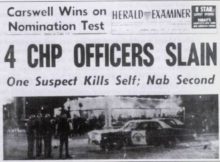
    The Newhall incident, also called the “Newhall massacre”, was a shootout between two heavily armed criminals and officers of the California Highway Patrol (CHP) in the Newhall unincorporated area of Los Angeles County, California on April 5, 1970. In less than 5 minutes, four CHP officers were killed in what was at the time the deadliest day in the history of California law enforcement.[1][2]

    At approximately 11:55 p.m. (UTC-8), CHP officers Walt Frago and Roger Gore conducted a traffic stop of Bobby Davis and Jack Twinning in conjunction with an incident involving the pair that had been reported to the CHP minutes earlier. After stopping in a restaurant parking lot and initially cooperating with the officers, Twinning and Davis opened fire and killed both officers. Minutes later, Officers George Alleyn and James Pence arrived on the scene and engaged Twinning and Davis in a shootout. A passerby picked up one of the officers’ weapons and opened fire on the perpetrators; however, the three were outgunned, and both Alleyn and Pence suffered fatal injuries while the passerby ran out of ammunition and took cover in a ditch. A third CHP patrol car arrived on the scene and the lone officer inside briefly exchanged gunfire with the perpetrators, but they were able to flee the scene.

    Over three hours later, after stealing a vehicle and exchanging gunfire with its owner, Davis attempted to flee the area; however, he was spotted by police and arrested. Meanwhile, Twinning broke into a house and took one of its occupants hostage. The house was surrounded by deputies of the Los Angeles County Sheriff’s Department and at approximately 9 a.m., he released the hostage and committed suicide when the deputies entered the house. Davis was sentenced to death but had his sentence commuted to life imprisonment without the possibility of parole in 1973. He killed himself[3] at Kern Valley State Prison in 2009.[1]

    The Newhall incident resulted in a number of changes at the CHP, including procedural changes in arresting high risk suspects and standardization of firearms and firearms training used across the department.[1][2]

    line

    The above describes a horrible situation where good and evil battled and eventually good won out. What struck me when I first heard this story was the involvement of that sheepdog that picked up an officers weapon and stood up against evil. I have corrected a few people when they refer to police, EMS, fire department, etc. as “first responders”. No disrespect meant at all but quite often it is a civilian that is the first responder. What they decide to do – or not do – can make all difference. I’m likely just overly obsessed with the semantics of terminology.

    So – how many of us would jump in in defense of those officers? Don’t answer – because I’m not sure most would really know until the situation occurred.

    Rourke

  • Active Shooters: When Violence Is The Answer

    Active Shooters: When Violence Is The Answer

    NOTE: The following article was originally published over at DoomandBloom.net.


    As a physician, my focus is how to heal wounds rather than how to cause wounds. A terrorist, however, has quite different goals. Normally, they have a short window of opportunity, and their focus is to cause as many casualties as possible during their brief (hopefully) remaining time on Earth.

    I’ve been asked quite a bit lately about what to do in active shooter situations. My standard answer has been the same as that given by the Department of Homeland Security: Run, Hide, Fight, in that order.

    Just as Stop, Drop, and Roll may save the life of someone on fire, Run, Hide, Fight may save the life of someone under fire. This is the order of the actions that I have been recommending in recent articles regarding active shooter situations.

    This sequence of actions is based upon the expected lifespan of the attack, and the attacker, in an active shooter event. Most active shooter events are over in a few minutes. Following the Run, then Hide, then Fight paradigm is often effective in these short-term events.

    When potential victims put distance between themselves and the shooter by running, they make themselves a more difficult target than someone laying on the ground two feet in front of the gunman. When targets remove themselves from the line of sight of a shooter by hiding in a different room, preferably with a barrier against the door, the gunman may, knowing his time is short, search for easier victims. Fighting back is recommended as a last resort; it’s a superior strategy to closing your eyes and taking a bullet to the head.

    Which takes us to the Orlando shooting. This horrific event took a full three hours before the threat was neutralized. This amount of time gave the gunman ample time to seek out people that were hiding, often in bathroom stalls, and make casualties out of those that would have survived if the event had been terminated more quickly.

    I’m not a member of a SWAT team, just an old sawbones, so I can’t comment on the time it took for SWAT team members to abolish the threat. I assume it had to do with concern about hostages and the safety of the team, all perfectly reasonable concerns.

    I have seen accounts of brave individuals helping people out of the building, which certainly saved lives, but I have yet to see any 9/11 Flight 93 “let’s roll” moments which indicated that some of the bar’s patrons tried to stop the killing by dropping the attacker.

    This disturbs me, as it is thought that the gunman fired off 200 rounds, something that would have required reloading magazines into the rifle multiple times. This was a rifle that the gunman had little experience with, so there must have been a number of opportunities to intervene in the killing and end the event. This, apparently, never happened and the casualties were a record for a lone gunman attack.

    The “success” of this terrorist may serve as a blueprint for future attacks. If there’s an exit to run through, it’s still the best option, in my opinion. Always be situationally aware and mentally mark where those exits are anytime you’re in a crowd. But if a gunman has three hours to find you, is hiding the next best thing? If someone was given three hours to find you in your house or your place of work, what do you think of their chances? Probably pretty good.

    This leads me to think that, in the Orlando shooting, fighting back would have cut down significantly on the casualties. Why did some of the 300 young and able people in the bar not take that option? It’s not as if the objective of the gunman wasn’t clear.

    It all comes down to the natural paralysis that occurs when something happens foreign to the average person’s thought process. We are all victims of normalcy bias: that is, we believe the events of the day will follow a certain pattern, because they always have. When this pattern is broken by an atrocity, the human brain processes it slowly; denial and hesitation makes for a soft target. Certainly, becoming violent is not part of the mindset of the average person in most scenarios.

    Yet, there are circumstances when violence is the answer. Statistics published in the FBI Law Enforcement Bulletin indicate a significant minority of attacks which ended before law enforcement arrived were aborted by a single citizen without a firearm. In fewer instances, a firearm-carrying citizen terminated the event and, in other cases, the shooter terminated himself or law enforcement arrived to do him (and us) the favor.

    I’m not saying that it’s a great idea for 300 people in a bar to be carrying loaded weapons, but an unarmed citizen can still make a difference. The patrons of the Orlando nightclub where the shootings occur were, indeed, armed. There were bar glasses, bottles, and 300 cell phones that could have been used as projectiles to hurl at the gunman, while a number charged the attacker from different directions to drop him to the ground and grab his weapon.

    This guy wasn’t James Bond. He would have been disconcerted by multiple attackers and objects thrown his way. He would have ducked and flinched, and would have had to make decisions as to who to shoot. I’m not saying someone might not have been killed attacking the gunman, but the fatalities would have been held to a minimum and the event would have ended with far less loss of life.

    A faulty strategy doomed to failure? Well, three unarmed men were able to stop a shooter on a train in Paris a while ago without any fatalities. It may be extreme, but sometimes violence is necessary to prevent worse violence.

    I recently saw a video of lions taking down a water buffalo. A few other water buffalo charged the lions, flipping one high into the air and ending the attack. When a herd takes action, the prey has a good chance of surviving.

    It’s time for us to decide that we are not going to be soft targets for these mass murderers. It’ll take a major change in mindset to do it, but it might just save some lives in the end. Your life. The lives of friends and loved ones. Prepare physically and mentally to both avoid and confront these situations with commitment, and we might see a little more reluctance on the part of those who wish harm to decent people.

    Joe Alton, MD

    author, “The Survival Medicine Handbook

    JoeAltonLibrary4-274x300