
The Baofeng UV-5R and similar radios are very useful tools. It’s a compact, handheld radio capable of transmitting with 4 watts of power across 136-174 MHz and 400-480 MHz frequencies. It can be programmed with up to 128 channels. They can receive and transmit a variety of frequencies including those used by weather radios and the often purchased walkie-talkies found at Wal-Mart. Their capability is actually much more and this article will provide instructions on how to manually program the popular Baofeng UV-5R for many common frequencies.
[Disclaimer: You are required to obtain a license to transmit on these devices and punishment for doing so without a liscence can range from fines to having your bottom lip pulled over to the back of your head. You’ve been informed and warned.]
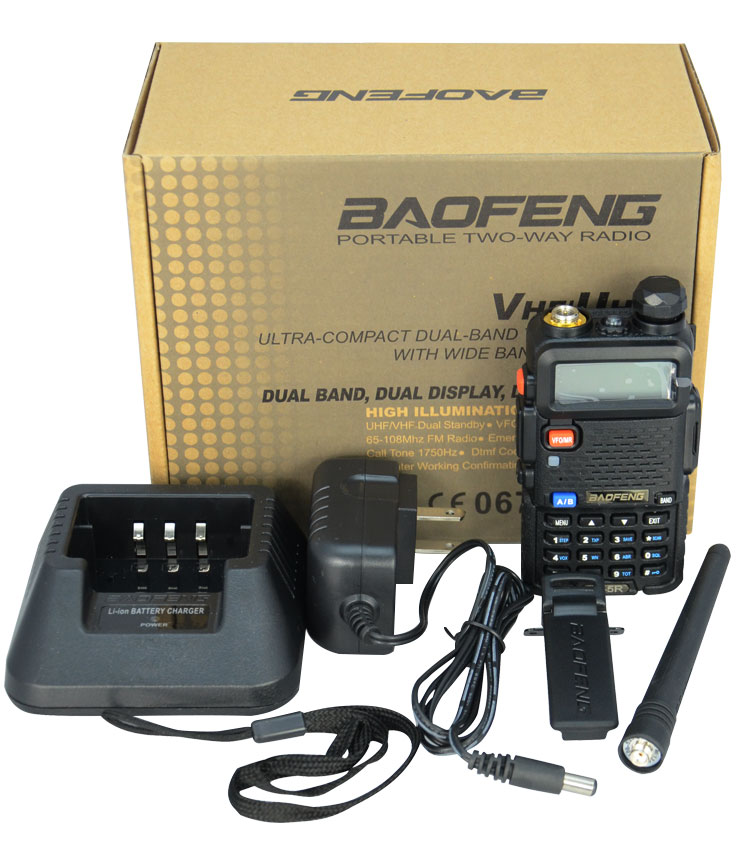
While the frequency can be entered in the Baofeng UV-5R and similar radio’s by just punching in numbers it is also possible to save it as a channel for easy access at any time(see below).
Manual Programming the Baofeng UV-5R
- Step 1. Press [VFO/MR] and enter Frequency Mode.
- Step 2. Press [A/B] and choose the A-Side (upper display).
The A side must be used to program channels into the radio.
- Step 3. Press [BAND] for the frequency band.
Toggle [BAND] to choose 136 MHz (VHF) – or 400 Mhz(UHF). Choose the right band based on your desired channel frequency.
If this is not performed correctly the radio will cancel the operation after entering the frequency in Step 5.
- Step 4. Disable TDR (Dual Watch/Dual Standby).
Press [MENU] 7 [MENU] [press up/down arrow keys] OFF [MENU] [EXIT]
- Step 5. Enter the frequency.
Using the keypad, enter the frequency into the radio.
- Step 6. Assign the frequency to a channel.
[MENU] 27 [MENU] [enter channel number XXX] [MENU] [EXIT]
That’s it. Programming frequencies via software is easier and more flexible. That’s for another post at a later date.
Now – go grab your Baofeng UV-5R and give it a shot…….
Common Frequencies for the Baofeng UV-5R
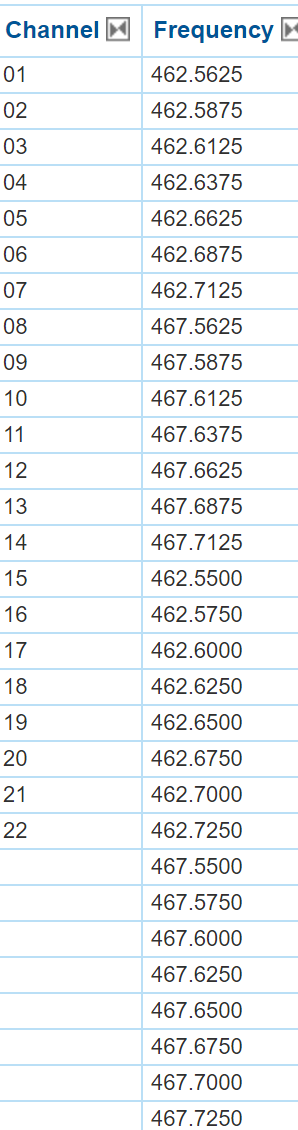
FRS/GMRS Frequencies
MURS Radio Frequencies
151.820 Mhz
151.880 Mhz
151.940 Mhz
154.570 Mhz
154.600 Mhz
NOAA Weather Radio Frequencies
 WX1         --     162.550
 WX2         --     162.400
 WX3         --     162.475
 WX4         --     162.425
 WX5         --     162.450
 WX6         --     162.500
 WX7         --     162.525
Commercial “DOT” Frequencies
151.625 Red Dot
154.570 Blue Dot
154.600 Green Dot
151.955 Purple Dot
464.550 Yellow Dot
464.500 Brown Dot
467.7625 J Dot
467.8125 KDot
467.8500 Silver Star
467.8750 Gold Star
467.9000 Red Star
467.9250 Blue Star
| Marine VHF Designated Frequencies | |||
| Channel Number | Ship Transmit MHz |
Ship Receive MHz |
Intended And Designated Use |
| 01A | 156.050 | 156.050 | Port Operations and Commercial, VTS. Available only in New Orleans / Lower Mississippi area. |
| 05A | 156.250 | 156.250 | Port Operations or VTS in the Houston, New Orleans and Seattle areas. |
| 06 | 156.300 | 156.300 | Intership Safety |
| 07A | 156.350 | 156.350 | Commercial |
| 08 | 156.400 | 156.400 | Commercial (Intership only) |
| 09 | 156.450 | 156.450 | Boater Calling. Commercial and Non-Commercial. |
| 10 | 156.500 | 156.500 | Commercial |
| 11 | 156.550 | 156.550 | Commercial. VTS in selected areas. |
| 12 | 156.600 | 156.600 | Port Operations. VTS in selected areas. |
| 13 | 156.650 | 156.650 | Intership Navigation Safety (Bridge-to-bridge). Ships >20m length maintain a listening watch on this channel in US waters. |
| 14 | 156.700 | 156.700 | Port Operations. VTS in selected areas. |
| 15 | — | 156.750 | Environmental (Receive only). Used by Class C EPIRBs. |
| 16 | 156.800 | 156.800 | International Distress, Safety and Calling. Ships required to carry radio, USCG, and most coast stations maintain a listening watch on this channel. |
| 17 | 156.850 | 156.850 | State Control |
| 18A | 156.900 | 156.900 | Commercial |
| 19A | 156.950 | 156.950 | Commercial |
| 20 | 157.000 | 161.600 | Port Operations (duplex) |
| 20A | 157.000 | 157.000 | Port Operations |
| 21A | 157.050 | 157.050 | U.S. Coast Guard only |
| 22A | 157.100 | 157.100 | Coast Guard Liaison and Maritime Safety Information Broadcasts. Broadcasts announced on channel 16. |
| 23A | 157.150 | 157.150 | U.S. Coast Guard only |
| 24 | 157.200 | 161.800 | Public Correspondence (Marine Operator) |
| 25 | 157.250 | 161.850 | Public Correspondence (Marine Operator) |
| 26 | 157.300 | 161.900 | Public Correspondence (Marine Operator) |
| 27 | 157.350 | 161.950 | Public Correspondence (Marine Operator) |
| 28 | 157.400 | 162.000 | Public Correspondence (Marine Operator) |
| 63A | 156.175 | 156.175 | Port Operations and Commercial, VTS. Available only in New Orleans / Lower Mississippi area. |
| 65A | 156.275 | 156.275 | Port Operations |
| 66A | 156.325 | 156.325 | Port Operations |
| 67 | 156.375 | 156.375 | Commercial. Used for Bridge-to-bridge communications in lower Mississippi River. Intership only. |
| 68 | 156.425 | 156.425 | Non-Commercial |
| 69 | 156.475 | 156.475 | Non-Commercial |
| 70 | 156.525 | 156.525 | Digital Selective Calling (voice communications not allowed) |
| 71 | 156.575 | 156.575 | Non-Commercial |
| 72 | 156.625 | 156.625 | Non-Commercial (Intership only) |
| 73 | 156.675 | 156.675 | Port Operations |
| 74 | 156.725 | 156.725 | Port Operations |
| 77 | 156.875 | 156.875 | Port Operations (Intership only) |
| 78A | 156.925 | 156.925 | Non-Commercial |
| 79A | 156.975 | 156.975 | Commercial. Non-Commercial in Great Lakes only |
| 80A | 157.025 | 157.025 | Commercial. Non-Commercial in Great Lakes only |
| 81A | 157.075 | 157.075 | U.S. Government only – Environmental protection operations. |
| 82A | 157.125 | 157.125 | U.S. Government only |
| 83A | 157.175 | 157.175 | U.S. Coast Guard only |
| 84 | 157.225 | 161.825 | Public Correspondence (Marine Operator) |
| 85 | 157.275 | 161.875 | Public Correspondence (Marine Operator) |
| 86 | 157.325 | 161.925 | Public Correspondence (Marine Operator) |
| 87 | 157.375 | 161.975 | Public Correspondence (Marine Operator) |
| AIS 1 | 161.975 | 161.975 | Automatic Identification System #1 (AIS) – Special equipment required! |
| 88 | 157.425 | 162.025 | Public Correspondence only near Canadian border. |
| AIS 2 | 162.025 | 162.025 | Automatic Identification System #2 (AIS) – Special equipment required! |
| 88A | 157.425 | 157.425 | Commercial, Intership only. |