Category: Communication

  • Prioriizing Short Range Communications – CB/HAM/GMRS

    Prioriizing Short Range Communications – CB/HAM/GMRS

    In this video, we’ll explore the differences between short-range and long-range communications! Short-range communication is like talking to a friend face-to-face or using walkie-talkies, where you can easily connect over a small distance. On the other hand, long-range communication is all about reaching people far away.

    Thanks for stopping by.

    Rourke

    [ecwid widgets=”productbrowser” default_category_id=”0″ default_product_id=”0″ minicart_layout=”MiniAttachToProductBrowser”]

  • Telegram Channels and Groups – Join Us!

    Telegram Channels and Groups – Join Us!

    I’ve discussed Telegram as a communications tool previously. It continues to rank up there as one of the most secure communication tools available.  With many media platforms and accounts being taken down the ability for like-minded folks to network and communicate online has been challenging at best. Many of us who are Constitutionalists, freedom-loving, traditional in our values, and support the 2nd Amendment are now being called “extremists” by our own government and expelled or censored from many social media platforms. Our ability to freely communicate remains but is certainly diminished.

    For some time I’ve had a Telegram Group where a small number of us get together daily and chat about current events, news, prepping, life, and sometimes what we’ve cooked for dinner. We also exchange digital books, guides, manuals and other items related to preparedness. It should be noted that Telegram was banned for two years in Russia as the government wanted access to user information, however, the owner refused.

    If interested in joining our small Telegram Chat Group – send me an email. I don’t want to publicize the link to join this private group. Email: 1776PatriotUSA ( at ) gmail ( dot ) com. This group discusses a variety of preparedness topics and current events all in real-time. Pretty cool!!

    Telegram can be used on both a computer as well as phones.

    What Is Telegram:

    Telegram is a freeware, cross-platform, cloud-based instant messaging software and service. The application servers of Telegram are distributed worldwide to decrease data load, while the operations center is currently based in Dubai. Along with regular IM, the service has video calling, VoIP, file sharing, and other features.

    No-  it’s not owned by Google, Facebook, or any other supergiant technological conglomerate. If you have any questions or issues joining up comment below and I’ll do what I can to assist.

    Rourke
  • Methods of Communication: Telegram Channels and Groups

    Methods of Communication: Telegram Channels and Groups

    With the ramped up attacks against free speech, it’s hard to get the truth. With media platforms being taken down the ability for like-minded folks to network and communicate online could get worse.

    For some time I’ve had a Telegram Group where a small number of us get together daily and chat about current events, news, prepping, life, and sometimes what we’ve cooked for dinner. Should Parler, MeWe, and other means to “get together” disappear, Telegram should remain.

    I’ve also created a Telegram Broadcast Channel. As a member relevant news and information is sent periodically. This is one-way communication.

    If interested in joining the Telegram Chat Group – send me an email. I don’t want to publicize the link to join. Email: emergencycd ( at ) gmail ( dot ) com.

    Want to receive news and information? Join the Telegram Broadcast Channel here – – – > https://t.me/joinchat/SSdzuLjVdku4LHAU


    What Is Telegram:

    Telegram is a freeware, cross-platform, cloud-based instant messaging software and service. The application servers of Telegram are distributed worldwide to decrease data load, while the operational center is currently based in Dubai. Along with regular IM, the service has video calling, VoIP, file sharing and other features.

    No-  it is not owned by Google, Facebook, or any other supergiant technological conglomerate.

    Rourke

  • VIDEO:  Baofeng For Dummies UV5R+ HAM Radio Tutorial

    VIDEO: Baofeng For Dummies UV5R+ HAM Radio Tutorial

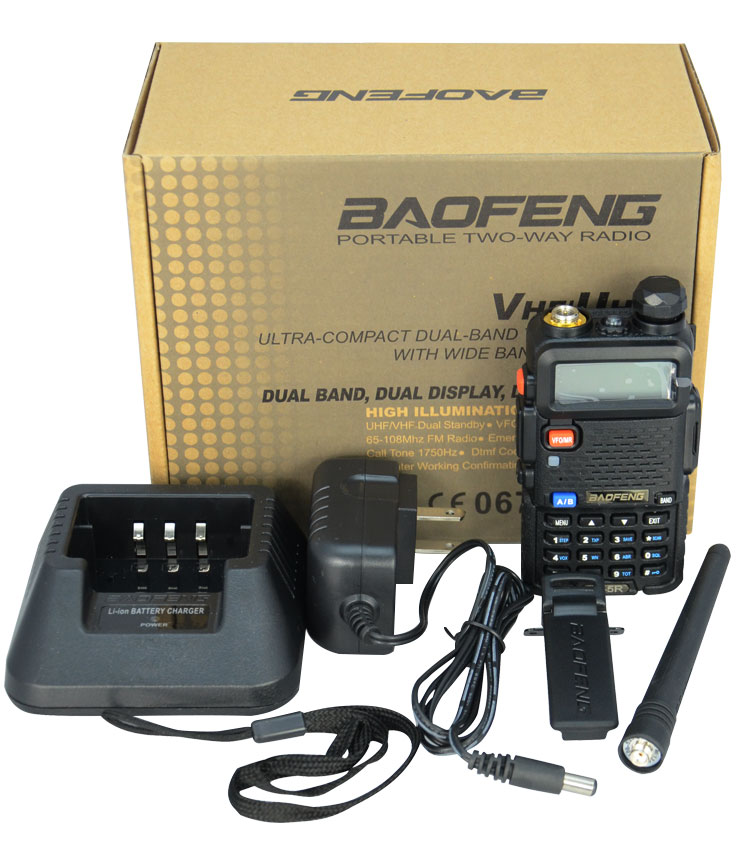
    Over the past few years, there have been numerous questions and requests pertaining to the “preppers radio” – the Baofeng UV-5R(and its siblings). The video below offers up some great insight and explanation.

    The featured radio in the video is the Baofeng UV-5RA – which is cosmetically different than the regular UV-5R, but, operates basically the same. There are some higher power radios available from Baofeng as well.

    Enjoy!


  • Programming the Baofeng UV-5R for Common Frequencies

    Programming the Baofeng UV-5R for Common Frequencies


    The Baofeng UV-5R and similar radios are very useful tools. It’s a compact, handheld radio capable of transmitting with 4 watts of power across 136-174 MHz and 400-480 MHz frequencies. It can be programmed with up to 128 channels. They can receive and transmit a variety of frequencies including those used by weather radios and the often purchased walkie-talkies found at Wal-Mart. Their capability is actually much more and this article will provide instructions on how to manually program the popular Baofeng UV-5R for many common frequencies.

    [Disclaimer: You are required to obtain a license to transmit on these devices and punishment for doing so without a liscence can range from fines to having your bottom lip pulled over to the back of your head. You’ve been informed and warned.]

    Baofeng, survival, communications, prepper, preparedness

    While the frequency can be entered in the Baofeng UV-5R and similar radio’s by just punching in numbers it is also possible to save it as a channel for easy access at any time(see below).

    Manual Programming the Baofeng UV-5R

    • Step 1. Press [VFO/MR] and enter Frequency Mode.


    • Step 2. Press [A/B] and choose the A-Side (upper display).
      The A side must be used to program channels into the radio.


    • Step 3. Press [BAND] for the frequency band.
      Toggle [BAND] to choose 136 MHz (VHF) – or 400 Mhz(UHF). Choose the right band based on your desired channel frequency.
      If this is not performed correctly the radio will cancel the operation after entering the frequency in Step 5.


    • Step 4. Disable TDR (Dual Watch/Dual Standby).
      Press [MENU] 7 [MENU] [press up/down arrow keys] OFF [MENU] [EXIT]


    • Step 5. Enter the frequency.
      Using the keypad, enter the frequency into the radio.


    • Step 6. Assign the frequency to a channel.
      [MENU] 27 [MENU] [enter channel number XXX] [MENU] [EXIT]

    That’s it. Programming frequencies via software is easier and more flexible. That’s for another post at a later date.

    Now – go grab your Baofeng UV-5R and give it a shot…….


    Common Frequencies for the Baofeng UV-5R

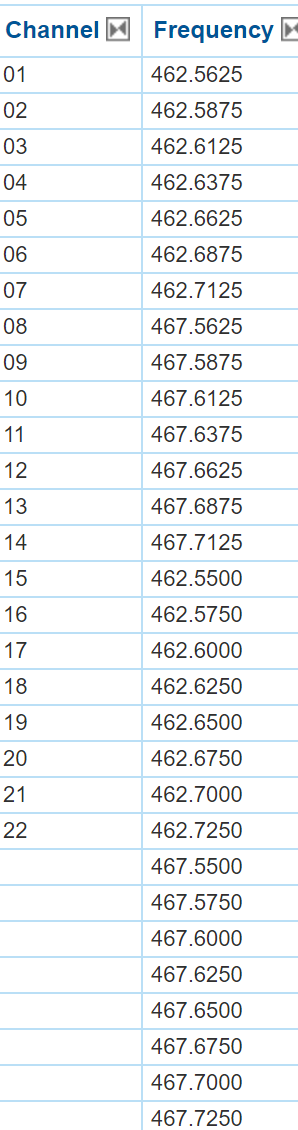
    FRS/GMRS Frequencies 

    frs, gmrs, 2017, frequencies, baofeng,


    MURS Radio Frequencies

    151.820 Mhz
    151.880 Mhz
    151.940 Mhz
    154.570 Mhz
    154.600 Mhz


    NOAA Weather Radio Frequencies

     WX1         --     162.550   
     WX2         --     162.400
     WX3         --     162.475
     WX4         --     162.425
     WX5         --     162.450
     WX6         --     162.500
     WX7         --     162.525


    Commercial “DOT” Frequencies

    151.625 Red Dot
    154.570 Blue Dot
    154.600 Green Dot
    151.955 Purple Dot
    464.550 Yellow Dot
    464.500 Brown Dot
    467.7625 J Dot
    467.8125 KDot
    467.8500 Silver Star
    467.8750 Gold Star
    467.9000 Red Star
    467.9250 Blue Star


    Marine VHF Designated Frequencies
    Channel Number Ship Transmit
    MHz
    Ship Receive
    MHz
    Intended And Designated Use
    01A 156.050 156.050 Port Operations and Commercial, VTS.  Available only in New Orleans / Lower Mississippi area.
    05A 156.250 156.250 Port Operations or VTS in the Houston, New Orleans and Seattle areas.
    06 156.300 156.300 Intership Safety
    07A 156.350 156.350 Commercial
    08 156.400 156.400 Commercial (Intership only)
    09 156.450 156.450 Boater Calling.  Commercial and Non-Commercial.
    10 156.500 156.500 Commercial
    11 156.550 156.550 Commercial.  VTS in selected areas.
    12 156.600 156.600 Port Operations.  VTS in selected areas.
    13 156.650 156.650 Intership Navigation Safety (Bridge-to-bridge).  Ships >20m length maintain a listening watch on this channel in US waters.
    14 156.700 156.700 Port Operations.  VTS in selected areas.
    15 156.750 Environmental (Receive only).  Used by Class C EPIRBs.
    16 156.800 156.800 International Distress, Safety and Calling.  Ships required to carry radio, USCG, and most coast stations maintain a listening watch on this channel.
    17 156.850 156.850 State Control
    18A 156.900 156.900 Commercial
    19A 156.950 156.950 Commercial
    20 157.000 161.600 Port Operations (duplex)
    20A 157.000 157.000 Port Operations
    21A 157.050 157.050 U.S. Coast Guard only
    22A 157.100 157.100 Coast Guard Liaison and Maritime Safety Information Broadcasts.   Broadcasts announced on channel 16.
    23A 157.150 157.150 U.S. Coast Guard only
    24 157.200 161.800 Public Correspondence (Marine Operator)
    25 157.250 161.850 Public Correspondence (Marine Operator)
    26 157.300 161.900 Public Correspondence (Marine Operator)
    27 157.350 161.950 Public Correspondence (Marine Operator)
    28 157.400 162.000 Public Correspondence (Marine Operator)
    63A 156.175 156.175 Port Operations and Commercial, VTS.  Available only in New Orleans / Lower Mississippi  area.
    65A 156.275 156.275 Port Operations
    66A 156.325 156.325 Port Operations
    67 156.375 156.375 Commercial.  Used for Bridge-to-bridge communications in lower Mississippi River.  Intership only.
    68 156.425 156.425 Non-Commercial
    69 156.475 156.475 Non-Commercial
    70 156.525 156.525 Digital Selective Calling (voice communications not allowed)
    71 156.575 156.575 Non-Commercial
    72 156.625 156.625 Non-Commercial (Intership only)
    73 156.675 156.675 Port Operations
    74 156.725 156.725 Port Operations
    77 156.875 156.875 Port Operations (Intership only)
    78A 156.925 156.925 Non-Commercial
    79A 156.975 156.975 Commercial.  Non-Commercial in Great Lakes only
    80A 157.025 157.025 Commercial.  Non-Commercial in Great Lakes only
    81A 157.075 157.075 U.S. Government only – Environmental protection operations.
    82A 157.125 157.125 U.S. Government only
    83A 157.175 157.175 U.S. Coast Guard only
    84 157.225 161.825 Public Correspondence (Marine Operator)
    85 157.275 161.875 Public Correspondence (Marine Operator)
    86 157.325 161.925 Public Correspondence (Marine Operator)
    87 157.375 161.975 Public Correspondence (Marine Operator)
    AIS 1 161.975 161.975 Automatic Identification System #1 (AIS) – Special equipment required!
    88 157.425 162.025 Public Correspondence only near Canadian border.
    AIS 2 162.025 162.025 Automatic Identification System #2 (AIS) – Special equipment required!
    88A 157.425 157.425 Commercial, Intership only.


  • Upcoming Ban on Baofeng Radio’s

    Upcoming Ban on Baofeng Radio’s


    Many may not be aware that effective September 20th, 2019 it will be illegal to import or sell the Baofeng UV-5R and similar radio’s. Why? You can head over to ARRL.org and read the specifics.

    What this means is the availability of these inexpensive, versatile and varying quality communication devices may decrease and become difficult to find. While it is widely reported that these radios will suddenly be gone and off the market, I have my doubts. Should supplies decline prices will go up. If you were interested in one of these radios – or twelve – the time to purchase is now.

    Baofeng, ham radio, UV-5R, ban, FCC

    Why is this important?

    As a communication and information gathering tool, these radio’s are high value. They can receive and transmit(with appropriate license) on a variety of frequencies.

    Right now prices are less than $30 per radio. It is my recommendation to stock up on a few of these before prices climb and supplies dry up.

    Visit this link for the best prices on Baofeng radios.

    Rourke